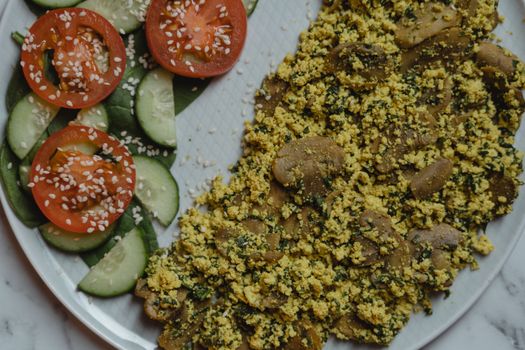
Photo: Tima Miroshnichenko / Pexels
American
Tofu Scramble
The diets react (see scores below)
Common Ingredients
- firm tofu
- turmeric
- nutritional yeast
- spinach
- bell pepper
- onion
- garlic
- olive oil
Specific recipes may vary.
Incompatible with 4 of 11 diets
Diet Ratings
Tofu scramble is keto-compatible with careful portioning. Firm tofu is moderate in carbs (~2g net carbs per 100g) and provides adequate fat and protein. Olive oil adds healthy fat. Spinach is very low-carb and keto-friendly. The concern comes from the combination of bell pepper (~4g net carbs per 100g), onion (~7g net carbs per 100g), and nutritional yeast (~5g net carbs per 2 tbsp), which can add up quickly if portions aren't controlled. A standard serving with modest amounts of these ingredients can fit within daily limits, but it requires mindful portioning — especially the onion and bell pepper. Turmeric and garlic contribute negligible carbs. Overall, this dish sits in the caution zone: workable for keto but not a free-pass meal.
Some strict keto practitioners flag tofu itself due to its phytoestrogen content and the fact that soy-based proteins can subtly raise insulin in sensitive individuals, leading certain carnivore-leaning keto camps to recommend avoiding soy products entirely in favor of animal proteins.
Tofu Scramble is a flagship vegan breakfast dish. Every ingredient is entirely plant-based: firm tofu provides protein from soybeans, turmeric gives the egg-like yellow color, nutritional yeast adds a savory/cheesy flavor and B-vitamins, and the remaining ingredients — spinach, bell pepper, onion, garlic, and olive oil — are all whole plant foods. There are no animal products, animal-derived ingredients, or meaningfully contested components. The dish skews toward whole-food, plant-based eating, earning a high score within the approve range.
Tofu Scramble is fundamentally incompatible with the Paleo diet. The primary protein, firm tofu, is derived from soybeans — a legume that is explicitly excluded from Paleo eating. Soy is one of the most clearly prohibited foods across all major Paleo frameworks due to its anti-nutrients (phytates, lectins) and phytoestrogens. Nutritional yeast, while not a grain, is a processed, commercially cultivated product that falls outside the bounds of unprocessed ancestral foods and is not considered Paleo-compliant. The remaining ingredients — turmeric, spinach, bell pepper, onion, garlic, and olive oil — are all individually Paleo-approved, but they cannot redeem a dish built on a soy foundation. The dish is essentially a plant-based egg substitute using a prohibited legume product.
Tofu scramble aligns well with Mediterranean diet principles. The dish is plant-forward, featuring tofu (a legume-based protein), abundant vegetables (spinach, bell pepper, onion, garlic), and extra virgin olive oil as the cooking fat. All core ingredients are whole, minimally processed, and nutrient-dense. Turmeric and nutritional yeast add flavor without compromising dietary quality. While tofu is not a traditional Mediterranean ingredient — soy products originate in East Asian culinary traditions — the dish's nutritional profile mirrors what the Mediterranean diet encourages: plant protein, vegetables, and olive oil as primary fat.
Traditional Mediterranean cuisine does not include tofu or nutritional yeast, which are absent from Greek, Italian, Spanish, or North African food traditions. Purists may argue that Mediterranean plant protein should come from chickpeas, lentils, fava beans, or other legumes native to the region rather than soy-derived products. However, modern clinical interpretations of the Mediterranean diet focus on dietary patterns and nutritional composition rather than strict geographic authenticity, making tofu an acceptable plant protein substitute.
Tofu Scramble is entirely incompatible with the carnivore diet. Every single ingredient is plant-derived: tofu (soy), turmeric (spice), nutritional yeast (fungus/yeast), spinach (leafy green), bell pepper (vegetable), onion (vegetable), garlic (vegetable), and olive oil (plant oil). There is no animal product whatsoever in this dish. Soy-based proteins like tofu are among the most excluded foods in carnivore — they are plant legumes, high in antinutrients (phytates, lectins, isoflavones), and represent the antithesis of the carnivore philosophy. This dish has zero carnivore-compatible components.
Tofu is made from soybeans, which are legumes — a categorically excluded food group on the Whole30 program. Soy in all forms (tofu, tempeh, edamame, soy milk, soy sauce, soy lecithin) is explicitly prohibited. Since tofu is the primary protein and foundational ingredient of this dish, the entire meal is non-compliant regardless of the other ingredients, all of which (turmeric, nutritional yeast, spinach, bell pepper, onion, garlic, olive oil) are themselves compliant.
This tofu scramble contains two major high-FODMAP ingredients that make it unsuitable for the elimination phase: onion and garlic. Both are among the highest-fructan foods in the FODMAP system and must be strictly avoided in any amount during elimination — there is no safe serving size. Even small amounts of onion or garlic cooked into a dish will leach fructans into the food, making the entire dish high-FODMAP. The remaining ingredients are largely low-FODMAP: firm tofu is low-FODMAP at a standard 170g serving, turmeric is a spice used in small amounts and is low-FODMAP, nutritional yeast is low-FODMAP at up to 2 teaspoons, spinach is low-FODMAP at 75g, bell pepper (red) is low-FODMAP at 52g, and olive oil is fat-based and FODMAP-free. However, the presence of onion and garlic alone disqualifies the dish. To make this low-FODMAP, onion and garlic must be omitted entirely and replaced with garlic-infused oil and the green tops of spring onions (scallions).
Tofu scramble is an excellent DASH-compatible breakfast. Firm tofu provides lean plant-based protein and is low in saturated fat, aligning well with DASH emphasis on beans and legumes as protein sources. Spinach and bell pepper contribute potassium, magnesium, and fiber — key DASH-targeted nutrients. Onion and garlic add flavor without sodium, supporting the DASH strategy of reducing sodium via herbs and aromatics. Olive oil is a heart-healthy unsaturated fat endorsed by DASH guidelines. Turmeric adds anti-inflammatory benefit with no nutritional downside. Nutritional yeast contributes B vitamins and a savory, cheese-like flavor with minimal sodium in typical amounts. The dish is naturally low in saturated fat, free of added sugar, low in sodium (assuming no added salt), and rich in vegetables — ticking virtually every DASH box for a breakfast meal.
Tofu scramble is an excellent Zone breakfast candidate. Firm tofu is a Zone-approved vegetarian protein source that provides complete protein blocks, though it comes packaged with some fat (requiring adjustment to fat block calculations for vegetarian protein — 3g fat per fat block rather than 1.5g). The carbohydrate ingredients — spinach, bell pepper, onion, and garlic — are all low-glycemic, colorful vegetables that are explicitly 'favorable' in Zone terminology and count toward the recommended 8 vegetable servings per day. Olive oil provides ideal monounsaturated fat. Nutritional yeast adds B-vitamins and a small protein contribution. Turmeric is a potent polyphenol that directly aligns with Sears' anti-inflammatory focus in his later writings. The dish naturally trends toward the 40/30/30 ratio with appropriate portioning: roughly 3-4 oz firm tofu (~20-25g protein), 1-2 cups vegetables (~10-15g net carbs), and 1 tsp olive oil. The main Zone consideration is that tofu's inherent fat means fat blocks should be counted carefully, and additional carbohydrates (e.g., fruit on the side) may be needed to fully hit the 40% carb target depending on portion sizes.
Tofu is classified as a vegetarian Zone protein, which uses a different fat block calculation (3g fat per block vs. 1.5g for animal protein) because soy contains more inherent fat. Some earlier Zone practitioners strictly preferred animal proteins as 'cleaner' protein blocks. Additionally, some Zone adherents note that tofu's isoflavones and phytoestrogens were not extensively addressed in Sears' early Zone books, though his later anti-inflammatory writings view soy polyphenols favorably.
This tofu scramble is an outstanding anti-inflammatory breakfast. Nearly every ingredient is explicitly emphasized in anti-inflammatory diet frameworks. Firm tofu is a whole soy food, specifically highlighted in Dr. Weil's Anti-Inflammatory Food Pyramid for its isoflavones and plant-based protein with a favorable omega-6 to omega-3 ratio. Turmeric contains curcumin, one of the most studied anti-inflammatory compounds in nutrition research, consistently linked to reduced CRP and IL-6. Garlic and onion provide organosulfur compounds and quercetin, both with established anti-inflammatory activity. Spinach is rich in carotenoids, vitamin K, and folate — all associated with reduced inflammatory markers. Bell pepper delivers high-dose vitamin C and beta-carotene, potent antioxidants. Olive oil (presumably extra virgin) contributes oleocanthal, which inhibits COX enzymes similarly to ibuprofen at culinary doses. Nutritional yeast adds B vitamins including B12 and beta-glucans with mild immune-modulatory effects. There are no pro-inflammatory ingredients — no refined carbohydrates, no seed oils, no added sugars, no saturated fat sources. This dish exemplifies anti-inflammatory eating principles across protein, fat, and micronutrient dimensions.
Tofu scramble is an excellent GLP-1-friendly breakfast. Firm tofu provides a solid plant-based protein source (approximately 15-20g per cup), directly supporting the top dietary priority of muscle preservation during weight loss. Nutritional yeast adds additional protein along with B-vitamins — particularly B12, which is important for patients on calorie-restricted diets. Spinach, bell pepper, onion, and garlic contribute meaningful fiber, micronutrients, and antioxidants with very low caloric cost, supporting the fiber and nutrient-density priorities. Turmeric has anti-inflammatory properties and is gentle on the GI tract. Olive oil is the preferred fat source — unsaturated and used in small amounts for cooking, it adds minimal saturated fat. The dish is easy to digest, works well in small portions, and contains no fried components, refined sugars, or carbonated ingredients. It scores slightly below a perfect 10 because plant-based protein from tofu is less bioavailable than animal protein (lower leucine content), and total protein per serving may fall short of the 15-30g per meal target unless a generous portion of tofu is used.
*See how scores were generated at our methodology page.
Nutritional profile
Six traits that cut across every diet.
Fiber & Plants
How much whole-plant food and fiber it delivers.
Healthy Fats
The quality of its fats (unsaturated, omega-3).
Whole / Unprocessed
How close it is to its natural, unprocessed form.
Gut Gentle
How easy it is on digestion (low FODMAP, few irritants).
Low Glycemic
How little it spikes your blood sugar.
Protein Density
How much protein it packs per calorie.
Controversy Index
Higher controversy = more disagreement between diets.
Diet-Specific Tips
 Keto — 5/10
View tips
- Firm tofu is moderate-carb and keto-permissible in standard servings (~150-200g)
- Bell pepper and onion are the primary carb contributors and must be kept to small amounts
- Nutritional yeast adds some carbs — limit to 1-2 tbsp per serving
- Olive oil boosts fat content, improving keto macro ratio
- Spinach is negligible in net carbs and adds fiber
- Combined net carbs can approach 8-12g per serving depending on portions — manageable but not low
- Tofu's protein and fat profile is moderate, not high-fat like animal proteins
 Vegan — 9/10
View tips
- Firm tofu is soy-based — fully plant-derived
- Nutritional yeast is a deactivated fungus, not an animal product
- Turmeric, spinach, bell pepper, onion, and garlic are unambiguously plant foods
- Olive oil is plant-derived with no animal processing concerns
- No eggs, dairy, or animal-derived additives present
- High whole-food content elevates score toward the top of the approve range
 Mediterranean — 8/10
View tips
- Tofu is a plant-based protein consistent with Mediterranean diet emphasis on legumes
- Extra virgin olive oil used as primary cooking fat — core Mediterranean staple
- Abundance of non-starchy vegetables (spinach, bell pepper, onion, garlic)
- No refined grains, added sugars, or processed ingredients
- Tofu and nutritional yeast are not traditional Mediterranean ingredients
- Anti-inflammatory spice turmeric complements Mediterranean health principles
 DASH — 9/10
View tips
- Firm tofu is a DASH-approved plant-based lean protein source (beans/legumes category)
- Spinach and bell pepper are core DASH vegetables rich in potassium, magnesium, and fiber
- Olive oil is a DASH-recommended unsaturated vegetable oil
- No high-sodium ingredients; sodium is controlled if no salt is added
- No saturated fat, trans fat, cholesterol, or added sugar
- Nutritional yeast is low in sodium and adds B12 without dietary downsides
- Onion and garlic enhance flavor as sodium-free DASH-recommended aromatics
- Excellent alternative to egg scrambles for those monitoring dietary cholesterol
 Zone — 8/10
View tips
- Firm tofu is a Zone-approved vegetarian protein (~7g protein per block)
- All vegetable ingredients (spinach, bell pepper, onion, garlic) are low-glycemic and Zone-favorable
- Olive oil provides ideal monounsaturated fat in controlled quantity
- Turmeric is a high-value polyphenol aligned with Sears' anti-inflammatory protocol
- Vegetarian protein fat block calculation (3g/block) differs from animal protein — inherent tofu fat must be tracked
- Dish may need supplemental low-GI carbs (fruit) to fully reach 40% carbohydrate target
- Nutritional yeast adds polyphenols and B12 with negligible macro impact
 Anti-Inflammatory — 9/10
View tips
- Tofu is a whole soy food explicitly emphasized in anti-inflammatory frameworks for isoflavones and clean plant protein
- Turmeric (curcumin) is among the most evidence-backed anti-inflammatory spices, reducing CRP and IL-6
- Extra virgin olive oil provides oleocanthal, a natural COX inhibitor
- Spinach and bell pepper supply carotenoids and vitamin C — high-antioxidant load
- Garlic and onion contribute quercetin and organosulfur anti-inflammatory compounds
- Zero pro-inflammatory ingredients: no refined carbs, seed oils, added sugar, or saturated fat
- Nutritional yeast adds B vitamins and beta-glucans with immune-supportive properties
 GLP-1 Friendly — 8/10
View tips
- Firm tofu delivers 15-20g plant-based protein per cup — supports muscle preservation priority
- Nutritional yeast adds protein and critical B12 for calorie-restricted patients
- Spinach, bell pepper, onion, and garlic provide fiber, micronutrients, and antioxidants at low caloric cost
- Olive oil is an approved unsaturated fat — minimal saturated fat load
- Turmeric is GI-gentle and anti-inflammatory
- Easy to digest — no frying, no heavy fat, no known GLP-1 side effect triggers
- Portion scalable — works well as a small, satisfying meal
- Minor limitation: tofu protein is less bioavailable than animal protein; portion size must be adequate to hit 15-30g per meal target