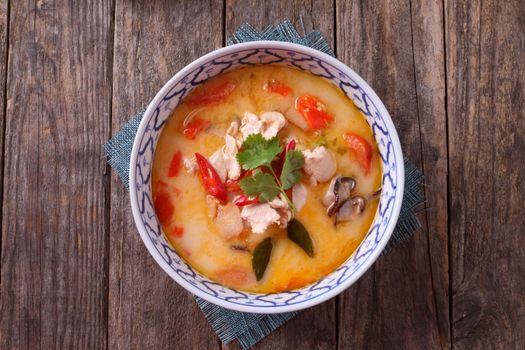
The diets react (see scores below)
Common Ingredients
- chicken
- coconut milk
- galangal
- lemongrass
- kaffir lime leaves
- mushrooms
- fish sauce
- lime juice
Specific recipes may vary.
Incompatible with 3 of 11 diets
Diet Ratings
Tom Kha Gai is a naturally keto-friendly Thai soup. The base is full-fat coconut milk, which is high in healthy saturated fats (MCTs), making it ideal for ketosis. Chicken provides clean, moderate protein. The aromatic ingredients — galangal, lemongrass, kaffir lime leaves — are used in small quantities and contribute negligible net carbs. Mushrooms add minimal carbs with fiber offsetting some. Fish sauce contains a small amount of sugar/sodium but in typical quantities (a few tablespoons) the carb contribution is minimal (~1-2g). Lime juice adds a few grams of carbs but typically only 1-2 tablespoons are used. Overall net carbs per serving are estimated at 4-7g, well within keto limits. The fat profile from coconut milk is excellent for keto macros.
Some strict keto practitioners flag restaurant versions of Tom Kha Gai, which often include added sugar, rice noodles, or higher lime juice quantities that can push carbs upward. Additionally, a minority who follow carnivore-adjacent or dairy-focused keto protocols may caution against coconut milk due to its omega-6 content and plant-based fat profile, preferring animal fats instead.
Tom Kha Gai contains multiple animal-derived ingredients that make it entirely incompatible with a vegan diet. Chicken is the primary protein — a direct animal product. Fish sauce, a staple seasoning in this dish, is made from fermented fish and is a clear animal-derived ingredient. These two ingredients alone firmly place this dish in the 'avoid' category. The remaining ingredients (coconut milk, galangal, lemongrass, kaffir lime leaves, mushrooms, lime juice) are all plant-based, but they do not offset the presence of animal products.
Tom Kha Gai is one of the most naturally paleo-friendly Thai dishes. Chicken is a clean, unprocessed protein. Coconut milk is a whole-food fat source widely accepted in paleo. Galangal, lemongrass, and kaffir lime leaves are natural herbs and aromatics with no paleo concerns. Mushrooms are approved vegetables. Lime juice is a whole fruit product. The two minor considerations are fish sauce and coconut milk. Fish sauce is traditionally made from fermented fish and salt — the salt content places it in a gray area for strict paleo (which excludes added salt), but most paleo practitioners accept it as a minimally processed condiment in small culinary quantities, consistent with how ancestral coastal populations would have used fermented fish products. Coconut milk from a can may contain guar gum or other stabilizers, which are a minor processing concern, but full-fat coconut milk is broadly accepted across paleo frameworks. Overall, this dish is as close to naturally paleo as Thai cuisine gets.
Strict Loren Cordain-school paleo would flag fish sauce due to its significant added salt content, and canned coconut milk due to potential additives and processing. Cordain's original framework discourages added salt entirely, and some purists would recommend making coconut milk from scratch or sourcing additive-free versions.
Tom Kha Gai presents a mixed Mediterranean diet profile. The chicken (poultry) is acceptable in moderation, and the aromatic vegetables, mushrooms, lime juice, and fish sauce align reasonably well with whole-food, minimally processed principles. However, coconut milk is the primary fat source here, which directly conflicts with the Mediterranean diet's foundational principle that extra virgin olive oil should be the dominant fat. Coconut milk is high in saturated fat and is not a traditional Mediterranean ingredient. The dish is otherwise low in refined grains and added sugars, and the herb-forward profile is positive, but the heavy coconut milk base is a significant departure from Mediterranean dietary patterns.
Some modern integrative Mediterranean diet interpretations focus on the overall dietary pattern — whole foods, lean protein, vegetables, minimal processing — and may view occasional use of coconut milk more permissively, especially given its natural, minimally processed origin. However, traditional and clinical Mediterranean diet guidelines (e.g., PREDIMED trial framework) are clear that olive oil, not coconut or other saturated fats, is the canonical fat source.
Tom Kha Gai is fundamentally incompatible with the carnivore diet. While chicken and fish sauce are animal-derived, the dish is overwhelmingly built around plant-based ingredients: coconut milk (plant fat), galangal, lemongrass, kaffir lime leaves, mushrooms, and lime juice are all plant foods explicitly excluded from carnivore. Coconut milk alone disqualifies it as a primary base fat. The aromatic herbs and vegetables are core to the dish's identity, not optional garnishes. Even the most lenient carnivore practitioners who allow coffee or spices would not consider this dish carnivore-compatible given the volume and variety of plant ingredients.
Tom Kha Gai as listed contains exclusively Whole30-compliant ingredients. Chicken is an allowed protein, coconut milk is a compliant fat/base, galangal and lemongrass are whole spices/aromatics, kaffir lime leaves are an herb, mushrooms are a vegetable, lime juice is a compliant acid, and fish sauce is generally compliant (though label-reading is required to confirm no added sugar). All ingredients align with the Whole30 framework of whole, unprocessed foods.
Fish sauce in practice often contains added sugar, making label verification essential — the 'caution' camp argues this dish should be rated lower because restaurant or store-bought versions frequently use non-compliant fish sauce or coconut milk with additives. Melissa Urban's official guidance would approve the dish if all ingredients are compliant, but the community notes that dining out or using pre-made versions makes guaranteed compliance difficult.
Tom Kha Gai contains mostly low-FODMAP ingredients — chicken, coconut milk (low-FODMAP up to 1/2 cup per Monash), galangal, lemongrass, kaffir lime leaves, fish sauce, and lime juice are all generally low-FODMAP. The critical variable is mushrooms: most common mushroom varieties (e.g., button, shiitake, oyster) are high-FODMAP due to polyols (mannitol), and Tom Kha Gai traditionally uses straw mushrooms or oyster mushrooms, both of which are high-FODMAP. Additionally, coconut milk quantity can be generous in this dish, and large servings may push it into moderate-FODMAP territory. Without confirming mushroom type and portion, the dish carries meaningful FODMAP risk.
Monash University has rated some mushroom varieties as high-FODMAP at standard servings due to mannitol content, but some clinical FODMAP practitioners note that the mushrooms in Tom Kha Gai could be omitted or substituted with canned straw mushrooms (which may have some mannitol leach out) — however, this substitution is not standard and the dish as typically prepared should be treated with caution during elimination phase.
Tom Kha Gai presents significant DASH diet concerns primarily due to two ingredients: coconut milk and fish sauce. Full-fat coconut milk is high in saturated fat from a tropical oil source, which DASH explicitly limits. A typical serving of Tom Kha Gai can contain 10-20g of saturated fat depending on coconut milk quantity — well above DASH recommendations. Fish sauce is extremely high in sodium (approximately 1,400mg per tablespoon), and this dish commonly uses multiple tablespoons, potentially contributing 1,000-2,000mg of sodium per serving — a substantial portion or excess of both the standard (2,300mg) and low-sodium (1,500mg) DASH daily limits. Positive elements include lean chicken protein, beneficial aromatic herbs (galangal, lemongrass, kaffir lime leaves), mushrooms (vegetables), and lime juice. However, the dual burden of high saturated fat and very high sodium makes this dish problematic for DASH adherence in its traditional preparation.
NIH DASH guidelines explicitly restrict tropical oils like coconut milk due to saturated fat content and high-sodium condiments like fish sauce. However, some updated clinical interpretations note that medium-chain triglycerides (MCTs) in coconut milk may behave differently metabolically than long-chain saturated fats, and that a modified version using light coconut milk and reduced/low-sodium fish sauce or coconut aminos could bring this dish into DASH-acceptable territory, earning a 'caution' rating rather than 'avoid.'
Tom Kha Gai has a solid Zone foundation — lean chicken provides a clean protein block, mushrooms are a favorable low-glycemic vegetable, and the aromatic ingredients (galangal, lemongrass, kaffir lime leaves, lime juice) contribute negligible calories while adding anti-inflammatory polyphenols Sears would appreciate. The primary challenge is coconut milk, which is high in saturated fat (primarily lauric acid). Traditional recipes use full-fat coconut milk generously, which can easily exceed the Zone's fat block targets and skew the fat profile toward saturated rather than monounsaturated sources. Fish sauce adds sodium but negligible macronutrient impact. With careful portioning — using light coconut milk or reducing the quantity of full-fat coconut milk — this dish can be made Zone-compatible, but as typically prepared in restaurants it likely delivers too much saturated fat and too few carbohydrate blocks to hit the 40/30/30 ratio without supplementing with a vegetable-based side. The dish is protein-and-fat heavy with minimal carbohydrate, meaning it needs to be paired with additional favorable carbs to reach Zone balance.
Sears' later anti-inflammatory work (The Mediterranean Zone, 2014) took a more nuanced view of coconut-derived saturated fats, acknowledging that medium-chain triglycerides (MCTs) in coconut milk have a different metabolic profile than long-chain saturated fats. Some Zone practitioners following Sears' updated thinking would rate this soup more favorably, particularly given the strong anti-inflammatory and polyphenol contribution of lemongrass, galangal, and kaffir lime leaves. Earlier Zone writings (Enter the Zone, 1995) would be stricter about the saturated fat load from coconut milk.
Tom Kha Gai has a genuinely mixed anti-inflammatory profile. On the positive side, it features several strongly anti-inflammatory ingredients: galangal (a ginger-family root rich in antioxidants and with demonstrated anti-inflammatory activity), lemongrass (contains citral and other anti-inflammatory compounds), kaffir lime leaves (polyphenols and flavonoids), mushrooms (beta-glucans, immune-modulating compounds), and lime juice (vitamin C, antioxidants). Lean chicken is a moderate-tier protein in anti-inflammatory frameworks — acceptable and preferable to red meat. Fish sauce, while high in sodium, provides fermented umami depth without significant pro-inflammatory concern in typical culinary quantities. The problematic element is full-fat coconut milk, which is high in saturated fat (primarily lauric acid). Coconut milk is a significant point of debate in anti-inflammatory nutrition: its saturated fat content is concerning from a classical anti-inflammatory standpoint, as saturated fat can activate TLR4 receptors and promote inflammatory signaling. However, the saturated fat in coconut milk is predominantly medium-chain triglycerides (MCTs), which some researchers argue are metabolized differently and have a neutral or even favorable effect on inflammatory markers. The dish as a whole has real anti-inflammatory assets from its aromatic herb base, but the coconut milk keeps it from reaching 'approve' territory under most mainstream anti-inflammatory frameworks. Best consumed occasionally rather than as a daily staple.
Dr. Weil's Anti-Inflammatory Pyramid permits coconut products in moderation, and some functional medicine practitioners highlight MCTs in coconut milk as metabolically distinct from long-chain saturated fats found in meat and dairy. Conversely, mainstream anti-inflammatory nutrition and the IF Rating system generally flag high saturated fat foods as pro-inflammatory, and many practitioners recommend limiting full-fat coconut milk for this reason — particularly for individuals with cardiovascular risk factors.
Tom Kha Gai is a mixed-profile dish for GLP-1 patients. The chicken breast provides a solid lean protein base, and the broth-heavy format is easy to digest and hydrating — both positives. However, the defining characteristic of this soup is full-fat coconut milk, which is high in saturated fat and calorie-dense. A typical restaurant serving can deliver 15-25g of fat, much of it saturated, which is a meaningful concern given that high-fat foods worsen GLP-1 side effects including nausea, bloating, and slowed gastric emptying compounded further by the medication itself. Galangal, lemongrass, and kaffir lime leaves are aromatic and generally well-tolerated, and fish sauce adds sodium but is used in small quantities. Mushrooms contribute modest fiber. The soup is low in refined carbohydrates and sugar, and the lime juice adds brightness without glycemic load. The dish is not fried or heavily processed, and it is portion-friendly in small servings. The main liability is the coconut milk fat content, which can be mitigated if prepared with light coconut milk or a reduced-coconut ratio, but restaurant versions typically use full-fat. Rated caution rather than avoid because the protein source is lean, the format is broth-based and easy to digest, and the fat concern is addressable with preparation modifications.
Some GLP-1-focused dietitians would rate this closer to approve, arguing that the medium-chain triglycerides (MCTs) in coconut milk are metabolized differently than long-chain saturated fats and may be better tolerated, and that the soup's high water content and lean protein make it a practical restaurant option. Others maintain that any high-saturated-fat preparation should be consistently cautioned against because individual GI sensitivity on GLP-1s is unpredictable and fat content is the most reliable predictor of nausea and reflux flares.
*See how scores were generated at our methodology page.
Nutritional profile
Six traits that cut across every diet.
Fiber & Plants
How much whole-plant food and fiber it delivers.
Healthy Fats
The quality of its fats (unsaturated, omega-3).
Whole / Unprocessed
How close it is to its natural, unprocessed form.
Gut Gentle
How easy it is on digestion (low FODMAP, few irritants).
Low Glycemic
How little it spikes your blood sugar.
Protein Density
How much protein it packs per calorie.
Controversy Index
Higher controversy = more disagreement between diets.
Diet-Specific Tips
 Keto — 8/10
View tips
- Full-fat coconut milk provides high MCT fat content ideal for ketosis
- Chicken is a clean moderate-protein source with zero carbs
- Aromatic herbs (galangal, lemongrass, kaffir lime leaves) used in trace amounts — negligible net carbs
- Mushrooms contribute minimal net carbs (~1-2g per serving)
- Fish sauce and lime juice add small but manageable carb contributions (~2-3g total)
- Estimated 4-7g net carbs per standard serving — well within keto limits
- No grains, starches, or added sugars in the listed ingredients
- Restaurant versions may add sugar or noodles — home preparation recommended
 Paleo — 8/10
View tips
- Chicken is a fully approved paleo protein
- Coconut milk is a widely accepted paleo fat source
- Galangal, lemongrass, kaffir lime leaves, and mushrooms are all paleo-approved whole foods
- Fish sauce contains added salt, a technical paleo exclusion, but is broadly accepted in moderation by most paleo practitioners
- Lime juice is a whole-food, naturally paleo ingredient
- Canned coconut milk may contain minor additives like guar gum — seek additive-free versions for strict compliance
- No grains, legumes, dairy, refined sugar, or seed oils present
 Mediterranean — 4/10
View tips
- Coconut milk is high in saturated fat and not a Mediterranean staple fat — conflicts with olive oil primacy
- Chicken (poultry) is acceptable in moderation under Mediterranean guidelines
- Mushrooms, lemongrass, galangal, lime juice, and kaffir lime leaves are whole, plant-based aromatics — positive
- Fish sauce is minimally processed and used in small amounts — broadly acceptable
- No refined grains, added sugars, or red meat — positive
- Non-Mediterranean cuisine with no traditional alignment to the dietary pattern
 Whole30 — 9/10
View tips
- Chicken is a fully compliant Whole30 protein
- Coconut milk is allowed — check label for no added sugars or non-compliant additives
- Fish sauce must be verified sugar-free (compliant brands exist, e.g., Red Boat)
- Galangal, lemongrass, and kaffir lime leaves are whole, compliant aromatics
- Mushrooms are compliant vegetables
- Lime juice is a compliant acid/flavor
- No grains, dairy, legumes, or excluded sweeteners in the listed ingredients
 Low-FODMAP — 5/10
View tips
- Mushrooms (polyols/mannitol) are the primary high-FODMAP concern — most varieties used in Tom Kha Gai are high-FODMAP
- Coconut milk is low-FODMAP at 1/2 cup but becomes moderate-FODMAP at larger servings typical of soup
- Chicken, galangal, lemongrass, kaffir lime leaves, fish sauce, and lime juice are all low-FODMAP
- Dish can be made low-FODMAP by omitting mushrooms and controlling coconut milk quantity
- No onion or garlic in the traditional recipe is a positive factor
 Zone — 5/10
View tips
- Lean chicken is an ideal Zone protein block
- Coconut milk is high in saturated fat — problematic in classic Zone framework but more tolerated in Sears' later anti-inflammatory work
- Mushrooms are a favorable low-glycemic Zone carbohydrate
- Dish is carbohydrate-light and requires pairing with additional low-GI carbs to hit 40/30/30 ratio
- Aromatic ingredients (galangal, lemongrass, kaffir lime, lime juice) contribute valuable polyphenols with minimal macronutrient impact
- Fish sauce adds sodium but does not materially affect Zone block calculations
- Light coconut milk substitution significantly improves Zone compatibility
 Anti-Inflammatory — 6/10
View tips
- Galangal: strong anti-inflammatory, antioxidant-rich (gingerols, galangin)
- Lemongrass: anti-inflammatory citral compounds
- Kaffir lime leaves: flavonoids and polyphenols
- Mushrooms: beta-glucans with immune-modulating and anti-inflammatory effects
- Coconut milk: high in saturated fat — debated; MCTs may be metabolically distinct but still flagged by many anti-inflammatory protocols
- Lean chicken: acceptable moderate-tier protein, preferable to red meat
- Fish sauce: high sodium but fermented; negligible direct inflammatory concern at culinary doses
- Lime juice: vitamin C and antioxidants support anti-inflammatory profile
 GLP-1 Friendly — 5/10
View tips
- Full-fat coconut milk is high in saturated fat and significantly increases nausea and bloating risk on GLP-1 medications
- Chicken is a lean protein source — supports the #1 priority if a meaningful portion is included
- Broth-based and hydrating format supports digestion and fluid intake
- Easy to digest overall — no fried components, not heavily spiced
- Low in fiber — mushrooms contribute modestly but the dish does not meet fiber targets on its own
- Sodium content from fish sauce is moderate and generally acceptable
- Light coconut milk substitution would significantly improve the fat profile and GLP-1 compatibility
- Restaurant versions are likely higher in fat than home-prepared versions