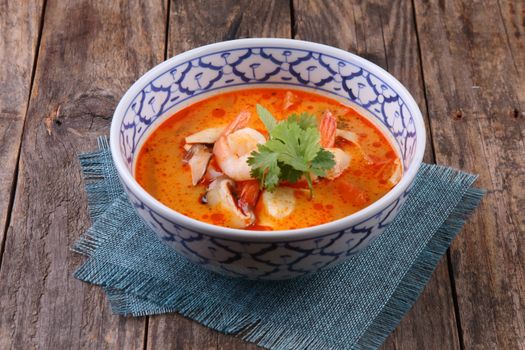
The diets react (see scores below)
Common Ingredients
- chicken
- lemongrass
- galangal
- kaffir lime leaves
- Thai chiles
- mushrooms
- lime juice
- fish sauce
Specific recipes may vary.
Incompatible with 2 of 11 diets
Diet Ratings
Tom Yum Gai is highly compatible with ketogenic eating in its traditional form. Chicken provides quality protein, while the aromatic base (lemongrass, galangal, kaffir lime leaves) contributes minimal net carbs primarily as flavor agents used in small quantities. Mushrooms add a small amount of carbs but remain well within keto limits for a standard serving. Fish sauce and lime juice contribute trace carbs. The broth-based soup avoids grains, starchy thickeners, and added sugars entirely. A standard bowl likely lands in the 4–8g net carb range, comfortably within daily keto limits. The main concern is restaurant versions, which may add sugar to balance the sour-spicy flavor profile.
Some strict keto practitioners flag fish sauce as a hidden sugar source (many commercial brands contain added sugar) and note that restaurant preparations routinely add palm sugar or sweetened chili paste, making the dish unreliable outside home cooking. These purists recommend verifying ingredients or avoiding it when dining out.
Tom Yum Gai contains multiple animal-derived ingredients that are strictly excluded from a vegan diet. Chicken (poultry) is a direct animal product, and fish sauce is derived from fermented fish — both are unambiguously non-vegan. There is no meaningful debate within the vegan community about either ingredient. The aromatic plant-based components (lemongrass, galangal, kaffir lime leaves, Thai chiles, mushrooms, lime juice) are all vegan-compliant, but they do not offset the presence of animal products. A vegan version of Tom Yum can be made by substituting tofu or mushrooms for chicken and using soy sauce or seaweed-based alternatives in place of fish sauce.
Tom Yum Gai is composed almost entirely of paleo-approved whole foods. Chicken is a clean protein, and the aromatic base — lemongrass, galangal, kaffir lime leaves, Thai chiles — are natural herbs and spices well within paleo guidelines. Mushrooms are approved vegetables, and lime juice is a natural fruit acid. The one point of discussion is fish sauce: traditional fish sauce is simply fermented fish and salt, with no grains or additives, making it broadly accepted in the paleo community. However, purist Cordain-school paleo excludes added salt entirely, and many commercial fish sauces contain added salt or preservatives. Assuming a clean, additive-free fish sauce is used, this dish is a strong paleo option with minimal processing and no grains, legumes, or dairy.
Strict Cordain-school paleo discourages added salt in any form, which would flag fish sauce as non-compliant. Additionally, some commercial fish sauce brands include additives or preservatives that would push this dish into caution territory — label scrutiny is advised.
Tom Yum Gai is a light, broth-based soup with lean chicken, aromatic herbs, mushrooms, and lime juice — a nutritionally sound profile with minimal fat, no refined grains, and strong anti-inflammatory ingredients. Chicken as the primary protein fits the Mediterranean diet's 'moderate poultry' category. The dish is whole-food-forward with no processed ingredients or added sugars. However, it is not Mediterranean in origin and relies on fish sauce for saltiness rather than olive oil as a fat source — in fact, there is essentially no added fat at all, which diverges from the Mediterranean emphasis on extra virgin olive oil as a daily cornerstone. The absence of olive oil and the non-Mediterranean herb profile (galangal, kaffir lime, lemongrass) mean this dish sits outside the traditional framework, though it does not contradict Mediterranean principles in any harmful way.
Some modern Mediterranean diet researchers take a broader 'dietary pattern' view, arguing that any lean-protein, vegetable-rich, minimally processed soup aligns with Mediterranean principles regardless of geographic origin. Under this interpretation, Tom Yum Gai's low saturated fat, high vegetable content, and whole-food ingredients could earn a higher 'approve' rating.
Tom Yum Gai is overwhelmingly plant-based in its flavoring and composition. While chicken and fish sauce are animal-derived and carnivore-compatible, the dish is fundamentally defined by its plant ingredients: lemongrass, galangal, kaffir lime leaves, Thai chiles, mushrooms, and lime juice. These are all excluded on a carnivore diet. Mushrooms are fungi, chiles and lime are plant foods, and the aromatic herbs are explicitly off-limits. The dish cannot be adapted while retaining its identity — removing the plant ingredients leaves plain boiled chicken. Fish sauce is generally accepted by carnivore practitioners (fermented fish product), and chicken is widely consumed, but these two ingredients do not redeem a soup that is structurally and culinarily defined by plant matter. This is a clear avoid with high community consensus.
Tom Yum Gai as described is fully Whole30-compliant. Every ingredient is a whole, unprocessed food explicitly permitted by the program: chicken (animal protein), lemongrass, galangal, kaffir lime leaves, and Thai chiles (herbs, spices, and aromatics), mushrooms (vegetables), lime juice (fruit juice, fully allowed), and fish sauce (a fermented condiment that is Whole30-compatible provided it contains no added sugar or non-compliant additives — the standard versions are anchovy-based and compliant). There are no grains, legumes, dairy, added sugars, alcohol, or other excluded ingredients. This is a naturally Whole30-friendly dish rooted in whole, minimally processed ingredients.
Tom Yum Gai contains several individually low-FODMAP ingredients (chicken, lemongrass, galangal, kaffir lime leaves, Thai chiles, lime juice, fish sauce), but mushrooms are the critical variable. Most common mushrooms — including oyster and button — are high-FODMAP due to polyols (mannitol), though some varieties like canned straw mushrooms or oyster mushrooms at very small servings have lower FODMAP ratings. The type and quantity of mushrooms used in restaurant or home preparations is typically high enough to push this dish into caution territory. Lemongrass, galangal, and kaffir lime leaves are used as aromatics and are generally strained or not consumed in large quantities, keeping their FODMAP contribution low. Fish sauce is low-FODMAP at standard amounts. The dish is otherwise well-suited to low-FODMAP eating, but mushrooms represent a meaningful risk.
Monash University rates oyster mushrooms as low-FODMAP at 65g and canned straw mushrooms as low-FODMAP, while rating common button and shiitake mushrooms as high-FODMAP due to mannitol. Clinical FODMAP practitioners often advise avoiding mushrooms entirely during elimination given the variety-dependent risk and difficulty confirming mushroom type in restaurant settings. Requesting the dish without mushrooms, or confirming low-FODMAP mushroom varieties, would likely bring this soup to an 'approve' rating.
Tom Yum Gai has several DASH-friendly components — lean chicken, aromatic herbs (lemongrass, galangal, kaffir lime leaves), mushrooms, lime juice, and Thai chiles all align well with DASH principles, providing lean protein, vegetables, potassium, and virtually no saturated fat. The critical concern is fish sauce, a staple seasoning in Thai cooking that is extremely high in sodium (roughly 1,400–1,500mg per tablespoon). A typical restaurant serving of Tom Yum soup can easily contain 800–1,500mg of sodium depending on how liberally fish sauce is used, which significantly strains or exceeds DASH's 1,500–2,300mg daily sodium targets in a single dish. The base ingredients themselves are excellent, but fish sauce as a primary seasoning makes this a 'caution' under standard preparation. A home-prepared version using reduced fish sauce or a low-sodium substitute could push this dish toward 'approve.'
NIH DASH guidelines broadly limit high-sodium condiments like fish sauce due to sodium content. However, some DASH-aligned clinicians note that when prepared at home with carefully controlled fish sauce quantities (e.g., 1–2 teaspoons total for a multi-serving batch), Tom Yum can fit within DASH sodium budgets, especially when combined with low-sodium eating throughout the rest of the day.
Tom Yum Gai is an excellent Zone-compatible dish. The primary protein is lean chicken, which is a Zone-favorable protein source. The aromatic base (lemongrass, galangal, kaffir lime leaves, Thai chiles) contributes negligible calories and carbohydrates while providing polyphenols and anti-inflammatory compounds that align perfectly with Sears' anti-inflammatory philosophy. Mushrooms are a low-glycemic, low-calorie Zone-favorable vegetable. Lime juice provides a small carbohydrate block from a low-glycemic source. Fish sauce adds sodium and umami with minimal macronutrient impact. The broth-based nature of the soup means fat content is naturally low, which actually requires the diner to add a modest monounsaturated fat source (e.g., a few almonds or a drizzle of olive oil on the side) to complete the 30% fat ratio. Overall, this is a high-protein, low-glycemic, anti-inflammatory dish that fits cleanly into Zone methodology with minimal adjustment needed beyond ensuring a fat source accompanies the meal.
Tom Yum Gai is a strongly anti-inflammatory dish by nearly every measure. The aromatic base — lemongrass, galangal, and kaffir lime leaves — contains bioactive compounds (citral, gingerols/galangin, and flavonoids respectively) with documented anti-inflammatory and antioxidant activity. Thai chiles provide capsaicin, one of the most well-researched anti-inflammatory compounds in food. Mushrooms are explicitly emphasized in the anti-inflammatory framework for their beta-glucans and immune-modulating properties. Lime juice delivers vitamin C and antioxidants. Fish sauce, while high in sodium, is used in small quantities as a flavoring and contributes umami without meaningful inflammatory load. Chicken (lean poultry) falls in the 'moderate' category — perfectly acceptable and provides clean protein without the saturated fat concerns of red meat. The dish contains no refined carbohydrates, added sugars, seed oils, or processed ingredients. Overall, this is a nutrient-dense, herb-forward soup that aligns closely with the anti-inflammatory dietary model — comparable in spirit to a broth-based dish from Dr. Weil's recommended pattern.
Tom Yum Gai is a lean, broth-based soup with chicken as the primary protein, making it a reasonably solid choice for GLP-1 patients. The broth is low in fat and easy to digest, and the high water content directly supports hydration — a meaningful benefit given GLP-1s reduce thirst sensation. Mushrooms contribute modest fiber and nutrients. However, the Thai chiles are a meaningful concern: spicy foods can worsen GLP-1-related nausea, reflux, and GI discomfort, particularly on injection days or during dose escalation. Fish sauce contributes high sodium, which can compound dehydration risk. Protein content per serving is moderate but likely below the 15–30g per meal target unless a generous portion of chicken is used, which may be challenging given reduced appetite. Overall this is a conditionally good choice — favorable structure, but the spice level is the deciding variable.
Some GLP-1-focused dietitians would rate this higher, arguing that spice tolerance is highly individual and that patients who tolerate chiles well benefit from the anti-inflammatory aromatics (lemongrass, galangal, kaffir lime) and the soup's strong hydration and easy digestibility profile. Others apply a blanket caution on spicy dishes given how commonly GLP-1 patients report heightened GI sensitivity, particularly during dose escalation, making individual tolerance the key clinical variable here.
*See how scores were generated at our methodology page.
Nutritional profile
Six traits that cut across every diet.
Fiber & Plants
How much whole-plant food and fiber it delivers.
Healthy Fats
The quality of its fats (unsaturated, omega-3).
Whole / Unprocessed
How close it is to its natural, unprocessed form.
Gut Gentle
How easy it is on digestion (low FODMAP, few irritants).
Low Glycemic
How little it spikes your blood sugar.
Protein Density
How much protein it packs per calorie.
Controversy Index
Higher controversy = more disagreement between diets.
Diet-Specific Tips
 Keto — 6/10
View tips
- Chicken is a clean, zero-carb protein source
- Aromatic herbs (lemongrass, galangal, kaffir lime) used in small amounts add negligible net carbs
- Mushrooms contribute minor carbs well within typical keto limits
- Broth-based — no grains, starches, or thickeners
- Fish sauce may contain added sugar depending on brand
- Restaurant versions frequently add palm sugar or sweetened pastes, significantly raising carb count
- Lime juice adds minimal carbs in typical quantities
 Paleo — 8/10
View tips
- Chicken is a fully approved paleo protein
- Lemongrass, galangal, kaffir lime leaves, and Thai chiles are natural herbs and spices — clearly paleo
- Mushrooms are approved whole-food vegetables
- Lime juice is a natural, unprocessed fruit acid
- Fish sauce is fermented fish and salt — broadly accepted in paleo but flagged by strict Cordain followers due to added salt
- No grains, legumes, dairy, seed oils, or refined sugars present
- Dish is minimally processed and closely resembles what hunter-gatherers could have assembled
 Mediterranean — 6/10
View tips
- Lean poultry protein — acceptable in moderation per Mediterranean guidelines
- No olive oil or Mediterranean fats present — a core pillar is missing
- Whole-food ingredients with no refined grains, added sugars, or processed components
- Mushrooms and aromatic vegetables add plant-forward value
- Fish sauce contributes sodium but is a minimally processed, traditional condiment
- Non-Mediterranean cuisine but not incompatible with Mediterranean health principles
 Whole30 — 9/10
View tips
- Chicken is a compliant animal protein
- Lemongrass, galangal, kaffir lime leaves, and Thai chiles are compliant aromatics and spices
- Mushrooms are compliant vegetables
- Lime juice is a compliant fruit juice — Whole30 allows all fruit juice including as a beverage
- Fish sauce is generally Whole30-compliant; labels should be checked to ensure no added sugar
- No grains, legumes, dairy, or other excluded ingredients present
 Low-FODMAP — 5/10
View tips
- Mushrooms are the primary FODMAP risk — most varieties are high-FODMAP due to mannitol (polyol); type and quantity are critical
- Chicken is fully low-FODMAP
- Lemongrass, galangal, and kaffir lime leaves are used as aromatics at low quantities — low-FODMAP contribution
- Thai chiles are low-FODMAP
- Fish sauce is low-FODMAP at standard serving amounts
- Lime juice is low-FODMAP
- No onion, garlic, or other fructan sources listed — a positive sign for this cuisine
- Restaurant versions may include unlisted high-FODMAP additions (e.g., onion, galangal in large amounts)
 DASH — 5/10
View tips
- Fish sauce is very high in sodium (~1,400mg/tbsp), the primary DASH concern
- Lean chicken is an approved DASH protein source
- Mushrooms, lemongrass, galangal, kaffir lime, and chiles are all DASH-compatible vegetables/aromatics
- No saturated fat, no added sugar, no processed ingredients besides fish sauce
- Restaurant portions likely exceed DASH sodium thresholds in a single serving
- Home preparation with reduced fish sauce or low-sodium alternative significantly improves DASH compatibility
 Zone — 8/10
View tips
- Lean chicken protein is a Zone-favorable primary protein source
- Aromatic herbs (lemongrass, galangal, kaffir lime leaves) are polyphenol-rich and anti-inflammatory, aligning with Sears' later anti-inflammatory framework
- Mushrooms are low-glycemic Zone-favorable vegetables
- Broth-based preparation keeps saturated fat naturally low
- Lime juice is a low-glycemic carbohydrate source
- Fish sauce contributes minimal macronutrients but adds sodium — acceptable in Zone context
- No fat source in the dish itself; a monounsaturated fat addition (avocado, almonds, olive oil drizzle) would be needed to complete the 40/30/30 ratio
- No high-glycemic carbohydrates, refined sugars, or seed oils present
 Anti-Inflammatory — 8/10
View tips
- Lemongrass contains citral and luteolin — anti-inflammatory flavonoids with CRP-reducing activity
- Galangal (related to ginger) provides galangin and other bioactive polyphenols with anti-inflammatory effects
- Thai chiles deliver capsaicin, a potent inhibitor of NF-κB inflammatory signaling
- Mushrooms provide beta-glucans with documented immune-modulating and anti-inflammatory properties
- Kaffir lime leaves contribute flavonoids and antioxidant limonoids
- Lean chicken protein with minimal saturated fat — 'moderate/acceptable' category
- Fish sauce adds sodium but is used as a trace flavoring, not a primary ingredient — low inflammatory concern
- No seed oils, refined carbs, added sugars, or processed ingredients
 GLP-1 Friendly — 6/10
View tips
- Lean broth-based format is easy to digest and low in fat
- High water content supports hydration on GLP-1s
- Thai chiles may worsen nausea, reflux, or GI discomfort — a meaningful GLP-1-specific risk
- Protein content is moderate and portion-dependent; may fall short of 15–30g per meal target
- High sodium from fish sauce may increase dehydration risk
- Mushrooms add modest fiber and micronutrients
- No refined grains, added sugar, or saturated fat concerns
- Spice level is the primary variable determining suitability for individual patients