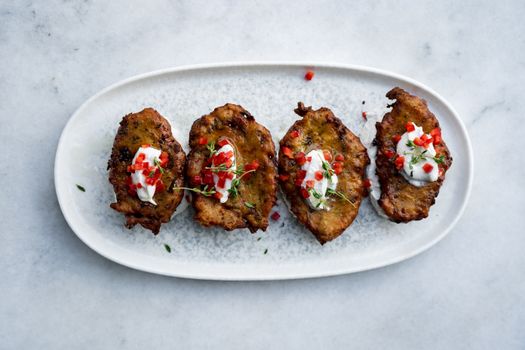
Photo: Kadir Avşar / Pexels
Mediterranean
Tomatokeftedes
The diets react (see scores below)
Common Ingredients
- tomatoes
- onion
- mint
- flour
- oregano
- olive oil
- baking powder
- parsley
Specific recipes may vary.
Incompatible with 5 of 11 diets
Diet Ratings
Tomatokeftedes (Greek tomato fritters) are fundamentally incompatible with ketogenic eating. The primary structural ingredient is wheat flour, which is a high-carb grain that alone disqualifies this dish. Combined with tomatoes (which contribute additional net carbs) and baking powder, a standard serving of these fritters would deliver a substantial carbohydrate load — easily exceeding 20-30g net carbs per portion. Flour-based batters or doughs have no place in a standard ketogenic diet regardless of portion size. The olive oil is keto-friendly, and the herbs are negligible, but they cannot offset the grain-based batter that defines this dish.
Tomatokeftedes (Greek tomato fritters) are made entirely from plant-based ingredients. Tomatoes, onion, fresh herbs (mint, parsley, oregano), flour, baking powder, and olive oil are all whole or minimally processed plant foods with no animal-derived components whatsoever. This is a traditional Santorinian dish that is naturally vegan. The use of whole vegetables, herbs, and minimal processing places it at the higher end of the approval score.
Tomatokeftedes (Greek tomato fritters) are fundamentally incompatible with the paleo diet due to flour as a core structural ingredient. Flour — almost certainly wheat flour in this traditional recipe — is a grain-derived product and one of the clearest 'avoid' foods in paleo. Baking powder typically contains cornstarch, adding another grain-based disqualifier. The remaining ingredients (tomatoes, onion, mint, oregano, olive oil, parsley) are all paleo-approved, but the dish cannot be prepared without the flour binder that defines its fritter form. The overall dish must be rated avoid based on its non-negotiable grain content.
Tomatokeftedes are traditional Greek tomato fritters, particularly from Santorini, and represent an authentically Mediterranean plant-based dish. The base is tomatoes, onion, and fresh herbs (mint, oregano, parsley), all strongly encouraged vegetables and aromatics. Olive oil is used for frying, consistent with Mediterranean fat principles. The flour serves as a binder and is used in relatively small quantities. The dish is whole-food, plant-forward, and deeply rooted in Aegean culinary tradition, making it a solid Mediterranean snack.
Some modern Mediterranean diet guidelines flag refined white flour — even in small binding quantities — as a minor concern, preferring whole-grain alternatives. Traditional Santorinian recipes use standard flour, but health-focused adaptations may substitute chickpea or whole wheat flour to better align with contemporary guidelines.
Tomatokeftedes is a traditional Greek tomato fritter made entirely from plant-based ingredients. Every single component — tomatoes, onion, mint, flour, oregano, olive oil, baking powder, and parsley — is plant-derived and explicitly excluded from the carnivore diet. There is no animal product whatsoever in this dish. It contains vegetables, grains (flour), plant oils, and herbs/spices, all of which are categorically off-limits under any tier of carnivore eating, including the most lenient 'animal-based' approaches.
Tomatokeftedes (Greek tomato fritters) contain flour, which is a grain and explicitly excluded on the Whole30. Additionally, even if a grain-free flour substitute were used, this dish is a fritter — a fried patty that falls squarely into the 'no recreating baked goods/junk food' category (analogous to pancakes or similar formed, fried patties). The remaining ingredients — tomatoes, onion, mint, oregano, olive oil, parsley — are all Whole30-compliant, but the flour alone disqualifies the dish entirely.
Tomatokeftedes (Greek tomato fritters) contain two significant high-FODMAP ingredients that make this dish problematic during the elimination phase. First, onion is one of the highest-FODMAP foods tested by Monash University, containing dense fructans even in small amounts — there is no safe serving size of onion during elimination. Second, wheat flour is high in fructans and is a primary structural ingredient in these fritters, not a trace amount. Tomatoes themselves are low-FODMAP at standard servings (up to 75g canned or one small fresh tomato), and the herbs (mint, oregano, parsley), olive oil, and baking powder are all low-FODMAP. However, the combination of onion and wheat flour as core ingredients makes this dish unsuitable during the elimination phase without significant recipe modification.
Tomatokeftedes (Greek tomato fritters) are made primarily from vegetables and herbs — tomatoes, onion, mint, parsley, oregano — which are strongly aligned with DASH principles. Olive oil is the recommended fat in DASH-friendly Mediterranean eating. However, these fritters are typically deep- or pan-fried in a notable quantity of olive oil, which significantly increases caloric density and total fat intake beyond what DASH portion guidance generally endorses, even though olive oil is unsaturated. The refined flour and baking powder are neutral-to-mild concerns. Sodium content depends heavily on preparation — many recipes add salt liberally, which would push this toward 'avoid' territory, but the base ingredients are low-sodium. As a snack, portion control is feasible. Overall, the vegetable-forward, herb-rich, olive-oil-based profile is DASH-compatible in spirit, but the frying method and potential added salt warrant caution rather than full approval.
NIH DASH guidelines emphasize limiting total fat and favor baking/steaming over frying; a strict reading would flag the fried preparation as inconsistent with DASH snack recommendations. However, updated Mediterranean-DASH hybrid interpretations (e.g., MIND diet research) increasingly recognize olive oil-based cooking as cardiovascular-neutral or beneficial, and some DASH clinicians would approve this dish if baked and prepared with minimal added salt.
Tomatokeftedes (Greek tomato fritters) are a Mediterranean snack made primarily from tomatoes, herbs, and flour, fried in olive oil. From a Zone perspective, this dish has some favorable elements and some problematic ones. Positives: tomatoes are a favorable low-glycemic vegetable rich in polyphenols and lycopene (strongly anti-inflammatory, aligning with Sears' later work); olive oil provides monounsaturated fat, which is ideal for Zone fat blocks; fresh herbs (mint, oregano, parsley) add polyphenols with negligible macro impact. The main concern is the flour used as a binder — white flour is a high-glycemic, 'unfavorable' carbohydrate in Zone terminology, and it becomes the dominant carb source in this dish, displacing the more favorable vegetable carbs. Additionally, this dish has no meaningful protein source, making it difficult to build a balanced 40/30/30 Zone snack or meal without pairing it with a lean protein. As a standalone snack, it skews heavily carb-heavy with inadequate protein. However, if paired with a lean protein (e.g., a few slices of turkey or low-fat cheese) and portioned moderately, it can fit into a Zone snack. The frying in olive oil, while calorically dense, uses the right fat type. Overall, the flour and protein absence require careful management.
Some Zone practitioners, particularly following Sears' later anti-inflammatory framework, would note that the polyphenol density from tomatoes, oregano, mint, and parsley partially offsets the glycemic concerns of the flour. If a small amount of whole wheat or almond flour is substituted, this dish becomes considerably more Zone-friendly. Conversely, strict early Zone adherents would flag the flour-dominant carb profile and absence of protein as making this a poor standalone Zone choice.
Tomatokeftedes (Greek tomato fritters) are built on a strongly anti-inflammatory foundation. Tomatoes provide lycopene and vitamin C — potent antioxidants associated with reduced inflammatory markers. Olive oil (presumably extra virgin) contributes oleocanthal, a natural COX inhibitor with ibuprofen-like anti-inflammatory action, and is a cornerstone of the anti-inflammatory diet. Fresh herbs — mint, oregano, and parsley — add polyphenols, flavonoids, and rosmarinic acid, all documented anti-inflammatory compounds. Onion provides quercetin, another well-studied anti-inflammatory flavonoid. The main limiting factor is refined wheat flour, which raises the glycemic profile and is a mild pro-inflammatory element when consumed regularly. However, flour here functions as a binder in a vegetable-forward dish, so its proportion is modest. Baking powder is nutritionally neutral. Overall, this is a whole-food, herb-rich, Mediterranean snack with a favorable anti-inflammatory profile, modestly tempered by the flour content.
Tomatoes are nightshade vegetables, and while mainstream anti-inflammatory nutrition (including Dr. Weil's pyramid) endorses them for their lycopene and antioxidant content, Autoimmune Protocol (AIP) practitioners and researchers like Dr. Tom O'Bryan argue that solanine and lectins in nightshades can provoke inflammation in individuals with autoimmune conditions or gut permeability issues. For the general population this concern is not mainstream, but it is meaningful for autoimmune-sensitive individuals.
Tomatokeftedes are Greek tomato fritters made primarily from tomatoes, herbs, onion, and flour, pan-fried in olive oil. They are low in protein with no primary protein source, making them a poor fit as a standalone snack for GLP-1 patients who must prioritize 15-30g protein per meal or snack opportunity. The tomato and herb base provides some fiber, micronutrients, and hydration-supportive water content, which is a positive. However, the refined flour batter adds low-nutrient carbohydrates, and pan-frying in olive oil — even though olive oil is an unsaturated fat — increases the fat per serving meaningfully and may worsen nausea or bloating in GLP-1 patients sensitive to higher-fat foods. The olive oil fat is the better-quality type, which prevents a lower score. As a small side dish or appetizer paired with a high-protein main (e.g., grilled fish, Greek yogurt tzatziki as a dip), this becomes more acceptable. As a standalone snack, it fails the protein priority rule and offers limited nutritional density per calorie.
Some GLP-1-focused dietitians would view this more favorably in a Mediterranean dietary pattern context, noting the anti-inflammatory herbs, lycopene-rich tomatoes, and heart-healthy olive oil as meaningful nutrient contributors for patients who struggle to eat much at all. Others would flag the frying method and refined flour as meaningful drawbacks that outweigh the vegetable content, particularly for patients experiencing active GI side effects.
*See how scores were generated at our methodology page.
Nutritional profile
Six traits that cut across every diet.
Fiber & Plants
How much whole-plant food and fiber it delivers.
Healthy Fats
The quality of its fats (unsaturated, omega-3).
Whole / Unprocessed
How close it is to its natural, unprocessed form.
Gut Gentle
How easy it is on digestion (low FODMAP, few irritants).
Low Glycemic
How little it spikes your blood sugar.
Protein Density
How much protein it packs per calorie.
Controversy Index
Higher controversy = more disagreement between diets.
Diet-Specific Tips
 Vegan — 9/10
View tips
- All ingredients are fully plant-based
- No animal products or animal-derived ingredients present
- Primarily whole foods with minimal processing
- Olive oil is the only refined/processed ingredient, which is standard in Mediterranean vegan cooking
- Baking powder is vegan-friendly (typically cream of tartar or sodium bicarbonate based)
- No cross-contamination concerns inherent to the dish itself
 Mediterranean — 8/10
View tips
- Authentically Mediterranean dish with Santorinian origins
- Tomatoes and fresh herbs form the primary base — strongly encouraged plant foods
- Olive oil used as the cooking fat, consistent with core Mediterranean principles
- Small amount of refined flour used as a binder — minor concern for modern guidelines
- No animal protein, processed ingredients, added sugars, or saturated fats
- Plant-forward snack with strong traditional Mediterranean credentials
 DASH — 6/10
View tips
- Tomatoes, onion, and fresh herbs are core DASH vegetables rich in potassium and antioxidants
- Olive oil is the preferred DASH fat source, but frying increases total fat and caloric load
- Refined flour provides little fiber compared to whole grain alternatives
- Sodium level is highly preparation-dependent — added salt could make this a high-sodium snack
- No saturated fat, tropical oils, red meat, or added sugar — positive DASH factors
- Baked version would score 7-8; deep-fried version with salted preparation would score 4-5
 Zone — 5/10
View tips
- Flour (white) is a high-glycemic 'unfavorable' carbohydrate in Zone methodology
- No protein source — fails the 40/30/30 balance as a standalone snack
- Tomatoes are a favorable low-glycemic, polyphenol-rich Zone vegetable
- Olive oil provides ideal monounsaturated fat blocks
- Herbs (oregano, mint, parsley) add anti-inflammatory polyphenols
- Must be paired with lean protein to approach Zone balance
- Portion control critical due to flour-based carb density
 Anti-Inflammatory — 7/10
View tips
- Tomatoes: rich in lycopene and vitamin C, strong anti-inflammatory antioxidants
- Extra virgin olive oil: oleocanthal content, anti-inflammatory cornerstone of Mediterranean diet
- Oregano, mint, parsley: polyphenols and flavonoids with anti-inflammatory properties
- Onion: quercetin, a well-studied anti-inflammatory flavonoid
- Refined wheat flour: mild pro-inflammatory element due to refined carbohydrate content
- Nightshade consideration: tomatoes may be problematic for autoimmune-sensitive individuals
 GLP-1 Friendly — 5/10
View tips
- No meaningful protein content — fails the 15-30g protein per snack target
- Pan-fried preparation increases fat per serving and may worsen GLP-1 GI side effects
- Refined flour contributes low-nutrient carbohydrates with minimal fiber
- Tomato base provides water content, lycopene, and some vitamins — a positive
- Olive oil fat is unsaturated, partially mitigating fat quality concern
- Herb-forward flavor profile is GI-gentle and anti-inflammatory
- Best used as a side dish paired with a high-protein food, not as a standalone snack