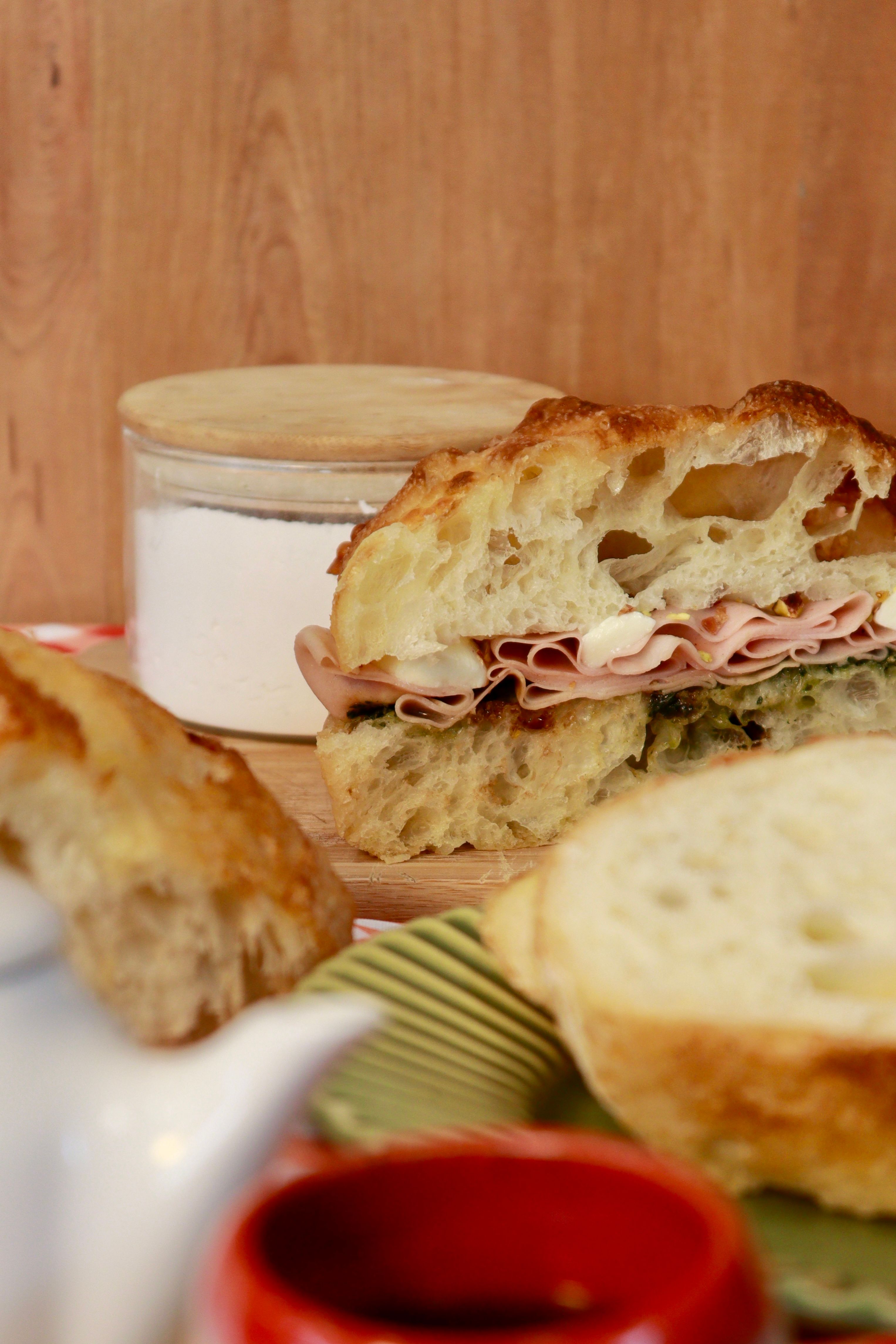
Photo: Kaue Barbier / Pexels
Mexican
Torta de Jamón
The diets react (see scores below)
Common Ingredients
- telera roll
- ham
- Oaxaca cheese
- refried beans
- avocado
- pickled jalapeños
- tomato
- onion
Specific recipes may vary.
Incompatible with 7 of 11 diets
Diet Ratings
The Torta de Jamón is fundamentally incompatible with a ketogenic diet due to two major high-carb components. The telera roll is a white wheat bread that alone contributes roughly 40-50g of net carbs, immediately exceeding most people's entire daily keto carb allowance. Refried beans add another significant carb load (approximately 20-25g net carbs per standard serving). Together, these two ingredients alone push net carbs well into triple digits for a full sandwich. While several individual ingredients are keto-friendly — avocado is excellent, Oaxaca cheese and ham are both good fat/protein sources, and pickled jalapeños, tomato, and onion are acceptable in small quantities — the foundational structure of this dish (bread + beans) makes it impossible to consume in any standard form on a ketogenic diet. No reasonable portion adjustment can make this sandwich keto-compatible without deconstructing it entirely and eliminating the core ingredients that define it as a torta.
Torta de Jamón contains multiple animal products that are categorically excluded from a vegan diet. Ham is cured pork (meat), Oaxaca cheese is a dairy product made from cow's milk, and refried beans are traditionally prepared with lard (animal fat). Three separate animal-derived ingredients make this dish firmly non-vegan with no ambiguity.
Torta de Jamón is fundamentally incompatible with the Paleolithic diet. The telera roll is a wheat-based bread (a grain), which alone disqualifies the dish under strict paleo rules. Refried beans are a legume, another clear paleo exclusion. Oaxaca cheese is a dairy product, also excluded. Ham is typically a processed, cured meat with added salt, preservatives, and sometimes sugar, making it non-paleo as well. The only paleo-compliant components in this dish are avocado, tomato, onion, and pickled jalapeños (though pickling often involves added salt and vinegar additives). With four core non-paleo ingredients — grain-based bread, legumes, dairy, and processed meat — this dish is firmly in the avoid category with no meaningful path to even a caution rating without a complete reconstruction.
The Torta de Jamón presents several conflicts with Mediterranean diet principles. Ham is a processed red meat product (cured pork), which falls squarely in the 'avoid' or heavily limit category — it's both red meat and processed, combining two negative factors. The telera roll is a refined white bread with no whole grain equivalent. Refried beans are a positive legume element, and avocado provides healthy monounsaturated fats. Tomato, onion, and pickled jalapeños are vegetable positives. However, the Oaxaca cheese adds moderate saturated fat, and the overall sandwich structure is built on a refined grain base with processed meat as the centerpiece. The beneficial ingredients (beans, avocado, vegetables) are supporting players rather than the focus. The combination of processed meat plus refined grain bread as the primary components makes this difficult to endorse even in moderation.
Some Mediterranean diet practitioners argue that a small amount of cured pork is part of traditional Spanish and Italian Mediterranean cuisine (e.g., jamón ibérico in Spain), and that the legume and vegetable content of this dish partially offset concerns. On this reading, occasional consumption might be rated 'caution' rather than 'avoid,' particularly if portion size is modest.
The Torta de Jamón is almost entirely incompatible with the carnivore diet. The telera roll is a wheat bread — a grain-based plant food that is strictly excluded. Refried beans are legumes, also firmly excluded. Avocado, tomato, onion, and pickled jalapeños are all plant foods. Even the Oaxaca cheese and ham, while animal-derived, are secondary to the overwhelming number of plant-based and grain-based components. This dish is a classic Mexican sandwich built around bread and plant toppings, making it one of the clearest possible violations of carnivore principles. There is no version of the carnivore diet — including the more permissive animal-based approach — that would accommodate telera bread, beans, and multiple vegetables simultaneously.
A Torta de Jamón contains multiple excluded ingredients. The telera roll is a bread made from wheat (a grain), which is explicitly excluded on Whole30. Oaxaca cheese is dairy, also explicitly excluded. Refried beans are legumes, explicitly excluded. Ham commonly contains added sugar and/or sulfites (though sulfites are no longer excluded per 2024 rules, sugar in processed ham remains an issue). Any one of the first three ingredients alone — the bread roll, the cheese, or the refried beans — is sufficient to make this dish non-compliant. This is also structurally a sandwich, a format that falls into the 'recreating junk food/comfort food' category even if ingredients were swapped for compliant versions.
This dish contains multiple high-FODMAP ingredients that make it unsuitable during the elimination phase. The telera roll is a wheat-based bread, which is high in fructans — a major FODMAP trigger. Refried beans are typically made from pinto or black beans, which are high in GOS (galacto-oligosaccharides) and fructans, making them a significant FODMAP offender. Onion is one of the highest-fructan foods and is explicitly flagged by Monash as a top trigger. Oaxaca cheese is a fresh/semi-soft cheese with moderate lactose content, adding another FODMAP concern. Avocado is only low-FODMAP at 1/8 of a fruit (30g), and a standard torta serving would far exceed this, pushing it into high-FODMAP territory for polyols (sorbitol). Ham itself is generally low-FODMAP if free of high-FODMAP additives like honey or onion/garlic powder, but this cannot be assumed. Tomato and pickled jalapeños are generally low-FODMAP at standard servings. However, the combination of wheat bread, refried beans, and onion alone is enough to make this dish a clear avoid during elimination phase.
The Torta de Jamón contains several DASH-friendly components — avocado provides healthy monounsaturated fats and potassium, tomato and onion contribute vegetables and micronutrients, and refried beans offer fiber, plant protein, and magnesium. However, it also presents notable DASH concerns. Ham is a processed, cured meat with high sodium content (a single serving can contribute 700–1,000mg sodium), directly conflicting with DASH's sodium limits (<2,300mg/day standard, <1,500mg/day low-sodium). Oaxaca cheese is a full-fat dairy product, not aligned with DASH's emphasis on low-fat or fat-free dairy. Pickled jalapeños add additional sodium. The telera roll is a refined white bread, not a whole grain. Refried beans, while nutritious, are often prepared with lard or added salt in traditional recipes. The combination of processed meat, full-fat cheese, pickled condiments, and refined bread pushes this dish into the caution range despite its vegetable content. Modifications — swapping ham for grilled chicken or turkey breast, using low-fat cheese, choosing a whole-grain roll, and using low-sodium or fresh jalapeños — would substantially improve its DASH compatibility.
NIH DASH guidelines explicitly limit processed meats and full-fat dairy, placing this dish in the caution-to-avoid range for sodium and saturated fat. However, some updated clinical interpretations note that the avocado, beans, tomato, and onion provide meaningful DASH-positive nutrients (potassium, fiber, magnesium), and that the overall dietary pattern — not a single meal — determines DASH adherence, so this dish eaten occasionally within a broader DASH pattern may be acceptable.
The Torta de Jamón presents a mixed Zone profile. On the positive side, several ingredients are Zone-friendly: avocado provides excellent monounsaturated fat, pickled jalapeños and tomato are low-glycemic vegetables, and ham offers a lean-ish protein source. However, the telera roll is a refined white flour bread — a high-glycemic carbohydrate that Zone methodology classifies as 'unfavorable.' This is the central problem: the bread alone likely constitutes 3-4 carb blocks of high-glycemic starch, which will spike insulin and throw off the 40/30/30 ratio significantly. Refried beans add moderate-glycemic carbs on top of the roll. Oaxaca cheese contributes saturated fat rather than the preferred monounsaturated fats. Ham, while a protein source, is processed and higher in sodium, and depending on the cut may have moderate fat content. As served traditionally, this sandwich skews heavily carb-heavy (and high-glycemic carb at that), with protein from ham likely insufficient relative to the carb load, and fat coming mostly from saturated sources. A Zone practitioner could theoretically deconstruct this — eat the fillings, skip most of the bread, reduce beans — but as a complete dish it requires significant modification to fit Zone ratios.
Some Zone practitioners note that Dr. Sears' block system is fundamentally about portioning, not exclusion. A half-telera roll, modest beans, and the favorable fillings (avocado, ham, vegetables) could be assembled into an approximate Zone meal with careful control. The avocado fat blocks are ideal, the vegetable content is solid, and the overall dish has more nutritional density than many processed Western sandwiches. Sears' later anti-inflammatory writings also place more emphasis on polyphenols (present in jalapeños, tomato, onion) than on strict glycemic avoidance alone.
The Torta de Jamón presents a mixed anti-inflammatory profile. On the positive side, avocado is a standout anti-inflammatory ingredient rich in monounsaturated fats, fiber, and antioxidants. Refried beans (assuming minimal lard) provide fiber and plant protein with anti-inflammatory benefits. Tomato offers lycopene, onion provides quercetin, and pickled jalapeños contribute capsaicin — all with meaningful anti-inflammatory properties. However, several components pull in the opposite direction. Ham is a processed red meat high in sodium, nitrates/nitrites, and saturated fat — all associated with increased inflammatory markers. The telera roll is a refined white bread with negligible fiber and a high glycemic load. Oaxaca cheese is a full-fat dairy product, which the anti-inflammatory framework asks you to limit. The net result is a sandwich with real anti-inflammatory highlights undermined by a processed meat foundation and a refined carbohydrate base — a classic 'caution' profile that could be improved by swapping to whole grain bread and replacing ham with grilled chicken or fish.
Most anti-inflammatory authorities would agree this is a 'caution' food due to processed meat and refined carbs, but some practitioners in the Mediterranean-adjacent anti-inflammatory tradition might rate it slightly more favorably given the avocado, beans, and vegetable components, arguing that the overall dietary pattern matters more than any single ingredient. Conversely, stricter anti-inflammatory protocols following Dr. Weil's emphasis on avoiding processed meats and refined grains might push this closer to an 'avoid.'
A Torta de Jamón has a mixed nutritional profile for GLP-1 patients. On the positive side, it contains meaningful protein from ham and Oaxaca cheese, fiber from refried beans and avocado, and beneficial unsaturated fats from avocado. Tomato and onion add micronutrients and water content. However, several components raise concern: the telera roll is a refined white bread with low fiber and nutrient density, occupying significant stomach volume; Oaxaca cheese adds saturated fat; refried beans are often prepared with lard; ham is a processed meat with moderate sodium and moderate saturated fat content; and pickled jalapeños may worsen reflux or nausea, which are common GLP-1 side effects. The sandwich format also tends toward a large, heavy single serving rather than a small, easily portioned meal — the slowed gastric emptying caused by GLP-1 medications means this volume could cause significant discomfort. Protein content is moderate but not high-density per calorie given the bread bulk. Overall, it is not ideal but could be acceptable if significantly modified — e.g., open-faced on half a roll, beans without lard, jalapeños omitted, and cheese reduced.
Some GLP-1-focused dietitians would rate this more favorably, noting that beans plus cheese plus ham can deliver 20-25g protein with meaningful fiber if portioned carefully, making it a practical real-world meal option. Others would rate it lower, citing processed meat, refined bread, and spicy pickled peppers as a combination likely to trigger nausea, reflux, or bloating in patients with active GI side effects.
*See how scores were generated at our methodology page.
Nutritional profile
Six traits that cut across every diet.
Fiber & Plants
How much whole-plant food and fiber it delivers.
Healthy Fats
The quality of its fats (unsaturated, omega-3).
Whole / Unprocessed
How close it is to its natural, unprocessed form.
Gut Gentle
How easy it is on digestion (low FODMAP, few irritants).
Low Glycemic
How little it spikes your blood sugar.
Protein Density
How much protein it packs per calorie.
Controversy Index
Higher controversy = more disagreement between diets.
Diet-Specific Tips
 DASH — 4/10
View tips
- Ham is a processed, cured meat with high sodium content (~700–1,000mg per serving), conflicting with DASH sodium limits
- Oaxaca cheese is full-fat dairy; DASH emphasizes low-fat or fat-free dairy
- Pickled jalapeños add additional sodium
- Telera roll is refined white bread, not a whole grain as DASH recommends
- Refried beans are DASH-friendly for fiber and plant protein but often contain added lard/sodium
- Avocado provides DASH-beneficial potassium and monounsaturated fats
- Tomato and onion contribute vegetables and micronutrients aligned with DASH
- Overall sodium load of the dish likely exceeds 1,000–1,500mg, challenging even the standard DASH sodium target
 Zone — 4/10
View tips
- Telera roll is refined white flour — high-glycemic, unfavorable Zone carbohydrate
- Avocado is an ideal monounsaturated fat source — Zone approved
- Refried beans add additional moderate-to-high glycemic carbs, compounding the bread issue
- Ham is a processed protein; acceptable in Zone but less ideal than fresh lean meats
- Oaxaca cheese contributes saturated fat rather than preferred monounsaturated fats
- Pickled jalapeños, tomato, and onion are favorable low-glycemic vegetables with polyphenol benefits
- As served, carbohydrate ratio is heavily skewed by the bread — hard to achieve 40/30/30 without modification
- Significant portion control or bread removal would be required to Zone-balance this meal
 Anti-Inflammatory — 5/10
View tips
- Ham is a processed meat with nitrates, sodium, and saturated fat — pro-inflammatory
- Telera roll is refined white bread with high glycemic load — promotes insulin spikes
- Avocado provides monounsaturated fats, fiber, and antioxidants — strongly anti-inflammatory
- Refried beans offer fiber and plant protein — anti-inflammatory benefit
- Tomato and onion provide lycopene and quercetin — anti-inflammatory polyphenols
- Pickled jalapeños contribute capsaicin — anti-inflammatory compound
- Oaxaca cheese is full-fat dairy — moderate concern under anti-inflammatory guidelines
- Overall: beneficial vegetables and legumes offset by processed meat and refined carbs
 GLP-1 Friendly — 4/10
View tips
- Refined telera roll adds bulk with low fiber and nutrient density
- Ham is a processed meat with saturated fat and high sodium
- Oaxaca cheese contributes saturated fat
- Refried beans may contain lard, increasing fat content
- Avocado provides beneficial unsaturated fats but adds caloric density
- Pickled jalapeños may worsen GLP-1-related reflux or nausea
- Large sandwich volume is poorly suited to slowed gastric emptying
- Moderate protein overall but not high-density per calorie
- Beans provide fiber benefit but portion is typically small within the sandwich