Photo: Andrés Góngora / Pexels
Mexican
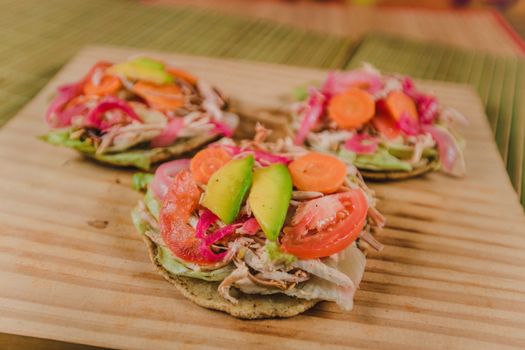
Tostadas de Tinga
The diets react (see scores below)
Common Ingredients
- corn tortillas
- shredded chicken
- chipotle in adobo
- refried beans
- lettuce
- Mexican crema
- queso fresco
- avocado
Specific recipes may vary.
Incompatible with 6 of 11 diets
Diet Ratings
Tostadas de Tinga are fundamentally incompatible with ketogenic eating. The base is a corn tortilla, which is a grain-based, high-carb foundation — a single corn tortilla contains roughly 10-12g net carbs, and tostadas typically use one or more. Refried beans add another significant carb load (approximately 15-20g net carbs per half-cup serving). Together, just these two ingredients can easily push a single tostada past the entire daily keto carb budget of 20g. Chipotle in adobo sauce also contains added sugars. While several individual toppings — shredded chicken, avocado, Mexican crema, queso fresco, and lettuce — are keto-friendly on their own, the structural components of this dish make it incompatible with ketosis without a complete reconstruction.
Tostadas de Tinga contains multiple animal products, making it entirely incompatible with a vegan diet. The dish includes shredded chicken (poultry), Mexican crema (dairy), and queso fresco (dairy cheese) — three distinct animal-derived ingredients. There is no ambiguity here; this dish is firmly non-vegan.
Tostadas de Tinga contains multiple core paleo violations that make it incompatible with the diet. Corn tortillas are a grain product — corn is explicitly excluded from paleo. Refried beans are legumes, another clear exclusion. Mexican crema is dairy, and queso fresco is dairy. Chipotle in adobo sauce typically contains added salt, sugar, and processed additives. The only paleo-compliant ingredients in this dish are the shredded chicken, lettuce, and avocado. With four out of eight ingredients being direct violations across three separate paleo-excluded food categories (grains, legumes, dairy), this dish is firmly in avoid territory with no meaningful adaptation possible without rebuilding it from scratch.
Tostadas de Tinga align moderately well with Mediterranean diet principles but are not a natural fit. The dish has several positive elements: shredded chicken (lean poultry, acceptable in moderation), refried beans (legumes, a Mediterranean staple), avocado (healthy monounsaturated fats, analogous to olive oil's role), and lettuce (fresh vegetable). Corn tortillas are a whole grain alternative and less refined than white flour tortillas, though not a traditional Mediterranean grain. The problematic components are Mexican crema (high saturated fat dairy, beyond moderate amounts), queso fresco (additional dairy), and chipotle in adobo (processed condiment with added sugars and sodium). The overall dish is not Mediterranean in origin but can be evaluated ingredient-by-ingredient as a moderate-compatibility meal. The bean base and avocado are strong positives; the dual dairy components and processed sauce push it toward caution.
Some Mediterranean diet interpreters might score this more favorably, noting that beans and avocado are core plant foods, and that moderate dairy (crema, queso fresco) is permissible under traditional Mediterranean frameworks that include cheese and yogurt. Others applying stricter modern clinical guidelines would flag the processed chipotle-adobo sauce and dual dairy toppings as incompatible with daily Mediterranean eating patterns.
Tostadas de Tinga is fundamentally incompatible with the carnivore diet. The dish is built on a corn tortilla base — a grain-based plant food that is strictly excluded. The majority of ingredients are plant-derived: corn tortillas, chipotle in adobo (dried chili peppers in a plant-based sauce), refried beans (legumes), lettuce, and avocado. While shredded chicken and Mexican crema are animal-derived, they are minor components surrounded by prohibited plant foods. This dish represents a quintessentially plant-heavy Mexican snack with no meaningful pathway to carnivore adaptation without a complete rebuild.
Tostadas de Tinga contains multiple Whole30-excluded ingredients. Corn tortillas are made from corn, a grain explicitly excluded from the program. Refried beans are legumes, also explicitly excluded. Mexican crema is a dairy product (excluded). Queso fresco is a dairy cheese (excluded). Additionally, corn tortillas fried into tostada shells would fall under the 'no chips/crackers/tortillas' junk food recreation rule even if the grain exclusion didn't already apply. The dish fails on at least four separate Whole30 rules simultaneously.
Tostadas de Tinga contains multiple high-FODMAP ingredients that make it unsuitable during the elimination phase. Refried beans are high in GOS (galacto-oligosaccharides) and are a significant FODMAP source at any typical serving. Chipotle in adobo sauce typically contains garlic and onion, both of which are high-fructan ingredients — among the highest-FODMAP foods tested by Monash. Queso fresco is a soft, fresh cheese with moderate-to-high lactose content. Avocado becomes high-FODMAP at portions larger than 1/8 of a fruit (due to polyols/sorbitol), and a standard tostada topping far exceeds this. Mexican crema (sour cream-based) contains lactose. The combination of at least four distinct high-FODMAP triggers across different FODMAP categories (GOS, fructans, lactose, polyols) makes this dish a clear avoid during elimination, even if individual components like corn tortillas, shredded chicken, and lettuce are themselves low-FODMAP.
Tostadas de Tinga contain several DASH-friendly elements — corn tortillas (whole grain-adjacent), shredded chicken (lean protein), lettuce (vegetable), avocado (healthy monounsaturated fats, potassium), and refried beans (fiber, potassium, plant protein). However, multiple ingredients raise DASH concerns. Chipotle in adobo sauce is high in sodium and can be high in added sugar. Refried beans, especially canned or restaurant-style, are often made with lard and significant sodium. Mexican crema is a full-fat dairy product, which DASH explicitly discourages in favor of low-fat dairy. Queso fresco adds additional sodium and saturated fat, though it is lower in fat than many cheeses. The cumulative sodium load across chipotle adobo, refried beans, and queso fresco likely pushes this dish above DASH-friendly thresholds for a single snack serving. The dish is not categorically off-limits but requires significant modification — low-sodium refried beans (or home-prepared beans without lard), limiting adobo sauce quantity, substituting crema with low-fat Greek yogurt, and using queso fresco sparingly — to align with DASH principles.
NIH DASH guidelines explicitly limit full-fat dairy and high-sodium condiments like adobo sauce, placing this dish in caution territory. However, updated clinical interpretations note that avocado, beans, and lean chicken provide substantial DASH-aligned nutrients (potassium, fiber, magnesium), and some DASH-oriented dietitians would approve a modified version of this dish with low-sodium beans and reduced crema as a nutrient-dense, culturally appropriate option.
Tostadas de Tinga present a mixed Zone profile that requires careful portioning. The shredded chicken (tinga) is an excellent lean protein source, and avocado provides ideal monounsaturated fat. Lettuce adds favorable low-glycemic carbs. However, the dish has several Zone challenges: corn tortillas are a moderate-to-high glycemic carb and an 'unfavorable' Zone carbohydrate; refried beans, while providing some protein, are primarily a starchy carb that can elevate glycemic load; Mexican crema and queso fresco add saturated fat that tips the fat profile away from monounsaturated-dominant. The chipotle in adobo adds negligible macros but some sugar. As a snack, this combination risks being carb-heavy (corn tortilla + refried beans) and fat-imbalanced (crema + queso fresco vs. avocado). With modifications — using a single small corn tortilla, increasing chicken, reducing crema and queso, and leaning on avocado — this can fit a Zone snack block. As traditionally prepared, the carb-to-protein ratio skews unfavorable.
Some Zone practitioners view corn tortillas more favorably than white flour tortillas due to their higher fiber content and lower glycemic impact per block. Dr. Sears' later anti-inflammatory writings also place less emphasis on strict saturated fat avoidance and more on overall polyphenol content — chipotle peppers and avocado both contribute meaningful polyphenols and anti-inflammatory compounds, which could elevate this dish's Zone standing in a more modern interpretation.
Tostadas de Tinga present a mixed anti-inflammatory profile. On the positive side, avocado contributes monounsaturated fats and anti-inflammatory compounds, chipotle and adobo spices provide capsaicin and antioxidants (chili peppers are emphasized in anti-inflammatory frameworks), refried beans offer fiber and polyphenols, corn tortillas are a whole-grain-adjacent complex carbohydrate, shredded chicken is a lean protein, and lettuce adds modest micronutrients. These are meaningful positives. On the concerning side, Mexican crema is a full-fat dairy product high in saturated fat, which anti-inflammatory guidelines recommend limiting. Queso fresco is also a full-fat dairy cheese, adding to saturated fat load. Chipotle in adobo sauce often contains added sugars and sodium, which in excess can promote inflammation. Refried beans, depending on preparation, may be made with lard (saturated fat) — though vegetarian versions are neutral to beneficial. The dish is not dominated by strongly pro-inflammatory ingredients, but the combination of two full-fat dairy components (crema + queso fresco) and the processed adobo sauce pulls it into caution territory. For someone managing chronic inflammation, reducing or substituting crema and queso fresco with lower-fat alternatives would improve the profile considerably.
Strict anti-inflammatory protocols (such as those emphasizing dairy elimination, like AIP or some functional medicine approaches) would rate this lower due to the crema and queso fresco contributing saturated fat and potential dairy-driven inflammation. Conversely, Dr. Weil's framework, which permits moderate full-fat dairy and emphasizes beans, avocado, and spices as strong positives, might view this dish more favorably — particularly if the dairy portions are modest.
Tostadas de Tinga have a genuinely mixed GLP-1 profile. The shredded chicken and refried beans provide meaningful protein and fiber — two top priorities — and corn tortillas are a reasonable whole-grain-adjacent base. However, several toppings raise concern: Mexican crema is high in saturated fat and low in protein, queso fresco adds moderate saturated fat, and avocado (while a healthy unsaturated fat) contributes additional fat load per serving. The chipotle in adobo introduces moderate spice and acidity that may worsen reflux or nausea in sensitive GLP-1 patients, especially given slowed gastric emptying. The fried corn tortilla base (tostadas are typically fried) adds grease and can be hard to digest. As a snack, portion size is critical — one tostada is manageable, but the fat accumulates quickly across toppings. Nutrient density is moderate: protein is present but diluted by calorie-dense toppings. This dish is not ideal but is workable with modifications: baked tortilla, light crema, reduced cheese, and avocado in small amounts.
Some GLP-1-focused dietitians would rate this more favorably, emphasizing the bean-and-chicken combination as a high-quality protein-plus-fiber pairing that supports satiety in small portions. Others would rate it lower, specifically citing the fried tortilla base, spicy chipotle, and high-fat toppings as a combination likely to trigger nausea, reflux, or delayed gastric discomfort in GLP-1 patients — particularly around injection day when GI sensitivity peaks.
*See how scores were generated at our methodology page.
Nutritional profile
Six traits that cut across every diet.
Fiber & Plants
How much whole-plant food and fiber it delivers.
Healthy Fats
The quality of its fats (unsaturated, omega-3).
Whole / Unprocessed
How close it is to its natural, unprocessed form.
Gut Gentle
How easy it is on digestion (low FODMAP, few irritants).
Low Glycemic
How little it spikes your blood sugar.
Protein Density
How much protein it packs per calorie.
Controversy Index
Higher controversy = more disagreement between diets.
Diet-Specific Tips
 Mediterranean — 5/10
View tips
- Refried beans provide a strong legume base aligned with Mediterranean principles
- Avocado contributes healthy monounsaturated fats similar to olive oil
- Shredded chicken is acceptable lean poultry in moderation
- Corn tortillas are less refined than white flour alternatives but not a Mediterranean grain
- Mexican crema and queso fresco together represent excessive saturated fat dairy
- Chipotle in adobo is a processed condiment with added sugar and sodium
- Dish is non-Mediterranean in culinary origin, requiring ingredient-level assessment
 DASH — 4/10
View tips
- Chipotle in adobo sauce contributes significant sodium and added sugar
- Refried beans often contain lard and high sodium — low-sodium, oil-prepared versions score better
- Mexican crema is full-fat dairy, which DASH discourages
- Queso fresco adds moderate sodium and saturated fat
- Avocado provides DASH-beneficial monounsaturated fats and potassium
- Shredded chicken is lean protein aligned with DASH
- Corn tortillas are acceptable but refined; whole-grain corn versions preferred
- Cumulative sodium across multiple ingredients likely exceeds DASH snack-level targets
 Zone — 5/10
View tips
- Shredded chicken is a favorable Zone lean protein source
- Avocado provides ideal monounsaturated fat and polyphenols
- Corn tortilla is an 'unfavorable' moderate-glycemic Zone carb
- Refried beans add starchy carbs that can compound glycemic load
- Mexican crema and queso fresco shift fat profile toward saturated
- Combination of two starchy carb sources (tortilla + beans) makes Zone balancing difficult as a snack
- Portion control is essential — one small tortilla with reduced dairy toppings can fit within a Zone snack block
 Anti-Inflammatory — 5/10
View tips
- Avocado: strong anti-inflammatory monounsaturated fats and antioxidants — positive
- Chipotle/chili peppers: capsaicin and polyphenols are anti-inflammatory — positive
- Refried beans: fiber and polyphenols support anti-inflammatory profile — positive (if lard-free)
- Lean shredded chicken: acceptable moderate protein — neutral
- Mexican crema: full-fat dairy, high saturated fat — negative
- Queso fresco: full-fat dairy cheese — negative
- Chipotle in adobo: often contains added sugar and sodium — mild negative
- Corn tortillas: whole-grain complex carbohydrate — neutral to mildly positive
 GLP-1 Friendly — 5/10
View tips
- Shredded chicken provides lean protein — positive
- Refried beans add protein and fiber — positive
- Fried corn tortilla base is greasy and hard to digest — negative
- Mexican crema is high in saturated fat with minimal protein — negative
- Queso fresco adds moderate saturated fat — mildly negative
- Avocado contributes healthy unsaturated fat but increases total fat load — neutral to mildly negative
- Chipotle in adobo introduces spice and acidity that may worsen GLP-1 GI side effects — negative
- As a snack, portion size is manageable but fat accumulates quickly across toppings — caution
- Modifiable: baking the tortilla and reducing crema and cheese improves the profile significantly