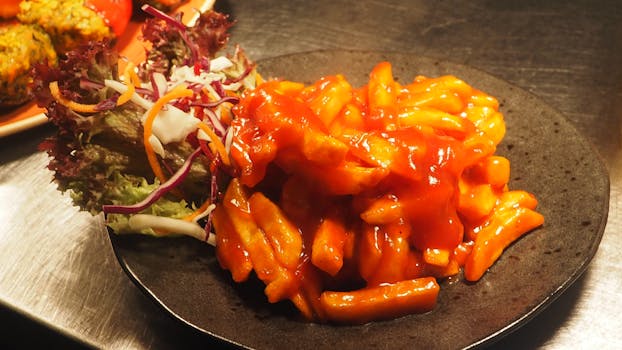
Photo: Chan Walrus / Pexels
The diets react (see scores below)
Common Ingredients
- rice cakes
- fish cakes
- gochujang
- gochugaru
- scallions
- sugar
- onion
- garlic
Specific recipes may vary.
Incompatible with 10 of 11 diets
Diet Ratings
Tteokbokki is fundamentally incompatible with ketogenic diet principles. The primary ingredient, rice cakes (tteok), are made from glutinous or short-grain rice flour — a pure starch source with extremely high net carbs. A standard serving (200g) of tteokbokki can contain 60-80g of net carbs from rice cakes alone, far exceeding the entire daily keto limit of 20-50g. Added sugar is listed explicitly as an ingredient, and gochujang paste also contains significant amounts of sugar and rice. Fish cakes additionally contain starch binders. There is virtually no fat content to offset these carbs, and the dish provides no meaningful fiber to reduce net carb count. Every core component of this dish violates keto macronutrient requirements.
This tteokbokki recipe includes fish cakes (eomuk/odeng), which are made from processed fish — a clear animal product that disqualifies the dish from being vegan. The remaining ingredients (rice cakes, gochujang, gochugaru, scallions, sugar, onion, garlic) are plant-based, meaning the dish is easily made vegan by omitting the fish cakes. However, as listed with fish cakes as an ingredient, it cannot be approved. Additionally, some commercial gochujang pastes contain small amounts of seafood-derived ingredients, so label-checking is advised. A fully vegan version of tteokbokki is widely popular and would score 8-9.
Tteokbokki is fundamentally incompatible with the paleo diet. The two core ingredients — rice cakes (made from rice flour, a grain) and fish cakes (typically made with wheat flour and various additives/preservatives) — are both non-paleo. Rice is a grain excluded from paleo, and fish cakes are processed foods containing grains and additives. Gochujang, the primary sauce, is a fermented paste made with glutinous rice and often sugar, compounding the grain and refined sugar violations. Added sugar is also explicitly excluded. The only paleo-compliant ingredients in this dish are gochugaru (dried chili flakes), scallions, onion, and garlic — which represent a small fraction of the dish. There is no meaningful way to adapt this dish while retaining its identity.
Tteokbokki is centered on refined rice cakes (tteok), which are a refined grain product with high glycemic load and minimal fiber or nutritional density — directly contradicting Mediterranean diet principles that emphasize whole grains. The dish is further problematic due to added sugar, which is explicitly discouraged. Gochujang paste is typically made with fermented chili and some whole ingredients but commercially contains added sugars and refined starches. Fish cakes (eomuk) are a processed food product, not whole fish or seafood as encouraged by Mediterranean guidelines. While the dish includes some vegetables (scallions, onion, garlic) and spices, these are minor components. The overall profile — refined grains, processed protein, added sugar, no whole grains, no olive oil, no legumes — places this firmly in the 'avoid' category.
Tteokbokki is fundamentally incompatible with the carnivore diet. The dish is built on rice cakes (grain-based starch), fish cakes that typically contain plant-based fillers and binders, and a sauce made from gochujang (fermented chili paste with rice and soy), gochugaru (chili flakes), sugar, scallions, onion, and garlic. Every single primary component is plant-derived or heavily plant-contaminated. There are no purely animal-derived ingredients present. This dish represents the opposite of carnivore principles — it is high-carb, plant-dominant, and heavily processed with multiple excluded ingredients.
Tteokbokki contains multiple Whole30-excluded ingredients. Rice cakes are made from rice, which is a grain explicitly excluded from the Whole30 program. Additionally, the dish includes sugar, which is an added sweetener that is also explicitly excluded. Fish cakes (eomuk) typically contain wheat flour and sometimes sugar or other additives, adding further grain-based exclusions. These are not edge cases or spirit-of-the-program concerns — rice and added sugar are hard exclusions with no exceptions listed in the official Whole30 rules.
Tteokbokki contains multiple high-FODMAP ingredients that make it unsuitable during the elimination phase. Onion and garlic are among the highest-FODMAP foods tested by Monash University, both being dense in fructans. These two ingredients alone are sufficient to classify this dish as high-FODMAP at any reasonable serving. Gochujang (fermented red pepper paste) typically contains garlic and onion as core ingredients, further compounding the fructan load. Fish cakes (eomuk) often contain wheat flour as a binder, adding additional fructans. Scallions are acceptable in their green parts only, but whole scallions including the white bulb — common in this dish — add further fructans. Rice cakes (tteok) made from plain rice flour are low-FODMAP, and gochugaru (red pepper flakes) is generally low-FODMAP in moderate amounts. However, the combination of onion, garlic, and gochujang represents an insurmountable FODMAP burden that cannot be mitigated by portion control in any standard preparation of this dish.
Tteokbokki is problematic for the DASH diet on multiple fronts. Gochujang (fermented chili paste) is very high in sodium, typically contributing 400-800mg per tablespoon, and fish cakes (eomuk) are heavily processed and also sodium-dense, often adding another 300-600mg per serving. Together, a standard serving of tteokbokki can easily contain 1,000-1,500mg of sodium, representing 65-100% of the strict DASH daily sodium limit in a single snack. Rice cakes (tteok) are made from refined white rice flour, offering minimal fiber and few DASH-emphasized micronutrients like potassium, calcium, or magnesium. Added sugar further detracts from DASH compatibility. While scallions, onion, and garlic are DASH-friendly aromatics, and gochugaru (red pepper flakes) is relatively lower in sodium than gochujang, these minor positives are overwhelmed by the sodium load and processed ingredients. The overall nutritional profile — high sodium, refined carbohydrates, processed fish cakes, added sugar, and low fiber — is largely misaligned with DASH principles.
Tteokbokki is built almost entirely around rice cakes (tteok), which are made from white rice flour — a high-glycemic, refined carbohydrate that Dr. Sears explicitly classifies as 'unfavorable' due to its rapid blood sugar impact. The dish is further compounded by added sugar in the sauce and gochujang (which contains significant fermented sugar). There is virtually no lean protein in this dish (fish cakes provide minimal protein and are heavily processed with starch fillers), no meaningful monounsaturated fat, and no low-glycemic vegetables in sufficient quantity to offset the glycemic load. The macronutrient ratio is severely imbalanced — overwhelmingly carbohydrate-dominant with inadequate protein and fat — making it nearly impossible to configure as a Zone-balanced snack or meal without fundamentally altering the dish. The scallions, garlic, and onion contribute polyphenols but are nutritionally negligible in terms of rebalancing the macro profile. This dish would spike eicosanoid-disrupting insulin levels, the exact outcome the Zone Diet is designed to prevent.
Tteokbokki presents a genuinely mixed anti-inflammatory profile. On the positive side, gochujang and gochugaru contain capsaicin, which has documented anti-inflammatory effects, and garlic and scallions provide quercetin and allicin — both associated with reduced inflammatory markers. However, the dominant ingredient, rice cakes (tteok), is made from refined white rice flour — a high-glycemic refined carbohydrate that can spike blood glucose and promote inflammatory signaling (elevated CRP, IL-6) when consumed regularly. Gochujang is also fermented, offering some probiotic benefit, but commercial versions typically contain significant added sugar and sometimes corn syrup. The dish itself calls for additional sugar, compounding the refined carbohydrate and glycemic load concern. Fish cakes (eomuk) are processed and may contain additives, fillers, and refined starch. The overall dish is high-glycemic, moderately processed, and sugar-forward — which places it in caution territory despite its genuinely beneficial spice components. Occasional consumption is unlikely to cause harm, but it is not a dish that supports an anti-inflammatory pattern when eaten regularly.
Some fermented-food advocates would note that gochujang's fermentation process and the capsaicin in Korean chili may provide meaningful anti-inflammatory benefit, and Dr. Weil's framework does not strictly prohibit white rice-based foods. Conversely, stricter anti-inflammatory and blood-sugar-focused practitioners (e.g., those aligned with Glucose Goddess or functional medicine frameworks) would rate the refined rice cake base and added sugar as clearly pro-inflammatory, potentially pushing this closer to 'avoid.'
Tteokbokki is a poor fit for GLP-1 patients on nearly every key criterion. Rice cakes are made from refined white rice flour, offering minimal fiber and very low protein — essentially empty refined carbohydrate calories. The dish has no meaningful primary protein source. Gochujang and gochugaru together create a significantly spicy and high-sugar profile: gochujang paste contains added sugar and the dish typically calls for additional sugar, meaning glycemic load is high. The spice level is a real concern for GLP-1 patients, as chili-based heat can worsen nausea, reflux, and gastric irritation — side effects already elevated by slowed gastric emptying. Fish cakes (eomuk) contribute a small amount of protein but are a processed ingredient often containing starch fillers, added sodium, and low nutrient density per calorie. The overall macronutrient profile — high refined carbohydrate, high sugar, moderate sodium, minimal protein, minimal fiber — is nearly the inverse of what GLP-1 patients need. Even in a small portion, this food offers little nutritional return and carries meaningful side effect risk.
*See how scores were generated at our methodology page.
Nutritional profile
Six traits that cut across every diet.
Fiber & Plants
How much whole-plant food and fiber it delivers.
Healthy Fats
The quality of its fats (unsaturated, omega-3).
Whole / Unprocessed
How close it is to its natural, unprocessed form.
Gut Gentle
How easy it is on digestion (low FODMAP, few irritants).
Low Glycemic
How little it spikes your blood sugar.
Protein Density
How much protein it packs per calorie.
Controversy Index
Higher controversy = more disagreement between diets.
Diet-Specific Tips
 Anti-Inflammatory — 4/10
View tips
- Rice cakes are refined high-glycemic carbohydrate with minimal fiber — a primary anti-inflammatory concern
- Added sugar in both the recipe and commercial gochujang raises glycemic and inflammatory load
- Gochujang and gochugaru contribute capsaicin with documented anti-inflammatory properties
- Garlic and scallions provide allicin and quercetin, both anti-inflammatory compounds
- Fish cakes are processed with fillers and additives — not equivalent to whole fish
- Gochujang offers fermentation-derived benefits but commercial versions vary in quality and sugar content
- No omega-3 sources, fiber-rich whole grains, or significant antioxidant vegetables present