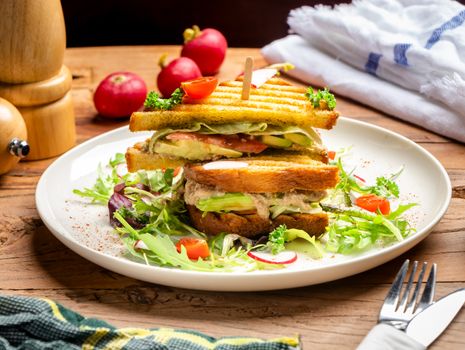
Photo: Mitchel Guanzon / Pexels
American
Tuna Salad Sandwich
The diets react (see scores below)

That’s a heavy plate — want to see the leaner version?
Common Ingredients
- canned tuna
- mayonnaiseGreek yogurt (plain, nonfat)
Nonfat Greek yogurt replaces mayonnaise: fat drops from ~75g to ~0g per 100g, removing the saturated-fat / refined-oil penalty cited by dash, mediterranean, zone, anti-inflammatory and glp-1, while preserving the creamy binding role and adding protein.
- celery
- red onion
- Dijon mustard
- white breadWhole wheat bread
Whole wheat bread replaces refined white bread: fiber rises from ~2.7g to ~6g per 100g and the refined-grain penalty cited by dash, mediterranean, zone and glp-1 falls. Sandwich form factor unchanged.
- lettuce
- lemon juice
Specific recipes may vary.
Incompatible with 6 of 11 diets
Diet Ratings
The tuna salad filling itself (canned tuna, mayonnaise, celery, red onion, Dijon mustard, lemon juice) is largely keto-compatible, but white bread is the critical disqualifying ingredient. Two slices of white bread contribute approximately 24-30g of net carbs from refined grains, which alone can exceed or nearly exhaust an entire day's keto carb budget. White bread is a high-glycemic, grain-based food with zero fiber benefit relative to its carb load, making it fundamentally incompatible with ketosis. The sandwich as a whole dish cannot be approved or even cautioned — it must be avoided. The tuna filling could be repurposed in a lettuce wrap or on its own for a keto-friendly alternative.
Tuna Salad Sandwich contains multiple animal-derived ingredients that are unequivocally non-vegan. Canned tuna is fish — a direct animal product. Standard mayonnaise is made with eggs, another animal product. These two ingredients alone disqualify this dish under any interpretation of veganism. The remaining ingredients (celery, red onion, Dijon mustard, white bread, lettuce, lemon juice) are plant-based, but they cannot redeem a dish built on fish and eggs as its primary components.
The Tuna Salad Sandwich is clearly non-paleo due to two major violations. White bread is a grain-based product (wheat), which is one of the most firmly excluded food groups in the paleo diet. Mayonnaise, as commercially prepared, almost universally contains soybean or canola oil — both seed oils explicitly excluded from paleo. These two ingredients alone disqualify the dish regardless of the otherwise paleo-friendly components (tuna, celery, red onion, lettuce, lemon juice). Dijon mustard may also contain added salt, vinegar, or trace non-paleo additives, and canned tuna often includes added salt or broth. The core concept of this dish — a sandwich — is fundamentally incompatible with paleo principles.
This sandwich has both Mediterranean-friendly and problematic elements. Tuna is an excellent Mediterranean protein source, strongly encouraged 2-3 times weekly. The vegetables (celery, red onion, lettuce) and lemon juice are all consistent with Mediterranean principles. However, two ingredients undermine its compatibility: mayonnaise replaces olive oil as the fat source (it is typically made with refined vegetable oils and is not a Mediterranean staple), and white bread is a refined grain that the Mediterranean diet discourages in favor of whole grain bread. The dish is not outright disqualifying, but modifications — swapping mayo for olive oil or Greek yogurt and using whole grain bread — would make it much more aligned.
Some traditional Mediterranean coastal communities do incorporate canned fish preparations with light condiments, and mayo-dressed fish salads appear in certain Southern European cuisines. A more lenient interpretation might view this as an acceptable fish-forward meal where the tuna's benefits outweigh the refined grain and mayo concerns, especially if portion of white bread is small.
This dish is fundamentally incompatible with the carnivore diet. While canned tuna is an acceptable animal protein, virtually every other ingredient violates carnivore principles. White bread is a grain-based processed food — one of the clearest violations. Celery, red onion, and lettuce are plant vegetables entirely excluded from the diet. Lemon juice is plant-derived. Dijon mustard contains plant-based ingredients and additives. Even the mayonnaise, while egg-and-oil-based, typically contains plant oils (soybean or canola) and other non-carnivore additives. The sandwich format itself is built around bread, making structural compliance impossible. The lone salvageable component (tuna) is buried under multiple disqualifying plant and processed ingredients.
This dish contains two clear Whole30 violations. First, white bread is a grain-based product and is explicitly excluded under the grains rule. Second, even if the bread were removed, sandwiches are explicitly listed in the 'no recreating baked goods/junk food' rule — bread is a canonical excluded item. The remaining ingredients (canned tuna, mayonnaise, celery, red onion, Dijon mustard, lettuce, lemon juice) could be compliant if individually sourced carefully (mayonnaise and Dijon mustard often contain sugar or non-compliant additives, requiring label-checking), but the white bread alone disqualifies the entire dish with no ambiguity.
This sandwich contains two significant high-FODMAP ingredients that make it problematic during the elimination phase. White bread is made from wheat, which is high in fructans — a major FODMAP trigger — at any standard serving size (2 slices). Red onion is one of the highest-fructan foods tested by Monash University and is high-FODMAP even in very small amounts (just 1 tablespoon chopped). The remaining ingredients are generally low-FODMAP: canned tuna is FODMAP-free, mayonnaise is low-FODMAP at standard servings, celery is low-FODMAP at under 1/4 stalk, Dijon mustard is low-FODMAP at 1 teaspoon, lettuce is low-FODMAP, and lemon juice is low-FODMAP at small amounts. However, the combination of wheat bread (fructans) and red onion (fructans) makes this dish clearly unsuitable for the elimination phase without significant modifications. A low-FODMAP version would require gluten-free bread and complete omission of red onion (substituting with green onion tops or garlic-infused oil for flavor).
This tuna salad sandwich has both DASH-friendly and DASH-problematic components. Tuna is an excellent lean protein and omega-3 source explicitly encouraged by DASH guidelines. Celery, red onion, lettuce, and lemon juice are DASH-positive vegetables adding fiber and micronutrients. However, several ingredients raise concerns: (1) Canned tuna is typically high in sodium (250–350mg per 3oz serving), though lower than many processed foods — low-sodium or no-salt-added versions are preferable. (2) Regular mayonnaise is high in total fat and often contains refined oils; a small amount is acceptable but standard recipes use 2–3 tablespoons, adding significant calories and fat with minimal DASH-beneficial nutrients. (3) White bread is a refined grain, not a whole grain — DASH explicitly recommends whole grains, and white bread contributes little fiber or micronutrient value. (4) Dijon mustard adds moderate sodium. With modifications — whole grain bread, reduced-fat or avocado-based mayo, no-salt-added canned tuna — this dish could score 7–8. As commonly prepared, it sits in the caution range.
NIH DASH guidelines favor whole grains and limit refined grains and high-fat condiments, placing this sandwich in the caution category as typically made. However, some DASH-oriented clinicians note that tuna's exceptional cardiovascular benefits (omega-3s, lean protein) and the sandwich's vegetable content make it a reasonable choice even with white bread, provided mayo is portioned carefully — they may accept it as a practical, accessible DASH-compatible meal rather than strictly penalizing refined grain use.
The tuna salad sandwich has both Zone-friendly and Zone-problematic elements. Canned tuna is an excellent lean protein source, well-suited for Zone meals. Celery, red onion, and lettuce are favorable low-glycemic vegetables. Lemon juice and Dijon mustard add negligible macros. However, the white bread is a high-glycemic, unfavorable carbohydrate explicitly discouraged in Zone methodology — it spikes insulin and provides poor nutritional value relative to its carb block cost. Standard mayonnaise is predominantly omega-6-rich seed oils (soybean oil), which directly conflicts with Sears' anti-inflammatory emphasis on monounsaturated and omega-3 fats. The overall dish is salvageable — tuna salad itself is a solid Zone component — but the delivery vehicle (white bread) and the fat source (conventional mayo) both work against Zone principles. A Zone-optimized version would swap white bread for a low-glycemic wrap or open-face on one slice of whole-grain bread, and replace standard mayo with avocado or olive-oil-based mayo to correct the fat profile.
This sandwich has a genuinely mixed anti-inflammatory profile. On the positive side, canned tuna is a meaningful source of omega-3 fatty acids (EPA and DHA), which are among the most well-supported anti-inflammatory nutrients in the research literature. Celery, red onion, and lemon juice contribute modest antioxidants and flavonoids (quercetin in red onion is particularly noted). Dijon mustard adds negligible but harmless phytochemicals. The negatives, however, are significant. White bread is a refined carbohydrate that spikes blood glucose and lacks fiber, which is broadly considered pro-inflammatory in anti-inflammatory nutrition frameworks. Mayonnaise is typically made with soybean or canola oil, both high in omega-6 fatty acids, which in excess can shift the omega-6:omega-3 ratio in a pro-inflammatory direction — the tuna's omega-3 benefit is partially offset by the mayo. The combination of white bread and mayo drags this dish from 'approve' territory into 'caution.' A simple swap to whole grain bread and avocado or olive oil-based mayo would substantially improve the profile.
Most anti-inflammatory practitioners would flag the white bread and conventional mayo as problematic; however, some mainstream nutritionists (including those aligned with AHA guidelines) consider canola and soybean oil in mayonnaise acceptable or even heart-healthy, and would view the tuna's omega-3s as the dominant signal, potentially rating this dish more favorably. The debate around seed oils in condiment quantities is less settled than for cooking oils used at high heat.
Canned tuna is an excellent GLP-1-friendly protein source — lean, nutrient-dense, and easy to digest. However, this sandwich has two meaningful drawbacks. First, mayonnaise adds significant saturated fat and calories with low nutritional return; the amount used can vary widely and even a moderate 2-tablespoon serving adds roughly 180–200 calories and 20g of fat, which risks worsening nausea and bloating. Second, white bread is a refined grain with minimal fiber and low nutrient density per calorie — a poor fit for the high-nutrient-density priority. The celery, red onion, and lemon juice are positive additions (hydration, micronutrients, digestibility), and Dijon mustard adds flavor without fat. A modified version — whole grain or high-fiber bread, Greek yogurt or light mayo substituted for regular mayo — would score significantly higher (7–8). As prepared with standard ingredients, this is a caution-range food that is acceptable occasionally but not optimal as a regular GLP-1 meal.
Some GLP-1-focused dietitians view tuna salad sandwiches as a practical, accessible protein vehicle and accept regular mayo in small amounts, arguing that palatability and adherence matter more than fat optimization in the short term. Others flag that GLP-1 patients with heightened nausea sensitivity may find high-fat condiments like mayo disproportionately problematic due to slowed gastric emptying, and recommend avoiding it entirely during dose escalation phases.
*See how scores were generated at our methodology page.
Nutritional profile
Six traits that cut across every diet.
Fiber & Plants
How much whole-plant food and fiber it delivers.
Healthy Fats
The quality of its fats (unsaturated, omega-3).
Whole / Unprocessed
How close it is to its natural, unprocessed form.
Gut Gentle
How easy it is on digestion (low FODMAP, few irritants).
Low Glycemic
How little it spikes your blood sugar.
Protein Density
How much protein it packs per calorie.
Controversy Index
Higher controversy = more disagreement between diets.
Diet-Specific Tips
 Mediterranean — 5/10
View tips
- Tuna is a core Mediterranean protein — strongly positive
- Mayonnaise is not a Mediterranean fat; olive oil or Greek yogurt would be preferred
- White bread is a refined grain, contradicting Mediterranean whole grain emphasis
- Vegetables and lemon juice align well with Mediterranean principles
- Overall dish is fish-forward, which is encouraged, but preparation method reduces score
 DASH — 5/10
View tips
- Tuna is a DASH-approved lean protein rich in omega-3 fatty acids
- Canned tuna carries moderate sodium (~300mg/serving); no-salt-added versions strongly preferred
- White bread is a refined grain — DASH recommends whole grain bread instead
- Mayonnaise adds significant fat with minimal DASH-beneficial nutrients; portion control critical
- Vegetables (celery, red onion, lettuce) and lemon juice are DASH-positive additions
- Dijon mustard contributes additional sodium
- Swap to whole grain bread, low-sodium tuna, and reduced-fat mayo to elevate to 'approve' status
 Zone — 5/10
View tips
- Canned tuna is a top-tier Zone lean protein — easy to portion in 1-oz blocks (~7g protein each)
- White bread is a high-glycemic 'unfavorable' carbohydrate explicitly flagged by Sears — spikes insulin response
- Standard mayonnaise is high in omega-6 seed oils, directly opposing Sears' anti-inflammatory fat recommendations
- Vegetables (celery, red onion, lettuce) are favorable low-glycemic Zone carb sources
- The 40/30/30 ratio is achievable with modifications but difficult as standardly prepared due to excess carbs from white bread and imbalanced fat profile
- Easy fix: open-face on whole grain bread or lettuce wrap restores Zone balance significantly
 Anti-Inflammatory — 5/10
View tips
- Canned tuna provides EPA and DHA omega-3 fatty acids — well-supported anti-inflammatory benefit
- White bread is a refined carbohydrate — pro-inflammatory, raises blood glucose, low fiber
- Mayonnaise typically contains soybean or canola oil — high omega-6, partially offsets tuna's omega-3 benefit
- Red onion contains quercetin, a well-studied anti-inflammatory flavonoid
- Celery and lemon juice offer minor antioxidant contributions
- No trans fats, added sugars, or highly processed additives beyond the bread and mayo
- Upgrading to whole grain bread and avocado-based or EVOO mayo would move this to 'approve'
 GLP-1 Friendly — 5/10
View tips
- Canned tuna is a high-quality lean protein source well-suited for GLP-1 patients
- Mayonnaise is high in fat and low in nutritional value — worsens nausea and bloating risk due to slowed gastric emptying
- White bread is a refined grain with low fiber and poor nutrient density per calorie
- Celery and red onion contribute hydration and micronutrients in small amounts
- Dijon mustard and lemon juice are low-calorie flavor additions with no meaningful drawbacks
- Sandwich format supports small-portion eating but white bread undermines nutrient density
- Straightforward substitutions (whole grain bread, Greek yogurt mayo) would move this to approve range