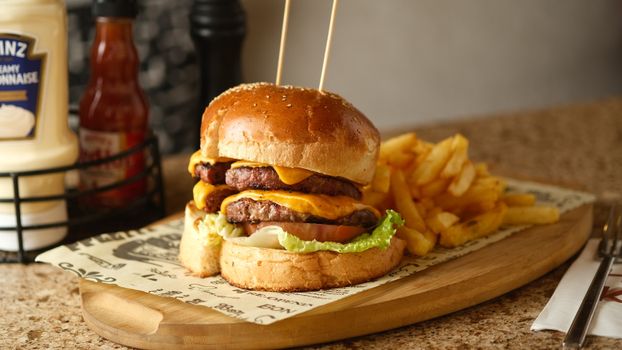
Photo: ufuk iseloglu / Pexels
American
Turkey Burger
The diets react (see scores below)
Common Ingredients
- ground turkey
- brioche bun
- lettuce
- tomato
- red onion
- cheddar cheese
- avocado
- Dijon mustard
Specific recipes may vary.
Incompatible with 6 of 11 diets
Diet Ratings
The turkey burger as described is incompatible with a ketogenic diet primarily due to the brioche bun, which is a refined grain product delivering approximately 25-35g of net carbs on its own — enough to consume or exceed the entire daily carb allowance. While several individual ingredients are keto-friendly (ground turkey, cheddar cheese, avocado, lettuce, Dijon mustard) or acceptable in small amounts (tomato, red onion), the bun is a hard disqualifier. As a sandwich in its standard form, this dish cannot be made keto-compatible without a fundamental structural change (e.g., lettuce wrap). Ground turkey is also a leaner protein, making it less ideal for keto's high-fat requirements compared to fattier meats, though the avocado and cheddar help offset this.
Turkey Burger contains multiple animal products that are strictly excluded from a vegan diet. Ground turkey is poultry (animal flesh), and cheddar cheese is a dairy product derived from cow's milk. The brioche bun typically contains eggs and butter, adding further animal-derived ingredients. These are unambiguous violations of vegan principles with no meaningful debate within the vegan community.
The Turkey Burger as presented contains multiple non-paleo ingredients that disqualify it from approval. The brioche bun is made from wheat flour, a grain explicitly excluded from the paleo diet. Cheddar cheese is a dairy product, also excluded. Dijon mustard typically contains added salt, vinegar, and sometimes sugar or wine, making it a processed condiment. The base protein — ground turkey — is fully paleo-approved, and lettuce, tomato, red onion, and avocado are all whole, paleo-compliant vegetables and fruits. However, the disqualifying ingredients (grain-based bun, dairy cheese, processed condiment) are core structural components of the dish as described, not minor garnishes. In its standard form, this dish cannot be considered paleo.
The turkey burger has a mixed Mediterranean profile. Ground turkey is poultry, which is acceptable in moderation under Mediterranean guidelines — a few servings per week. The vegetables (lettuce, tomato, red onion, avocado) are positive additions aligned with plant-forward eating, and Dijon mustard is a low-concern condiment. However, the brioche bun is a refined, enriched grain — not a whole grain — and represents a meaningful departure from Mediterranean principles. Cheddar cheese adds saturated fat beyond what the diet encourages. The overall format (American-style burger) is not a Mediterranean dietary pattern, even with poultry substituted for beef. The dish is acceptable occasionally but is not a Mediterranean staple.
Some Mediterranean diet practitioners note that lean poultry eaten a few times per week is well within guidelines, and with generous vegetables and avocado this meal has real plant-forward merit. Swapping the brioche for a whole-grain pita or wrap and omitting or reducing the cheddar would move this dish meaningfully closer to a Mediterranean-compatible meal.
The Turkey Burger as presented is fundamentally incompatible with the carnivore diet. While ground turkey itself is an animal product, the dish is dominated by plant-based and processed ingredients: a brioche bun (grain-based bread), lettuce, tomato, red onion (all vegetables), avocado (fruit/plant), and Dijon mustard (plant-derived condiment with vinegar and spices). The cheddar cheese is a debated dairy item but is the least problematic ingredient here. The brioche bun alone disqualifies this dish outright — it is a refined grain product central to the sandwich structure. This dish is a classic omnivore/plant-heavy meal that violates nearly every carnivore principle. The only salvageable component would be the ground turkey patty eaten alone, possibly with cheese.
This turkey burger contains multiple excluded ingredients. The brioche bun is a grain-based bread product, which is excluded under Whole30's grain elimination rule. Cheddar cheese is dairy, which is also explicitly excluded. Even if those two ingredients were removed, the dish is categorized as a sandwich, and Whole30 explicitly prohibits recreating bun-based/bread-wrapped meals in that format. The remaining ingredients — ground turkey, lettuce, tomato, red onion, avocado, and Dijon mustard (check for compliant version with no added sugar or wine vinegar issues) — could be compliant on their own, but the dish as described cannot be made Whole30-compatible without fundamental reconstruction.
This turkey burger contains multiple high-FODMAP ingredients that make it unsuitable during the elimination phase. The brioche bun is made from wheat flour and is high in fructans — a primary FODMAP trigger. Red onion is one of the highest-FODMAP foods tested by Monash University, rich in fructans even in small amounts. Avocado is low-FODMAP only at 1/8 of a fruit (~30g); a standard burger portion (1/4 to 1/2 avocado) easily exceeds this threshold, pushing it into high-FODMAP territory for polyols (sorbitol). Cheddar cheese is generally low-FODMAP as a hard aged cheese with minimal lactose, so it is not a concern. Ground turkey, lettuce, tomato, and Dijon mustard (in small amounts) are all low-FODMAP. However, the combination of a wheat brioche bun, red onion, and a typical avocado serving creates a clearly high-FODMAP dish overall. Modifications — such as a gluten-free bun, omitting red onion, and limiting avocado — could make this dish tolerable.
Monash University confirms brioche/wheat buns as high-FODMAP due to fructans, but some clinical FODMAP practitioners may allow a small portion of sourdough-style bun if fructan content is reduced through fermentation; this does not apply to standard brioche. Avocado is approved at 30g per Monash, but most practitioners flag it as a practical caution since standard burger servings far exceed this.
A turkey burger has several DASH-friendly elements — ground turkey is a lean protein explicitly endorsed by DASH guidelines, and the vegetable toppings (lettuce, tomato, red onion) are excellent DASH foods. Avocado provides heart-healthy monounsaturated fats, potassium, and magnesium, aligning well with DASH principles. However, several components pull the rating down: (1) Cheddar cheese is full-fat dairy, which DASH specifies should be replaced with low-fat or fat-free dairy — it adds saturated fat and sodium. (2) A brioche bun is made with refined white flour and enriched with butter and eggs, making it a poor substitute for the whole-grain buns DASH would recommend. (3) Dijon mustard contributes moderate sodium (around 120–180mg per teaspoon), manageable in isolation but worth noting in a low-sodium DASH context. (4) Ground turkey itself varies — lean 93/7 ground turkey is DASH-appropriate, but 80/20 ground turkey approaches the saturated fat levels of lean red meat. The overall dish is acceptable as an occasional meal with modifications (swap brioche for whole-grain bun, use reduced-fat or omit cheese), but as described it requires portion awareness and ingredient-level adjustments to fit DASH well.
NIH DASH guidelines clearly favor lean poultry and vegetable-rich meals, which this burger partially delivers. However, some updated DASH clinical interpretations are less strict about full-fat dairy in small portions given emerging evidence that saturated fat from dairy may not carry the same cardiovascular risk as saturated fat from red meat — under that lens, a thin slice of cheddar may be tolerable, improving the overall DASH compatibility of this meal slightly.
The Turkey Burger has a promising Zone-friendly foundation but is complicated by several elements. Ground turkey is a solid lean protein source, aligning well with Zone protein block requirements (~25g per meal). Avocado provides excellent monounsaturated fat, a Zone ideal. Lettuce, tomato, and red onion are favorable low-glycemic vegetables. However, the brioche bun is the primary problem: brioche is a high-glycemic, refined-flour, butter-enriched bread that Sears classifies as an 'unfavorable' carbohydrate — it spikes insulin and contributes significant saturated fat. Cheddar cheese adds saturated fat, which the classic Zone protocol limits. To make this Zone-compliant, the brioche bun would need to be swapped for a whole-grain or low-glycemic alternative (or removed entirely), cheddar replaced with a lower-fat option, and portion sizes carefully controlled. As served, the meal skews toward high-glycemic carbs and saturated fat, disrupting the 40/30/30 ratio. The dish is not beyond salvage but requires meaningful modification.
Some Zone practitioners, particularly those following Sears' later anti-inflammatory refinements, are more permissive about occasional saturated fat from cheese and would focus primarily on the bun as the key offender. If the bun is removed or replaced with a lettuce wrap, many Zone followers would rate this dish much more favorably (score 7+), treating the avocado, lean turkey, and vegetables as near-ideal Zone components. The version 'as-is' with brioche is the core concern, not the overall dish concept.
The turkey burger presents a mixed anti-inflammatory profile. On the positive side, ground turkey is a lean protein that falls within the 'moderate' category — far preferable to red meat. Avocado is a clear anti-inflammatory win, providing monounsaturated fats, fiber, and potassium. Lettuce, tomato, and red onion contribute antioxidants, quercetin, and lycopene. Dijon mustard is benign and contains turmeric in many formulations. However, two ingredients pull the score down: the brioche bun is a refined carbohydrate made with enriched white flour, eggs, and butter — pro-inflammatory elements (refined carbs spike blood sugar and can elevate inflammatory markers like CRP). Cheddar cheese is a full-fat dairy product that falls in the 'limit' category due to saturated fat content. Together, the brioche and cheddar represent meaningful pro-inflammatory load that offsets the benefits. Swapping the brioche for a whole-grain bun and the cheddar for a lighter cheese or omitting it would substantially improve the profile. As assembled, this is a moderately balanced dish — acceptable occasionally but not a strong anti-inflammatory meal.
Some anti-inflammatory practitioners (particularly those aligned with Paleo or AIP frameworks) would rate this lower, flagging both the refined grain bun and dairy as reliably pro-inflammatory and arguing the dish should be 'avoid' unless substantially modified. Conversely, mainstream dietitians might rate it more favorably, noting that lean turkey, avocado, and fresh vegetables make this a reasonable, health-supporting sandwich compared to most burger options.
A turkey burger has a solid protein foundation — ground turkey typically provides 20-25g of protein per patty, which aligns well with GLP-1 protein priorities. However, this build introduces several compounding drawbacks. The brioche bun is a refined, high-calorie, low-fiber bread that contributes empty carbohydrates and is not small-portion-friendly given how filling the overall sandwich becomes. Cheddar cheese adds saturated fat with modest protein return. Avocado, while providing heart-healthy unsaturated fats, adds significant caloric density and fat load in a context where GLP-1 patients have limited appetite capacity. The combination of brioche + cheese + avocado together meaningfully raises the fat content per serving, which can worsen nausea, bloating, and reflux — core GLP-1 side effects. On the positive side, lettuce, tomato, and red onion contribute hydration and micronutrients, and Dijon mustard is a low-calorie, GLP-1-friendly condiment. The dish is salvageable with modifications: swapping brioche for a whole grain or lettuce wrap, omitting or halving cheese, and keeping avocado to a small portion would push this closer to an approve.
Some GLP-1-focused dietitians view turkey burgers favorably as a practical high-protein meal that patients will actually eat, accepting moderate fat from cheese and avocado as worthwhile trade-offs for adherence and satiety. Others flag the cumulative fat load of this specific build — brioche plus cheese plus avocado — as likely to trigger GI side effects, particularly in the first months of medication use when gastric emptying is most significantly slowed.
*See how scores were generated at our methodology page.
Nutritional profile
Six traits that cut across every diet.
Fiber & Plants
How much whole-plant food and fiber it delivers.
Healthy Fats
The quality of its fats (unsaturated, omega-3).
Whole / Unprocessed
How close it is to its natural, unprocessed form.
Gut Gentle
How easy it is on digestion (low FODMAP, few irritants).
Low Glycemic
How little it spikes your blood sugar.
Protein Density
How much protein it packs per calorie.
Controversy Index
Higher controversy = more disagreement between diets.
Diet-Specific Tips
 Mediterranean — 4/10
View tips
- Ground turkey is acceptable poultry — moderate consumption permitted
- Brioche bun is a refined grain, not a whole grain — a notable negative
- Cheddar cheese adds saturated fat beyond Mediterranean norms
- Avocado, lettuce, tomato, and red onion are plant-forward positives
- No olive oil as primary fat — American fast-casual preparation style
- Overall format is American fast food, not Mediterranean culinary tradition
 DASH — 5/10
View tips
- Ground turkey is a DASH-approved lean protein — choose 93% lean or leaner
- Brioche bun is refined/enriched bread; swap for 100% whole-grain bun to align with DASH
- Cheddar cheese is full-fat dairy, which DASH limits — use reduced-fat cheese or omit
- Avocado adds DASH-beneficial monounsaturated fats, potassium, and magnesium
- Lettuce, tomato, and red onion are excellent low-calorie, nutrient-dense DASH vegetables
- Dijon mustard adds moderate sodium — use sparingly under the low-sodium DASH threshold
- Overall sodium load is moderate but manageable; full DASH compliance requires bun and cheese swaps
 Zone — 5/10
View tips
- Brioche bun is high-glycemic, refined carbohydrate — classified as 'unfavorable' in Zone terminology
- Ground turkey is a lean protein source well-suited to Zone protein blocks
- Avocado provides ideal monounsaturated fat aligned with Zone fat block recommendations
- Cheddar cheese adds saturated fat, limited under classic Zone protocol
- Lettuce, tomato, and red onion are favorable low-glycemic Zone vegetables
- Dijon mustard is a negligible-calorie condiment with minimal Zone impact
- Dish concept is Zone-adaptable with bun swap or removal (e.g., lettuce wrap)
- As served, the 40/30/30 ratio is likely skewed toward excess carbohydrates and saturated fat
 Anti-Inflammatory — 5/10
View tips
- Ground turkey is a lean, moderate-category protein — preferable to red meat
- Avocado provides anti-inflammatory monounsaturated fats and fiber
- Tomato, red onion, and lettuce add antioxidants and polyphenols (quercetin, lycopene)
- Brioche bun is a refined carbohydrate with butter — pro-inflammatory and the weakest element
- Cheddar cheese is full-fat dairy, in the 'limit' category due to saturated fat
- No omega-3 sources, anti-inflammatory spices, or whole grains present
 GLP-1 Friendly — 5/10
View tips
- Ground turkey is a lean, high-protein base well-suited to GLP-1 dietary needs
- Brioche bun is a refined grain with low fiber and high caloric density — not ideal
- Cheddar cheese adds saturated fat with limited protein benefit at typical serving size
- Avocado contributes healthy unsaturated fats but adds significant caloric and fat load
- Combined fat from brioche, cheese, and avocado may worsen nausea, bloating, or reflux
- Lettuce, tomato, and red onion add hydration and micronutrients
- Dijon mustard is a GLP-1-friendly, low-calorie condiment
- Overall portion size and caloric density are high relative to GLP-1 reduced-appetite context
- Easily modified: whole grain or lettuce wrap, reduced or omitted cheese, smaller avocado portion would improve rating significantly