Photo: Change C.C / Pexels
American
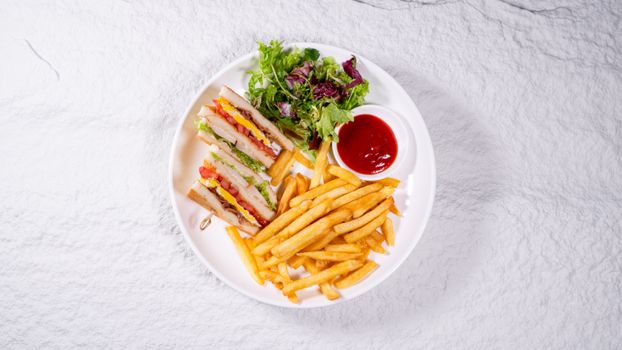
Turkey Club Sandwich
The diets react (see scores below)
Common Ingredients
- sliced turkey
- bacon
- white bread
- lettuce
- tomato
- mayonnaise
- Swiss cheese
Specific recipes may vary.
Incompatible with 7 of 11 diets
Diet Ratings
The Turkey Club Sandwich is fundamentally incompatible with a ketogenic diet due to white bread, which is the core structural component. Two to three slices of white bread (as is standard in a club sandwich) contribute approximately 30-45g of net carbs from refined grains alone, easily exceeding or maxing out the daily keto carb budget in a single meal. While several ingredients — bacon, mayonnaise, Swiss cheese, turkey, and lettuce — are keto-friendly, the white bread makes this dish a clear avoid in its standard form. Tomatoes add a small additional carb load (~2-3g net carbs), which is negligible but worth noting. The dish could theoretically be deconstructed (lettuce wrap or bread-free) to become keto-compatible, but as presented it is not.
The Turkey Club Sandwich contains multiple animal products that are categorically excluded from a vegan diet. Sliced turkey and bacon are both animal flesh (poultry and pork respectively), Swiss cheese is a dairy product, and mayonnaise is traditionally made with eggs. This dish is fundamentally built on animal-derived ingredients and is entirely incompatible with vegan dietary principles.
The Turkey Club Sandwich contains multiple hard paleo violations. White bread is a grain-based product and one of the clearest avoid items in paleo. Swiss cheese is dairy, which is excluded across nearly all paleo frameworks. Bacon, while made from pork, is a processed meat typically cured with added salt, nitrates, and sometimes sugar — disqualifying it under paleo's no-processed-foods and no-added-salt rules. Mayonnaise is almost universally made with soybean or canola oil, both seed oils explicitly excluded from paleo. Even setting aside the format (a sandwich structure built around bread is fundamentally incompatible), the dish has at least four distinct paleo violations. The lettuce and tomato are paleo-compliant, and turkey itself is approved, but the overall dish cannot be reconciled with paleo principles.
The Turkey Club Sandwich conflicts with Mediterranean diet principles on multiple fronts. Bacon is a processed red meat high in saturated fat and sodium, which the Mediterranean diet explicitly discourages. White bread is a refined grain offering little nutritional value compared to whole grain alternatives. Mayonnaise is a processed condiment based on industrial seed oils rather than extra virgin olive oil. Swiss cheese and turkey are individually acceptable in moderation, but together with bacon and white bread, the overall profile of this dish is far outside Mediterranean guidelines. The positive elements — lettuce and tomato — are minimal and do not redeem the dish.
The Turkey Club Sandwich is fundamentally incompatible with the carnivore diet. While it does contain animal-derived ingredients (turkey, bacon, mayonnaise, Swiss cheese), the dish is built around white bread — a grain-based plant food that is strictly excluded. Additionally, lettuce and tomato are plant foods that violate carnivore principles. The sandwich format itself is defined by its bread base, making this dish structurally non-carnivore. Even stripping out the plant ingredients would leave a carnivore-compatible protein stack, but as presented, this dish cannot be approved or even cautioned — it must be avoided.
The Turkey Club Sandwich contains multiple Whole30-excluded ingredients. White bread is a grain product and is explicitly excluded. Swiss cheese is dairy and is excluded. Bacon commonly contains added sugar and is excluded in its standard form. Additionally, the sandwich format itself (bread-based) falls squarely into the 'no recreating baked goods/junk food' category, which explicitly prohibits sandwiches, wraps, and similar constructions. Even if compliant versions of bacon and mayonnaise were used, the bread and cheese alone make this dish entirely incompatible with Whole30.
The primary FODMAP issue with this Turkey Club Sandwich is the white bread. Standard white wheat bread is high in fructans and is a clear 'avoid' during the elimination phase. A typical club sandwich uses 2-3 slices of bread, compounding the fructan load significantly. The remaining ingredients are largely low-FODMAP: sliced turkey (plain, unprocessed) is low-FODMAP, bacon is low-FODMAP, lettuce is low-FODMAP, tomato is low-FODMAP at standard servings (up to 1 medium tomato), and mayonnaise made without garlic/onion is generally low-FODMAP. Swiss cheese is low in lactose and considered low-FODMAP at a standard serving (around 2 slices/40g). However, the wheat bread alone disqualifies this dish during elimination phase regardless of the other safe ingredients.
The Turkey Club Sandwich contains several components that conflict with core DASH principles, though not all ingredients are problematic. Sliced turkey (especially deli-style) is typically high in sodium, bacon is explicitly limited on DASH due to high sodium and saturated fat content, white bread lacks the fiber of whole grains, mayonnaise adds saturated fat and sodium, and Swiss cheese contributes additional sodium and saturated fat. On the positive side, lettuce and tomato are DASH-friendly vegetables, and turkey as a lean protein is generally encouraged. The combination of bacon, deli turkey, mayonnaise, and cheese creates a high-sodium, moderate-to-high saturated fat profile that places this sandwich in caution territory. A DASH-modified version using low-sodium turkey, whole grain bread, avocado instead of mayo, and omitting bacon would score considerably higher.
The Turkey Club Sandwich has a mixed Zone profile. On the positive side, sliced turkey is a lean protein that fits well within Zone guidelines, and lettuce and tomato are favorable low-glycemic carbohydrate sources. However, the sandwich has several Zone-unfriendly components that require attention. White bread is a high-glycemic carbohydrate that Sears explicitly classifies as 'unfavorable' — it spikes insulin quickly and provides two slices in a club format, significantly overloading the carb block allotment. Bacon adds saturated fat rather than the preferred monounsaturated fat, and Swiss cheese adds additional saturated fat. Mayonnaise does contribute fat (often omega-6-heavy soybean oil), which is not the preferred monounsaturated source. The ratio as served is almost certainly skewed: too many high-glycemic carbs, excess saturated fat, and the protein-to-carb balance is off. A Zone practitioner could salvage this meal by eating only one slice of bread, removing or minimizing the bacon, skipping the cheese, and replacing mayo with a small amount of avocado — but as traditionally served, it requires significant modification to approach 40/30/30 balance.
The Turkey Club Sandwich presents a mixed anti-inflammatory profile. On the positive side, sliced turkey (lean poultry) is in the 'moderate' category and provides protein without significant saturated fat. Lettuce and tomato contribute modest antioxidants, including lycopene from tomato. However, the sandwich has several pro-inflammatory elements: white bread is a refined carbohydrate with high glycemic index, which promotes inflammatory markers like CRP and IL-6. Bacon is processed red meat — high in saturated fat, sodium, nitrates/nitrites, and is considered pro-inflammatory. Mayonnaise is typically made with soybean or canola oil, contributing omega-6 fatty acids; while debated, regular consumption of high-omega-6 condiments is not consistent with anti-inflammatory principles. Swiss cheese is full-fat dairy, which falls in the 'limit' category. The combination of refined bread, processed meat (bacon), and omega-6-heavy mayonnaise tips this dish into net pro-inflammatory territory, offset only partially by the lean turkey and vegetables. It scores a 4 — technically in the 'caution' range, but toward the lower end. Swapping white bread for whole grain, eliminating bacon, and replacing mayo with avocado or EVOO-based spread would significantly improve the profile.
The Turkey Club Sandwich has a meaningful protein contribution from sliced turkey and Swiss cheese, but several ingredients work against GLP-1 dietary priorities. Bacon adds saturated fat with limited protein payoff per calorie. Mayonnaise is calorie-dense with high fat and near-zero nutritional value — a significant issue when every calorie must count. White bread offers refined carbohydrates with minimal fiber and low nutrient density, worsening blood sugar stability and contributing empty calories. Swiss cheese adds some protein but also saturated fat. The lettuce and tomato are positive for hydration and micronutrients but contribute negligibly to fiber targets. The overall fat load from bacon plus mayo together may worsen GLP-1 side effects including nausea, bloating, and reflux. The sandwich can be salvaged with substitutions — whole grain bread, no bacon, light or no mayo, avocado in small amounts — but as standardly prepared it is a caution-tier food rather than an approve.
Some GLP-1-focused dietitians view turkey sandwiches as a practical, accessible protein vehicle and emphasize simple modifications (swap mayo for mustard, drop the bacon, upgrade the bread) rather than avoidance, arguing that real-world adherence matters more than theoretical optimization. Others take a stricter position, noting that the saturated fat and refined carbohydrate combination in the classic preparation makes it a poor choice given slowed gastric emptying and the premium on nutrient density.
*See how scores were generated at our methodology page.
Nutritional profile
Six traits that cut across every diet.
Fiber & Plants
How much whole-plant food and fiber it delivers.
Healthy Fats
The quality of its fats (unsaturated, omega-3).
Whole / Unprocessed
How close it is to its natural, unprocessed form.
Gut Gentle
How easy it is on digestion (low FODMAP, few irritants).
Low Glycemic
How little it spikes your blood sugar.
Protein Density
How much protein it packs per calorie.
Controversy Index
Higher controversy = more disagreement between diets.
Diet-Specific Tips
 DASH — 4/10
View tips
- Bacon is high in sodium and saturated fat, explicitly limited on DASH
- Deli sliced turkey is typically high in sodium (600-900mg per serving)
- White bread is a refined grain; DASH emphasizes whole grains
- Mayonnaise adds saturated fat and sodium
- Swiss cheese contributes additional sodium and saturated fat
- Lettuce and tomato are DASH-approved vegetables
- Turkey is a lean protein aligned with DASH when low-sodium
- Overall sodium content of this sandwich likely exceeds 1,000-1,500mg, a large portion of the daily DASH limit
 Zone — 4/10
View tips
- White bread is a high-glycemic 'unfavorable' carbohydrate per Sears' published Zone framework
- Turkey is a lean, Zone-favorable protein source
- Bacon contributes saturated fat, not the preferred monounsaturated fat
- Mayonnaise is typically soybean oil-based, an omega-6 source Sears discourages
- Swiss cheese adds additional saturated fat beyond Zone ideals
- Lettuce and tomato are favorable low-GI Zone carbohydrates
- As served, the macronutrient ratio skews too high in carbs and saturated fat to hit 40/30/30 without significant modification
 Anti-Inflammatory — 4/10
View tips
- White bread: refined carbohydrate with high glycemic load, promotes inflammatory markers
- Bacon: processed red meat with saturated fat, sodium, and nitrates — pro-inflammatory
- Mayonnaise: typically soybean oil-based, high in omega-6 fatty acids
- Swiss cheese: full-fat dairy in the 'limit' category
- Sliced turkey: lean poultry in the acceptable 'moderate' category
- Lettuce and tomato: modest antioxidant contribution, lycopene from tomato
- Overall omega-6 to omega-3 ratio is unfavorable
- No anti-inflammatory boosters present (no herbs, spices, olive oil, whole grains, or omega-3 sources)
 GLP-1 Friendly — 4/10
View tips
- Turkey provides lean protein but total protein per serving is moderate, not high
- Bacon adds saturated fat and calories with poor protein-to-fat ratio for GLP-1 patients
- Mayonnaise is high in fat and empty calories — counterproductive given reduced caloric intake
- White bread is a refined carbohydrate with negligible fiber, worsening nutrient density per calorie
- Swiss cheese contributes protein but also adds to the saturated fat load
- Combined fat content from bacon, mayo, and cheese may worsen nausea, bloating, or reflux
- Lettuce and tomato support hydration and add micronutrients but fiber contribution is minimal
- Highly modifiable dish — healthier versions exist, but standard preparation earns caution