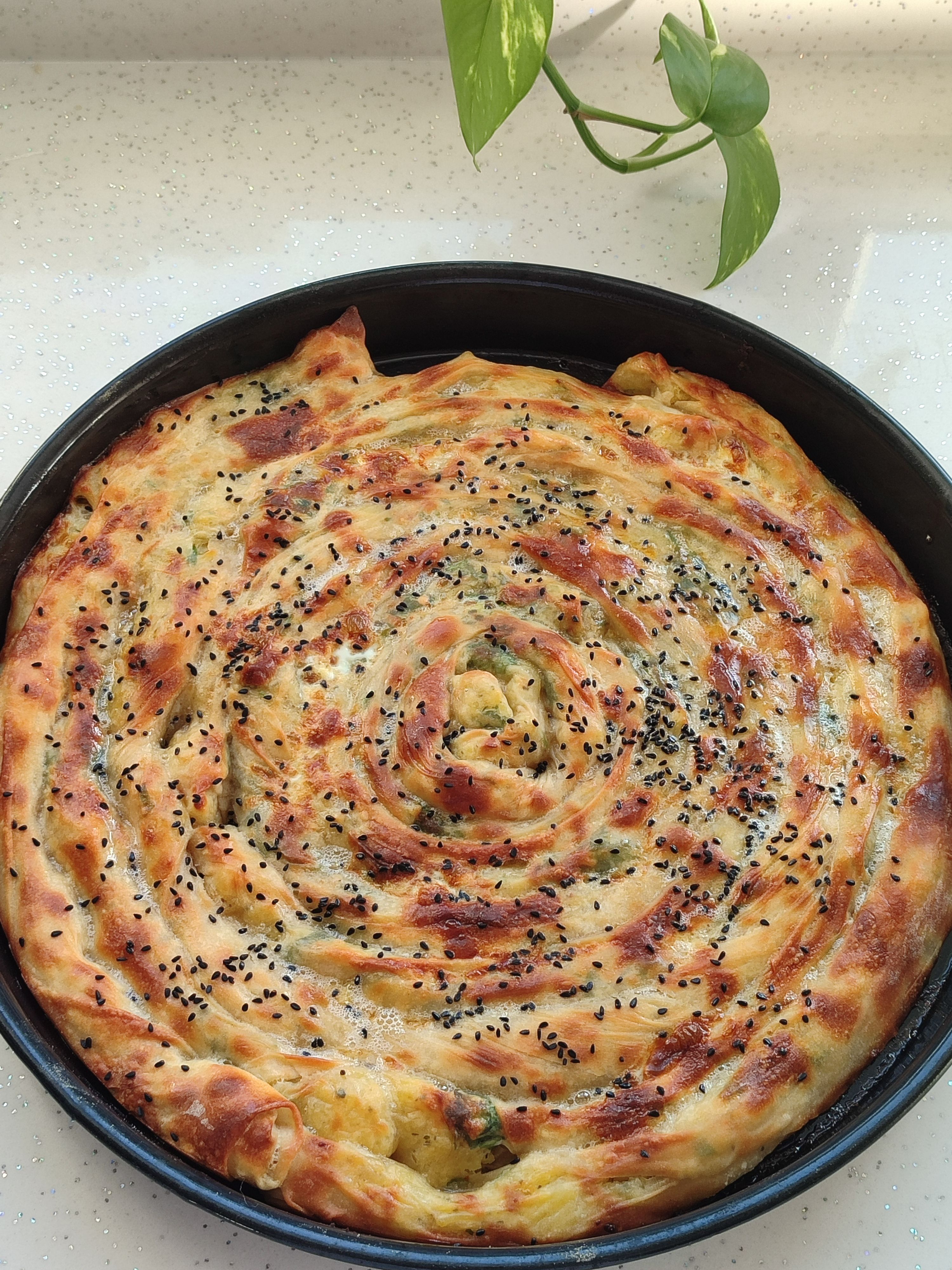
Middle-Eastern
Börek
The diets react (see scores below)
Common Ingredients
- phyllo dough
- feta
- spinach
- egg
- butter
- yogurt
- parsley
- nigella seeds
Specific recipes may vary.
Incompatible with 6 of 11 diets
Diet Ratings
Börek is built around phyllo dough, which is a refined wheat flour pastry with extremely high net carbs — typically 30–40g per serving. Phyllo dough alone disqualifies this dish from keto compatibility. While the filling ingredients (feta, spinach, egg, butter, parsley) are all keto-friendly, they are incidental to the carb-heavy pastry shell that defines the dish. Even small portions would likely push a person well over a typical meal's carb budget, and the dough cannot be removed without fundamentally changing the dish. The yogurt used in some börek preparations adds modest additional carbs. There is no meaningful way to consume traditional börek and maintain ketosis.
Börek as described contains multiple animal-derived ingredients that are explicitly excluded from a vegan diet. Feta is a dairy cheese, butter is an animal fat derived from milk, egg is an animal product, and yogurt is a dairy product. These four ingredients collectively make this dish fundamentally incompatible with vegan principles. Spinach, parsley, nigella seeds, and phyllo dough (in its basic form) are plant-based, but the animal-derived components are central to the dish's structure, flavor, and texture — not incidental additions. A vegan version of börek could theoretically be made by substituting plant-based butter, omitting egg, replacing feta with tofu-based cheese, and using plant-based yogurt, but the dish as described cannot be considered vegan.
Börek is fundamentally incompatible with the paleo diet. The dish is built on phyllo dough, a wheat-based grain product that is strictly excluded from paleo — grains are one of the clearest 'avoid' categories with unanimous consensus across all paleo authorities. Beyond the dough, feta cheese and yogurt are dairy products, also excluded. Butter is debated but secondary here. The only paleo-compliant ingredients are spinach, egg, parsley, and nigella seeds. With its two core structural components (phyllo dough and dairy) firmly outside paleo guidelines, this dish cannot be modified into a paleo meal without being entirely reconstructed into something unrecognizable as börek.
Börek is a traditional pastry found across Turkish, Greek, and broader Eastern Mediterranean cuisines, making it culturally adjacent to the Mediterranean diet. It contains several Mediterranean-friendly ingredients — spinach (a nutrient-rich vegetable), feta (a traditional dairy), egg, yogurt, parsley, and nigella seeds. However, phyllo dough is a refined grain product, and the use of butter as the primary fat departs from the Mediterranean principle of olive oil as the dominant fat. Feta and egg in moderate portions are acceptable, and spinach is strongly encouraged. The refined dough and butter content prevent a full approval, but the dish is not heavily processed or loaded with added sugars, and its vegetable-and-dairy profile keeps it in the moderate/caution range rather than avoid.
Traditional Turkish and Greek culinary practice has long included börek as a regular part of the diet, and some Mediterranean diet researchers acknowledge that phyllo-based pastries made with whole-food fillings represent an acceptable occasional indulgence within a broadly plant-forward eating pattern. Some cooks substitute olive oil for butter (as in many Greek spanakopita recipes), which would push the dish closer to approval under stricter olive-oil-first interpretations.
Börek is fundamentally incompatible with the carnivore diet. The dish is built on phyllo dough, a grain-based product that is entirely plant-derived and explicitly excluded. Spinach and parsley are plant foods, nigella seeds are plant-derived spices, and the yogurt adds a debated dairy element — but none of that matters when the foundational structure of the dish is a wheat-flour pastry shell. The feta, egg, and butter are the only carnivore-adjacent ingredients, but they are minor components within an overwhelmingly plant-based and grain-based dish. There is no meaningful way to adapt Börek to carnivore compliance without it ceasing to be Börek.
Börek contains multiple excluded ingredients that make it clearly non-compliant with Whole30. Phyllo dough is a grain-based product (wheat flour), which is explicitly excluded. Feta cheese and yogurt are dairy products, both explicitly excluded. Butter (not ghee or clarified butter) is also excluded dairy. Even setting aside the spirit-of-the-program concern about recreating a baked pastry-style snack (which would itself be excluded under Rule 4), the ingredient list alone contains at least four separately excluded categories.
Börek contains multiple high-FODMAP ingredients that make it unsuitable during the elimination phase. Phyllo dough is made from wheat flour, which is high in fructans — a major FODMAP trigger. Feta cheese, while lower in lactose than soft fresh cheeses, is present in significant quantities in börek and can contribute meaningful lactose at typical serving sizes. Yogurt is high in lactose and commonly used as a topping or wash. Together, these ingredients create a dish with stacked FODMAP loads that cannot be mitigated by portion reduction to any realistic serving size. Spinach, egg, butter, parsley, and nigella seeds are individually low-FODMAP and not concerns, but they cannot offset the wheat and dairy issues.
Börek contains several ingredients that align with DASH principles (spinach, egg, yogurt, parsley) but is significantly undermined by feta cheese and butter. Feta is high in sodium — a single ounce contains roughly 320–400mg — and a typical börek serving uses a substantial amount, easily pushing sodium content to 600–900mg or more per serving. Butter adds saturated fat, which DASH limits. Phyllo dough itself is relatively low in fat but does contribute refined carbohydrates with minimal fiber. The spinach filling is a genuine DASH positive (potassium, magnesium, fiber), and yogurt as a binder is acceptable under low-fat DASH guidelines. However, the combined sodium load from feta and the saturated fat from butter make this a 'caution' food rather than an 'approve.' Modifications — reducing feta, substituting low-sodium cheese or cottage cheese, using olive oil instead of butter, and using whole-wheat phyllo if available — would improve the score meaningfully.
NIH DASH guidelines explicitly limit high-sodium cheeses and saturated fat sources like butter, placing börek firmly in caution territory. However, some updated DASH-oriented clinicians note that when portioned carefully and prepared with olive oil and reduced feta, börek's spinach base and yogurt component contribute meaningfully to the diet's micronutrient goals, and a single moderate serving need not disqualify an otherwise DASH-compliant day.
Börek presents a mixed Zone profile. On the positive side, it contains spinach (a favorable low-glycemic vegetable with polyphenols), feta (a moderate protein source with some saturated fat but manageable in small portions), egg (a lean protein contributor), yogurt (low-glycemic protein and fat), and parsley and nigella seeds (anti-inflammatory polyphenol sources Sears would appreciate). However, the primary structural ingredient — phyllo dough — is a refined grain, high-glycemic carbohydrate that the Zone classifies as 'unfavorable.' It drives the carb load quickly into high-GI territory. Butter adds saturated fat, which the Zone limits in favor of monounsaturated fats. The dish as traditionally prepared is carb-heavy relative to protein, making the 40/30/30 ratio difficult to hit without significant portion reduction. A small portion (1-2 triangles) could fit as a snack block with careful accounting, but the macro balance skews toward unfavorable carbs and saturated fat. The spinach, egg, and feta filling components are favorable; the delivery vehicle (buttered phyllo) is the Zone liability.
Some Zone practitioners in the Mediterranean context note that phyllo dough, while refined, is used in very thin layers, so the actual glycemic load per serving can be lower than expected. Feta and yogurt contribute protein and fat that partially blunt the glycemic response. Sears' later anti-inflammatory writings also softened the strict stance on saturated fat, and the polyphenol content from spinach, parsley, and nigella seeds aligns with his OmegaRx Zone philosophy, potentially upgrading this dish's standing in later Zone iterations.
Börek presents a mixed anti-inflammatory profile. On the positive side, spinach is a nutrient-dense leafy green rich in antioxidants (lutein, zeaxanthin, vitamin K) and anti-inflammatory compounds. Parsley contributes flavonoids and vitamin C. Nigella seeds (Nigella sativa) have well-documented anti-inflammatory properties via thymoquinone, a notable plus. Eggs provide choline and selenium with a broadly neutral-to-modest anti-inflammatory profile. Yogurt, as a fermented dairy product, may support gut health and reduce inflammatory markers in some research. On the negative side, butter is a saturated fat that the anti-inflammatory framework recommends limiting — ideally replaced by olive oil. Feta is a full-fat dairy cheese, placing it in the 'limit' category. Phyllo dough is a refined carbohydrate with little fiber or nutritional benefit, contributing to the glycemic load of the dish. However, phyllo is notably lower in fat than puff pastry or shortcrust, which partially mitigates the concern. Overall, the dish is not strongly pro-inflammatory — the beneficial ingredients (spinach, nigella seeds, parsley) provide real anti-inflammatory value — but butter and refined dough hold it back from approval. Occasional consumption is reasonable; regular intake warrants substitutions (e.g., olive oil brushing instead of butter).
Some anti-inflammatory practitioners, particularly those following stricter protocols like AIP or low-glycemic frameworks, would rate this more negatively due to refined flour in the phyllo and full-fat dairy (butter, feta), arguing these ingredients consistently elevate inflammatory markers. Conversely, Mediterranean diet researchers (Dr. Weil's framework broadly aligns with Mediterranean principles) would note that traditional börek in context of an overall Mediterranean dietary pattern poses minimal inflammatory concern, and that fermented dairy like feta may be less problematic than other full-fat cheeses.
Börek is a layered pastry made with phyllo dough and butter, filled with feta cheese, spinach, and egg. While it does offer some protein from feta and egg, and some fiber and micronutrients from spinach, the overall profile is not well-suited for GLP-1 patients as a regular snack. The phyllo dough is a refined grain with low fiber and minimal nutritional value per calorie. The butter used to layer the pastry adds significant saturated fat, which can worsen GLP-1 side effects such as nausea, bloating, and reflux due to slowed gastric emptying. Feta is moderately high in fat and sodium. The dish is also calorically dense relative to its protein yield — a typical serving provides perhaps 8-12g of protein alongside a substantial fat and refined carb load. The spinach filling is a genuine positive, contributing fiber, iron, and micronutrients. Yogurt as a topping or dip improves the protein profile marginally. For GLP-1 patients, the high fat and refined carbohydrate content make this a poor nutrient-density-per-calorie choice, and the buttery, pastry-heavy format risks triggering nausea or GI discomfort. Acceptable occasionally in a small portion, but not a recommended regular snack.
Some GLP-1-focused dietitians note that spinach-and-egg filled böreks provide meaningful micronutrients and modest protein, and argue that a small portion is preferable to ultra-processed snack alternatives. However, others flag the saturated fat from butter and the low protein-to-calorie ratio as meaningful concerns for patients already at risk of muscle loss and GI side effects.
*See how scores were generated at our methodology page.
Nutritional profile
Six traits that cut across every diet.
Fiber & Plants
How much whole-plant food and fiber it delivers.
Healthy Fats
The quality of its fats (unsaturated, omega-3).
Whole / Unprocessed
How close it is to its natural, unprocessed form.
Gut Gentle
How easy it is on digestion (low FODMAP, few irritants).
Low Glycemic
How little it spikes your blood sugar.
Protein Density
How much protein it packs per calorie.
Controversy Index
Higher controversy = more disagreement between diets.
Diet-Specific Tips
 Mediterranean — 5/10
View tips
- Phyllo dough is a refined grain — not a whole grain, limiting approval
- Butter is the traditional fat rather than extra virgin olive oil, contradicting a core Mediterranean principle
- Spinach filling is strongly Mediterranean-friendly
- Feta cheese and egg are acceptable moderate dairy/protein sources
- Yogurt and fresh herbs (parsley, nigella seeds) add nutritional value
- Dish is minimally processed with whole-food ingredients overall
- Culturally embedded in Eastern Mediterranean traditions
 DASH — 4/10
View tips
- Feta cheese is high in sodium (~320–400mg/oz), significantly raising dish sodium load
- Butter adds saturated fat, which DASH limits
- Spinach is a strong DASH food — rich in potassium, magnesium, and fiber
- Egg and yogurt are acceptable DASH protein/dairy sources
- Phyllo dough is low-fat but refined; whole-grain alternatives would improve score
- Portion size is critical — one piece may be acceptable, multiple pieces problematic
- Substituting olive oil for butter and reducing or replacing feta would improve DASH compatibility
 Zone — 4/10
View tips
- Phyllo dough is a refined, high-glycemic carbohydrate — classified as 'unfavorable' in Zone terminology
- Butter contributes saturated fat, not the preferred monounsaturated fat of the Zone
- Spinach is a highly favorable Zone vegetable with polyphenols and low glycemic impact
- Feta and egg provide moderate protein, though feta is higher in saturated fat
- Nigella seeds and parsley align with Sears' anti-inflammatory polyphenol emphasis
- Traditional portion sizes skew carb-heavy, making 40/30/30 ratio difficult to achieve
- Small controlled portions could fit as a partial snack block but not an ideal Zone snack
 Anti-Inflammatory — 5/10
View tips
- Spinach: anti-inflammatory leafy green, rich in antioxidants and vitamin K
- Nigella seeds: contains thymoquinone, a well-researched anti-inflammatory compound
- Parsley: source of flavonoids and vitamin C
- Butter: saturated fat, falls in the 'limit' category of anti-inflammatory guidelines
- Phyllo dough: refined carbohydrate, low fiber, moderate glycemic load
- Feta: full-fat dairy, moderate saturated fat content
- Yogurt: fermented dairy with potential gut-health and anti-inflammatory benefits
- Eggs: broadly neutral, modest anti-inflammatory contribution
 GLP-1 Friendly — 4/10
View tips
- Refined phyllo dough is low in fiber and nutrient-poor per calorie
- Butter layering adds significant saturated fat, risking nausea and reflux on GLP-1s
- Moderate protein from feta and egg, but low relative to caloric density
- Spinach filling contributes fiber, iron, and micronutrients — a genuine positive
- High fat content may worsen GI side effects due to slowed gastric emptying
- Calorically dense format conflicts with small-portion, nutrient-dense eating goals
- Acceptable in a very small portion occasionally, not recommended as a routine snack