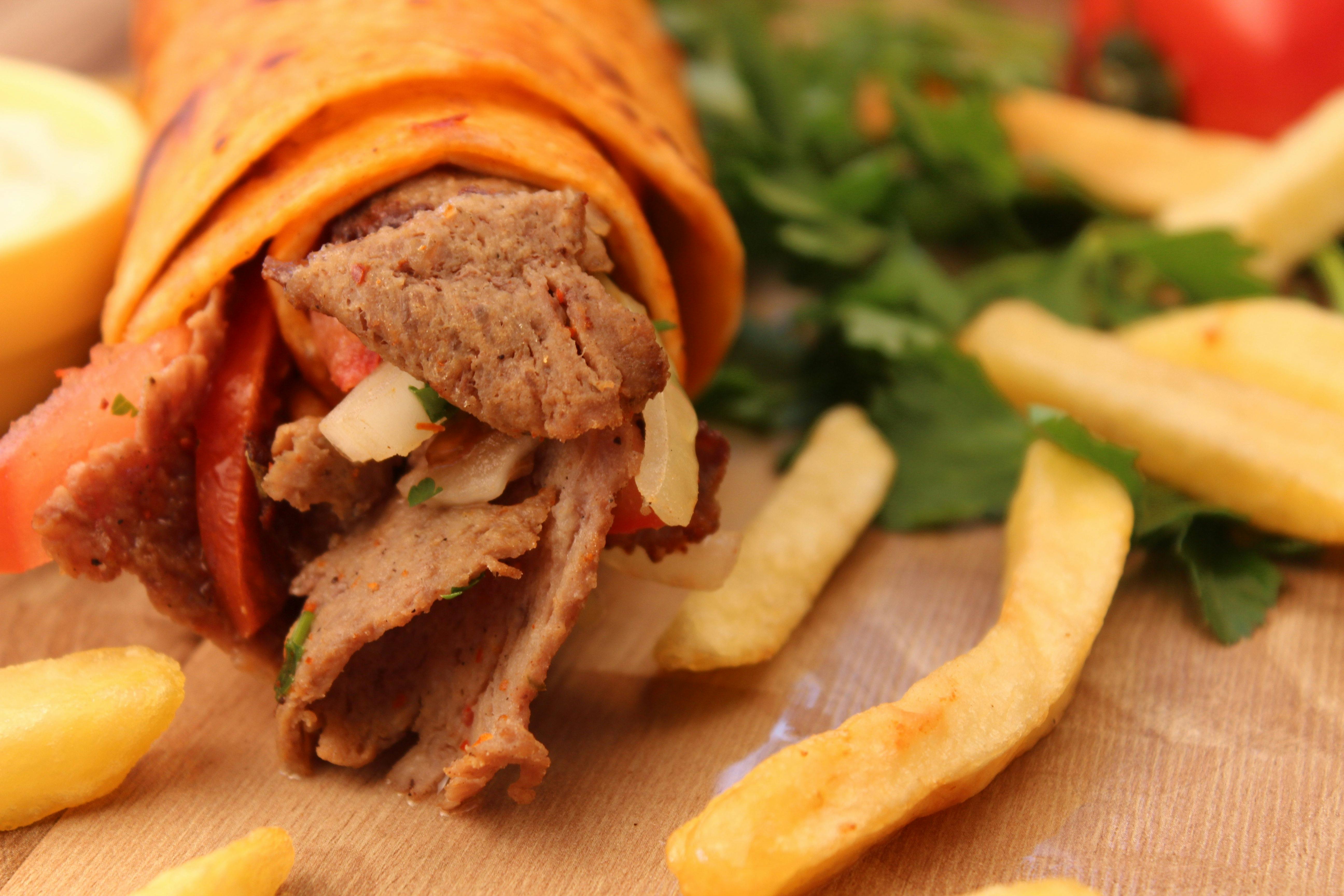
Photo: Peyman Hamsayeh / Pexels
Middle-Eastern
Döner Kebab
The diets react (see scores below)
Common Ingredients
- lamb
- yogurt
- garlic
- cumin
- paprika
- flatbread
- tomatoes
- onion
Specific recipes may vary.
Incompatible with 7 of 11 diets
Diet Ratings
Döner Kebab in its standard form is incompatible with a ketogenic diet primarily due to the flatbread, which is a grain-based, high-carb wrapper typically contributing 30-50g of net carbs on its own — enough to exceed the entire daily keto carb allowance in a single serving. The meat filling (lamb or chicken with yogurt, garlic, cumin, paprika) is actually keto-friendly on its own, providing quality protein and fat. Tomatoes and onions add minor carbs but are not the disqualifying factor. The dish as a whole, served in the traditional sandwich format, is simply not keto-compatible without significant modification (e.g., serving the meat in a lettuce wrap or bowl). Evaluating the most common form as a sandwich, this must be rated 'avoid'.
Döner Kebab contains multiple animal products that are strictly excluded from a vegan diet. The primary protein is lamb, a red meat, and the marinade includes yogurt, a dairy product. Both are direct animal-derived ingredients with no ambiguity in vegan classification. While the supporting ingredients — garlic, cumin, paprika, flatbread, tomatoes, and onion — are plant-based, the core components of the dish are fundamentally non-vegan. Vegan versions of döner kebab do exist using seitan, jackfruit, or other plant proteins with dairy-free marinades, but the traditional dish as described cannot be considered vegan-compatible.
Döner Kebab contains two major non-paleo ingredients that make it incompatible with a Paleolithic diet. The flatbread is a grain-based product (typically wheat), which is strictly excluded from paleo — grains are one of the most clearly defined exclusions across all paleo frameworks. Yogurt is a dairy product, also universally excluded from strict paleo. While the core protein (lamb) is excellent paleo food, and the supporting ingredients (garlic, cumin, paprika, tomatoes, onion) are all paleo-approved, the dish as traditionally constructed cannot be considered paleo-compatible. A paleo adaptation would require removing both the flatbread and yogurt marinade, essentially deconstructing it into a spiced lamb plate rather than a döner kebab.
Döner Kebab as traditionally prepared presents several concerns from a Mediterranean diet perspective. Lamb is a red meat, which the Mediterranean diet limits to a few times per month. The flatbread is typically a refined grain product, which conflicts with the diet's emphasis on whole grains. The combination of red meat plus refined bread in a single meal makes this a poor fit. Some positive elements exist — yogurt is an acceptable dairy, garlic, tomatoes, and onion are encouraged vegetables, and the spices are fine — but the core protein and bread components work against Mediterranean principles.
Some Mediterranean diet interpreters note that lamb holds cultural culinary significance across Greek, Turkish, and Levantine traditions that genuinely overlap with Mediterranean eating patterns, and that occasional consumption is not strictly prohibited. If prepared with chicken instead of lamb, served in a whole-grain wrap, and eaten infrequently, a more lenient reading could push this into 'caution' territory.
Döner Kebab as traditionally prepared is fundamentally incompatible with the carnivore diet. While lamb is an excellent ruminant meat fully approved on carnivore, the dish is built around multiple plant-based and processed components that disqualify it entirely. The flatbread is a grain-based food — a clear violation. Tomatoes and onion are plant vegetables. Garlic, cumin, and paprika are plant-derived spices excluded on strict carnivore. Yogurt is a dairy product that introduces its own debate, but it is the least of the concerns here. The dish as a whole is a sandwich — a carbohydrate-heavy, plant-laden meal where the meat is secondary to the bread and vegetable components. There is no version of a traditional döner kebab that qualifies as carnivore-compliant without stripping away nearly every defining characteristic of the dish.
Döner Kebab as described contains two excluded ingredients: yogurt (dairy) and flatbread (grain-based bread). Yogurt is explicitly excluded under the Whole30 dairy rule, and flatbread is a grain-based wrap/bread product that falls squarely under the excluded grains category (wheat) as well as the 'no recreating baked goods/bread' rule. Even if the lamb, garlic, cumin, paprika, tomatoes, and onion are all fully compliant, the combination of dairy marinade and grain-based bread makes this dish non-compliant in its traditional form.
Döner Kebab as traditionally prepared contains multiple high-FODMAP ingredients that make it unsuitable during the elimination phase. Garlic is one of the highest-FODMAP foods known, rich in fructans — even small amounts are problematic. Onion is similarly high in fructans and is a major FODMAP offender. The flatbread (typically wheat-based pita or lavash) is high in fructans due to its wheat content. Yogurt contributes lactose, which is a disaccharide FODMAP. Together, these four ingredients (garlic, onion, flatbread, yogurt) create a dish that is decisively high-FODMAP at any standard serving size. The lamb, cumin, paprika, and tomatoes are individually low-FODMAP, but they cannot offset the significant FODMAP load from the other components. Even if modifications were made (e.g., garlic-infused oil instead of garlic, no onion, lactose-free yogurt), the wheat flatbread alone would still make this a high-FODMAP dish unless replaced with a certified gluten-free or sourdough alternative.
Döner kebab sits in a gray zone for the DASH diet. On the positive side, it contains DASH-friendly ingredients: tomatoes and onions (vegetables), yogurt (low-fat dairy if used as a marinade), garlic and spices (sodium-free flavor enhancers), and flatbread (a grain serving). However, several concerns arise. Lamb is a red meat with notable saturated fat content — DASH explicitly limits red meat, recommending lean poultry or fish instead. A chicken version would rate higher. Street-style döner kebab is also typically high in sodium from seasoning blends and sauces, and the flatbread (especially if white/refined) adds refined carbohydrates. Portion sizes in commercial preparations tend to be large. The dish is not inherently disqualifying, but as commonly consumed (lamb-based, generously seasoned, large portions), it requires meaningful modification to fit DASH principles. A chicken döner on a whole-grain wrap with no added sauces, controlled sodium, and extra vegetables would score 6-7.
NIH DASH guidelines categorically limit red meat due to saturated fat and sodium load, placing lamb-based dishes in the caution-to-avoid range. However, some updated clinical interpretations note that lean cuts of lamb in controlled portions, combined with DASH-positive vegetables and yogurt marinade, can fit within weekly red meat allowances — particularly when no high-sodium sauces are added.
Döner Kebab is a mixed picture for the Zone Diet. The protein component — lamb or chicken — provides adequate protein, though lamb carries more saturated fat than ideal Zone sources like skinless chicken or fish. Favorable ingredients include tomatoes, onion, garlic, and yogurt, which are low-glycemic and anti-inflammatory. The spices (cumin, paprika) are polyphenol-rich and Zone-friendly. The main problem is the flatbread, which is a high-glycemic refined carbohydrate that the Zone classifies as 'unfavorable.' A typical döner serving also skews heavily toward carbs from the bread, disrupting the 40/30/30 ratio. With modifications — using chicken instead of lamb, reducing flatbread portion, adding more vegetables — it can be brought closer to Zone balance. As served traditionally, it requires careful portioning and ideally partial bread removal to avoid a carb-heavy ratio imbalance.
Some Zone practitioners argue that lamb, while higher in saturated fat than chicken, contains conjugated linoleic acid (CLA) and is acceptable in moderate portions. Dr. Sears' later writings in 'Toxic Fat' and his anti-inflammatory work soften the strict stance on all saturated fat, focusing more on the omega-6 to omega-3 ratio. If chicken is substituted and flatbread is minimized or replaced with a lettuce wrap, some practitioners would rate this meal as a moderate approve rather than caution.
Döner kebab presents a mixed anti-inflammatory profile. On the positive side, garlic, cumin, and paprika are anti-inflammatory spices with polyphenol and antioxidant activity. Tomatoes and onions contribute beneficial antioxidants (lycopene, quercetin). Yogurt provides probiotics, which support gut health and may reduce systemic inflammation. The lean protein option (chicken) would rate more favorably than lamb. However, lamb is a red meat, which the anti-inflammatory framework recommends limiting due to saturated fat and arachidonic acid content, both of which can promote inflammatory pathways. The flatbread is a refined carbohydrate, another category to limit under anti-inflammatory guidelines. The commercial preparation of döner also often involves fatty cuts of lamb or a lamb-beef mix with higher saturated fat content than a home-prepared version. Overall, the dish is not inherently pro-inflammatory but the red meat base and refined flatbread temper its potential benefits, placing it solidly in the 'acceptable in moderation' category.
Some anti-inflammatory practitioners (including followers of a Mediterranean-adjacent approach as in Dr. Weil's pyramid) would view this dish more favorably when made with chicken, citing the spice blend, tomatoes, and yogurt as meaningfully anti-inflammatory; the lamb version, however, would be flagged more strongly by stricter protocols that treat all red meat as pro-inflammatory due to saturated fat and heme iron content.
Döner kebab with lamb is a mixed profile for GLP-1 patients. The dish provides meaningful protein from lamb and yogurt marinade, with some fiber and micronutrients from tomatoes and onion. However, lamb is a fatty red meat — traditional döner is often made from heavily seasoned, higher-fat cuts cooked on a rotating spit, meaning the fat content per serving can be significant and variable. High fat content worsens GLP-1 side effects including nausea, bloating, and reflux. The flatbread adds refined carbohydrates with limited fiber. Cumin and paprika are generally well-tolerated, and garlic in moderate amounts is fine. A chicken döner version would score meaningfully higher (6-7) due to leaner protein. Portion size is also a concern — a standard restaurant döner wrap is large and calorie-dense, poorly suited to the small-portion eating pattern GLP-1 patients require. If prepared at home with chicken, whole wheat flatbread, and portions controlled, this dish becomes more acceptable.
Some GLP-1-focused dietitians would rate lamb döner more favorably, noting that lamb provides complete protein, iron, and zinc — nutrients at risk during calorie-restricted weight loss — and that the yogurt marinade adds a small probiotic benefit. Others flag that the high saturated fat content in lamb and the unpredictable fat load in restaurant preparation make it a consistent GI risk for patients in early GLP-1 dose escalation phases.
*See how scores were generated at our methodology page.
Nutritional profile
Six traits that cut across every diet.
Fiber & Plants
How much whole-plant food and fiber it delivers.
Healthy Fats
The quality of its fats (unsaturated, omega-3).
Whole / Unprocessed
How close it is to its natural, unprocessed form.
Gut Gentle
How easy it is on digestion (low FODMAP, few irritants).
Low Glycemic
How little it spikes your blood sugar.
Protein Density
How much protein it packs per calorie.
Controversy Index
Higher controversy = more disagreement between diets.
Diet-Specific Tips
 DASH — 4/10
View tips
- Lamb is a red meat high in saturated fat, which DASH limits
- Chicken substitution would significantly improve the DASH score
- Tomatoes and onions contribute beneficial potassium and fiber
- Yogurt marinade is a DASH-compatible dairy component
- Commercial döner preparations are typically high in sodium
- Refined flatbread adds minimal nutritional value vs. whole-grain alternatives
- Large portion sizes common in restaurant/street servings challenge DASH portion control
 Zone — 5/10
View tips
- Flatbread is a high-glycemic 'unfavorable' carbohydrate that disrupts the Zone's 40/30/30 ratio
- Lamb is higher in saturated fat than ideal Zone protein sources; chicken version is significantly more Zone-compatible
- Tomatoes, onion, garlic, and yogurt are favorable low-glycemic Zone ingredients
- Spices provide polyphenols consistent with Sears' anti-inflammatory focus
- Portion control of bread is essential; reducing or eliminating flatbread dramatically improves Zone compatibility
- Traditional serving size tends to be protein-heavy and carb-heavy simultaneously, making block balancing difficult
 Anti-Inflammatory — 5/10
View tips
- Lamb is red meat — limited in anti-inflammatory protocols due to saturated fat and arachidonic acid
- Garlic, cumin, and paprika are anti-inflammatory spices
- Tomatoes and onion contribute lycopene and quercetin (antioxidants)
- Yogurt provides probiotics beneficial for gut-mediated inflammation
- Flatbread is a refined carbohydrate — recommended to limit
- Chicken substitution would improve the overall anti-inflammatory profile
- Commercial versions often use fattier lamb cuts, increasing saturated fat load
 GLP-1 Friendly — 5/10
View tips
- Lamb is a high-saturated-fat protein — increases GI side effect risk on GLP-1s
- Protein content is moderate to good but fat-to-protein ratio is unfavorable compared to leaner options
- Flatbread is typically refined grain with low fiber contribution
- Tomatoes and onion add modest fiber and micronutrients
- Spices (cumin, paprika, garlic) are generally well-tolerated in typical amounts
- Restaurant portions are large — poor fit for small-portion GLP-1 eating pattern
- Chicken substitution significantly improves the rating
- Yogurt marinade adds minimal but positive nutritional contribution