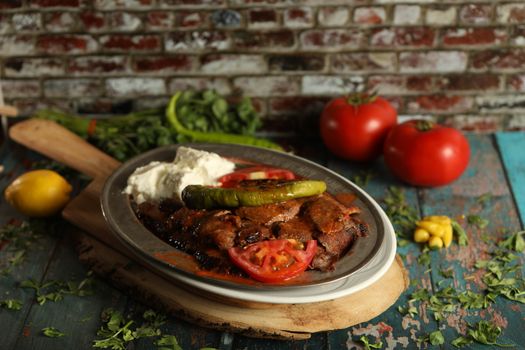
Photo: Oben Kural / Pexels
Middle-Eastern
İskender Kebab
The diets react (see scores below)
Common Ingredients
- lamb
- pita bread
- tomato sauce
- yogurt
- butter
- onion
- sumac
- parsley
Specific recipes may vary.
Incompatible with 9 of 11 diets
Diet Ratings
İskender Kebab is fundamentally incompatible with a ketogenic diet due to its core structural component: pita bread. Pita is a grain-based bread delivering roughly 30-40g of net carbs per serving, which alone can exceed or max out the entire daily keto carb allowance. Beyond the bread, the tomato sauce typically contains added sugars and contributes additional net carbs. While the lamb, butter, yogurt, and most garnishes (onion in small amounts, parsley, sumac) are keto-friendly or acceptable in moderation, the dish cannot be consumed in its traditional form without breaking ketosis. The lamb itself is an excellent keto protein with good fat content, and the butter is a keto staple, but these positives are negated by the dominant carbohydrate sources. A heavily modified version removing pita and reducing tomato sauce could theoretically be keto-adapted, but that would no longer constitute İskender Kebab.
İskender Kebab contains multiple animal products that are fundamentally incompatible with a vegan diet. The dish is built around lamb (slaughtered animal flesh), topped with yogurt (dairy) and butter (dairy), making it triply non-vegan. There is no ambiguity here — this dish cannot be considered vegan in any form without completely reconstructing it.
İskender Kebab contains multiple core non-paleo ingredients that disqualify it outright. Pita bread is a wheat-based grain product — one of the clearest 'avoid' categories in paleo. Yogurt is dairy, excluded under standard paleo rules. Butter is also dairy, though ghee (clarified butter) is more debated; regular butter retains milk solids and is generally excluded. The lamb, onion, parsley, and sumac are all paleo-approved, but the foundational components of this dish — pita and yogurt — are definitively off-plan. The dish cannot be meaningfully adapted without losing its identity.
İskender Kebab presents multiple concerns from a Mediterranean diet perspective. The primary protein is lamb (red meat), which should be limited to only a few times per month. The dish is served over pita bread (refined grain), topped with melted butter as a key finishing element — butter directly contradicts the Mediterranean principle of olive oil as the primary fat source. While several ingredients are Mediterranean-friendly (tomato sauce, yogurt, onion, sumac, parsley), the combination of red meat + refined bread + butter makes this a poor fit for regular consumption. As an occasional indulgence it may be tolerated, but as a main dish it scores low.
Some traditional Eastern Mediterranean and Levantine culinary traditions do incorporate lamb and butter-enriched dishes as part of celebratory or weekly eating, and yogurt-based accompaniments align with Mediterranean dairy moderation. A strictly traditional Mediterranean diet researcher might rate this slightly higher as an occasional red-meat allowance paired with probiotic-rich yogurt and fresh herbs.
İskender Kebab is fundamentally incompatible with the carnivore diet despite containing carnivore-approved lamb and butter. The dish is built around multiple strictly excluded plant-based components: pita bread (grain-based), tomato sauce (plant-derived, often with added sugar), onion, sumac (a plant spice), and parsley. While the lamb itself is an ideal carnivore protein and butter is at minimum a caution-tier dairy fat, the overall dish as prepared cannot be adapted without stripping it down to essentially just the meat and butter — at which point it is no longer İskender Kebab. The yogurt adds a debated dairy element, but the grain and plant components are the primary disqualifiers. This dish receives a score of 2 rather than 1 solely because the lamb and butter components are carnivore-compatible in isolation.
İskender Kebab contains multiple Whole30-excluded ingredients. Pita bread is a grain-based product (wheat) and is explicitly excluded. Yogurt is a dairy product and is excluded. Butter (regular, not ghee or clarified butter) is also excluded dairy. The lamb, tomato sauce, onion, sumac, and parsley are all compliant, but the combination of pita bread, yogurt, and butter makes this dish clearly off-limits for Whole30 without significant modification.
İskender Kebab contains multiple high-FODMAP ingredients that make it unsuitable during the elimination phase. Pita bread is made from wheat flour, which is high in fructans — a major FODMAP — at any standard serving size. Onion is one of the highest-FODMAP foods tested by Monash University, rich in fructans, and is a core component of this dish. Yogurt is high in lactose (a disaccharide), and the butter adds minimal FODMAP concern but the yogurt topping is a substantial lactose source. The tomato sauce may also contain onion or garlic as a base. Lamb itself is low-FODMAP, parsley is low-FODMAP, and sumac is low-FODMAP, but the structural components of this dish — pita, onion, and yogurt — are all independently high-FODMAP at standard servings. There is no realistic way to order or consume İskender Kebab in its traditional form during the FODMAP elimination phase.
İskender Kebab presents multiple DASH diet concerns. Lamb is a red meat with relatively high saturated fat content — DASH guidelines explicitly limit red meat consumption. The dish is finished with melted butter, adding significant saturated fat. Pita bread, especially white pita, is a refined grain rather than a whole grain. Traditional tomato sauce and restaurant preparation typically carry high sodium. The yogurt component is a positive element (calcium, probiotics), and onion, parsley, and sumac contribute beneficial phytonutrients with negligible sodium, but these positives are insufficient to offset the red meat + butter combination. Taken together, this dish conflicts with DASH's core directives to limit saturated fat and red meat, and its sodium load in typical restaurant preparation likely exceeds DASH thresholds for a single meal.
NIH DASH guidelines explicitly limit red meat and saturated fat; however, some updated clinical interpretations note that lamb in small portions (3 oz lean cuts) can fit within DASH's lean protein allowance, and if butter is minimized and whole-wheat pita substituted, a modified version of this dish could reach 'caution' territory — though the traditional preparation as served does not meet this standard.
İskender Kebab presents several Zone Diet challenges that place it firmly in 'caution' territory. The dish combines lamb (a higher-fat red meat with notable saturated fat content), pita bread (a refined, higher-glycemic carbohydrate), and butter (saturated fat) — all of which are 'unfavorable' Zone choices. The tomato sauce, yogurt, onion, sumac, and parsley are genuinely Zone-friendly components, providing low-glycemic carbs, polyphenols, and some lean protein from yogurt. However, the protein source (lamb) is not ideal — Zone favors lean proteins, and lamb tends toward higher saturated fat. The pita bread disrupts the low-glycemic carbohydrate principle. The butter adds saturated fat on top of what the lamb already contributes. That said, the dish is not impossible to fit into Zone thinking: portion control (smaller lamb serving, minimal pita, emphasizing the yogurt and vegetable components) could bring the ratios closer to 40/30/30, though it would require significant modification from the traditional preparation. As served in a restaurant, the lamb-to-pita-to-butter ratio is likely to be Zone-unfriendly, with excess saturated fat and high-glycemic carbs dominating.
Some Zone practitioners following Sears' later anti-inflammatory writings (notably 'The Mediterranean Zone') might be more permissive with lamb in moderate portions, noting that grass-fed lamb contains some beneficial omega-3s and conjugated linoleic acid. The yogurt component is a genuine Zone positive, and if pita is consumed minimally (½ pita as the carb block) with a lean lamb portion and the butter reduced, the dish could approach Zone balance. The sumac and parsley also contribute polyphenols consistent with Sears' later emphasis on anti-inflammatory eating.
İskender Kebab presents a mixed anti-inflammatory profile. On the positive side, lamb provides complete protein and contains some conjugated linoleic acid (CLA) and zinc; tomato sauce offers lycopene and antioxidants; yogurt contributes probiotics and is a moderate-category dairy; onion provides quercetin (a notable anti-inflammatory flavonoid); sumac is rich in polyphenols and has demonstrated anti-inflammatory properties in research; and parsley contributes apigenin and vitamin C. However, several components work against an anti-inflammatory rating: lamb is red meat and should be limited in an anti-inflammatory framework due to saturated fat and arachidonic acid content; butter is a saturated fat explicitly in the 'limit' category; and pita bread is a refined carbohydrate with a high glycemic load, contributing to inflammatory spikes. The dish's signature butter drizzle—often generous in traditional preparation—is a particular concern. The combination of red meat + refined carbs + butter creates a pro-inflammatory triad that the beneficial spices and yogurt cannot fully offset. Occasional consumption is acceptable, but this dish is not aligned with anti-inflammatory eating as a regular meal.
Some anti-inflammatory practitioners, particularly those following Mediterranean-adjacent frameworks, would note that grass-fed lamb in moderate portions alongside probiotic-rich yogurt and polyphenol-dense sumac and onion is acceptable periodically—Dr. Weil's pyramid allows moderate red meat consumption and does not categorically ban it. However, stricter anti-inflammatory protocols (and those targeting autoimmune or cardiovascular conditions) would flag the butter and refined pita as concerns that lower the dish's overall suitability.
İskender Kebab is a poor fit for GLP-1 patients in its traditional form. The dish is built around sliced fatty lamb (typically from a döner-style preparation with significant saturated fat), pita bread (refined carbohydrates, minimal fiber), and — critically — a generous pour of hot browned butter directly over the dish before serving. That butter component alone adds a concentrated load of saturated fat that is very likely to worsen nausea, bloating, and reflux in GLP-1 patients, whose slowed gastric emptying means high-fat meals sit in the stomach far longer than usual. The tomato sauce and yogurt are genuinely positive elements — yogurt contributes protein and the sauce adds some micronutrient value — but they are insufficient to offset the fat burden of the lamb-plus-butter combination. The pita bread base adds refined carbohydrate calories with low nutrient density per bite. Portion sizes are also traditionally large and not small-serving-friendly. The protein content is real but comes packaged with too much saturated fat and too little fiber to earn an approve or even a mid-range caution rating.
Some GLP-1-focused dietitians might argue this deserves a low caution (4) rather than an avoid if the butter is reduced or omitted and leaner lamb cuts are used — noting that the yogurt and tomato components do contribute protein and some micronutrients. However, the realistic served version of İskender Kebab, as typically prepared in restaurants, includes the full butter pour as a defining feature of the dish, and most obesity medicine RDs would counsel patients to avoid it or substantially reconstruct it before it becomes appropriate.
*See how scores were generated at our methodology page.
Nutritional profile
Six traits that cut across every diet.
Fiber & Plants
How much whole-plant food and fiber it delivers.
Healthy Fats
The quality of its fats (unsaturated, omega-3).
Whole / Unprocessed
How close it is to its natural, unprocessed form.
Gut Gentle
How easy it is on digestion (low FODMAP, few irritants).
Low Glycemic
How little it spikes your blood sugar.
Protein Density
How much protein it packs per calorie.
Controversy Index
Higher controversy = more disagreement between diets.
Diet-Specific Tips
 Zone — 4/10
View tips
- Lamb is a higher saturated fat protein — Zone prefers lean proteins like skinless chicken or fish
- Pita bread is a refined, higher-glycemic carbohydrate classified as 'unfavorable' in Zone
- Butter adds saturated fat, compounding the lamb's saturated fat load — Zone favors monounsaturated fats
- Yogurt is a Zone-favorable protein/carb component that partially redeems the dish
- Tomato sauce, onion, sumac, and parsley are Zone-friendly polyphenol-rich additions
- As traditionally served, the macro ratio likely skews toward excess fat (saturated) and unfavorable carbs
- Significant portion modification would be needed to approach Zone 40/30/30 ratios
 Anti-Inflammatory — 4/10
View tips
- Red meat (lamb): limited in anti-inflammatory frameworks due to saturated fat and arachidonic acid
- Butter: saturated fat explicitly in 'limit' category, often used heavily in traditional İskender
- Refined pita bread: high glycemic load, pro-inflammatory refined carbohydrate
- Sumac: polyphenol-rich spice with documented anti-inflammatory properties
- Yogurt: probiotic benefit, acceptable moderate dairy
- Tomato sauce: lycopene and antioxidants are anti-inflammatory
- Onion: quercetin flavonoid with anti-inflammatory activity
- Parsley: apigenin and vitamin C contribute antioxidant value