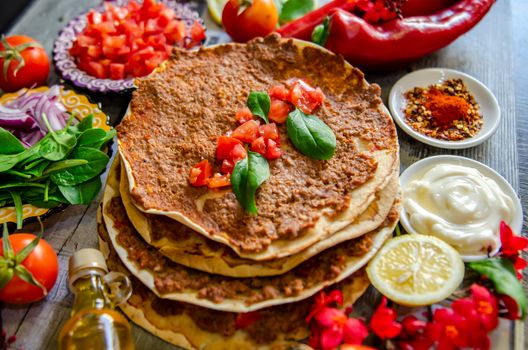
Photo: Fauzan Fitria / Pexels
Middle-Eastern
Lahmacun (Turkish Flatbread Pizza)
The diets react (see scores below)
Common Ingredients
- bread dough
- ground lamb
- tomato
- onion
- parsley
- red pepper paste
- cumin
- sumac
Specific recipes may vary.
Incompatible with 7 of 11 diets
Diet Ratings
Lahmacun is fundamentally built on bread dough (wheat-based flatbread), which is the primary structural component of the dish. A single lahmacun contains roughly 30-45g of net carbs from the dough alone, immediately threatening or exceeding the daily keto carb limit in one serving. While the topping ingredients — ground lamb, tomato, onion, parsley, spices — are largely keto-compatible in reasonable portions, they are inseparable from the high-carb flatbread base in this dish's traditional form. The dish as a whole is incompatible with ketogenic dietary goals.
Lahmacun contains ground lamb (or beef) as its primary protein, which is a direct animal product. This is an unambiguous disqualifier under vegan dietary rules. The remaining ingredients — bread dough, tomato, onion, parsley, red pepper paste, cumin, and sumac — are all plant-based, but the meat topping makes the dish as traditionally prepared incompatible with a vegan diet. A vegan-adapted version could substitute the ground meat with spiced lentils, mushrooms, or a plant-based mince while keeping all other ingredients intact.
Lahmacun is fundamentally built on bread dough — a grain-based flatbread that is central to the dish and cannot be separated from it. Wheat flour is a clear avoid under any paleo framework. While the toppings (ground lamb, tomato, onion, parsley, cumin, sumac) are largely paleo-compatible, and even red pepper paste could be acceptable if free of additives, the dish as a whole is defined by its grain base. The paleo community has no meaningful debate about wheat-based bread products — they are universally excluded. The compliant toppings do not redeem the dish when the grain component is structural and non-negotiable.
Lahmacun presents two significant conflicts with Mediterranean diet principles: red meat (ground lamb or beef) as the primary protein, and refined white bread dough as the base. Red meat is restricted to a few times per month in the Mediterranean diet, and refined flatbread contributes little nutritional value compared to whole grains. The dish does have redeeming elements — tomato, onion, parsley, and spices like cumin and sumac are excellent plant-based Mediterranean ingredients, and red pepper paste is traditional in Eastern Mediterranean cuisines. However, the combination of refined grain base plus red meat as the dominant component pushes this firmly into 'avoid' territory for regular consumption.
Some Mediterranean diet scholars who take a broader regional view, particularly those studying Turkish and Levantine culinary traditions, argue that dishes like lahmacun — where meat is used in thin, moderate quantities spread across a flatbread — represent a traditional use of red meat 'as a condiment' rather than a primary protein, making occasional consumption compatible with Mediterranean eating patterns.
Lahmacun is fundamentally incompatible with the carnivore diet. While it contains ground lamb or beef as a primary protein, the dish is built on a bread dough base (wheat flour — a grain) and topped with multiple plant-derived ingredients: tomato, onion, parsley, red pepper paste, cumin, and sumac. The grain-based flatbread alone is a categorical exclusion, and the plant-based toppings compound the violation across every carnivore tier. Even the most lenient 'animal-based' practitioners would reject this dish due to the grain foundation and processed plant condiments. The only carnivore-compatible component is the ground meat itself.
Lahmacun is built on bread dough, which is a wheat-based grain product explicitly excluded on the Whole30. Beyond the categorical grain exclusion, this dish also falls squarely under Rule 4 — the 'no recreating baked goods/junk food' provision — as it is explicitly listed as a pizza-style flatbread, and 'pizza crust' is one of the named forbidden formats. The meat and vegetable toppings (ground lamb, tomato, onion, parsley, cumin, sumac) would individually be compliant, and red pepper paste is likely compliant depending on added ingredients, but the bread base makes the entire dish non-compliant regardless.
Lahmacun contains multiple high-FODMAP ingredients that make it unsuitable during the elimination phase. The bread dough is wheat-based, delivering a significant fructan load. Onion is one of the highest-FODMAP foods tested by Monash University, rich in fructans, and is a core structural ingredient in lahmacun — not a garnish. Red pepper paste (biber salçası) typically contains garlic and/or onion as base ingredients, adding further fructan burden. These three problem ingredients alone — wheat dough, onion, and onion/garlic-based pepper paste — make this dish clearly high-FODMAP at any reasonable serving size. The remaining ingredients (ground lamb or beef, tomato at moderate amounts, parsley, cumin, sumac) are individually low-FODMAP and are not the issue. The dish cannot be easily modified in its traditional form, as onion and wheat flatbread are definitional to lahmacun.
Lahmacun sits in a middle ground for DASH compliance. On the positive side, it contains several DASH-friendly components: tomato, onion, parsley, and spices (cumin, sumac) contribute potassium, fiber, and antioxidants with minimal sodium. The flatbread base, if made from whole wheat dough, aligns with whole grain recommendations. However, ground lamb is a red meat with moderate-to-high saturated fat content, which DASH explicitly limits. Ground beef (depending on fat percentage) carries similar concerns. Red pepper paste can be a significant source of added sodium depending on preparation — commercial versions may contain 200–400mg per tablespoon. The bread dough, especially if refined flour is used, adds limited nutritional value. Overall, this dish is not categorically incompatible with DASH but requires portion control and mindful preparation choices (leaner meat, low-sodium pepper paste, whole wheat dough) to fit within DASH parameters. As a periodic inclusion in a DASH-compliant diet it is acceptable, but it cannot be considered a core DASH food.
NIH DASH guidelines recommend limiting red meat and emphasize lean poultry and fish as preferred proteins, making regular lamb or beef consumption a concern. However, updated clinical interpretations note that small portions of lean red meat (e.g., extra-lean ground beef or trimmed lamb) can fit within DASH when total saturated fat stays within daily limits — some DASH-oriented dietitians allow red meat 1–2 times per week without compromising cardiovascular outcomes.
Lahmacun presents a mixed Zone profile. The protein source (ground lamb or beef) is moderately acceptable but higher in saturated fat than Zone-ideal lean proteins like chicken breast or fish. The bread dough base is the primary concern — a refined wheat flatbread is a high-glycemic carbohydrate that Zone methodology classifies as 'unfavorable,' contributing rapidly absorbed carbs that can spike insulin. However, the topping ingredients are genuinely Zone-friendly: tomatoes, onions, and parsley are low-glycemic polyphenol-rich vegetables, red pepper paste adds favorable phytonutrients, and spices like cumin and sumac are anti-inflammatory and carb-neutral. The macro balance skews carb-heavy and fat-moderate (from lamb), making it difficult to hit the 40/30/30 ratio without significant modification. A single lahmacun piece could work as a partial Zone component if paired with a large side salad and lean protein to rebalance the ratio, but as a standalone meal it falls short. The thin flatbread (thinner than standard pizza) is a mild redeeming factor compared to thick-crust pizza, as the dough-to-topping ratio is more favorable.
Some Zone practitioners note that a thin lahmacun with modest dough and rich vegetable-herb toppings can be portion-controlled into an acceptable Zone meal — especially if served open-faced with a large salad, which is traditional. Dr. Sears' later writings in 'The Zone Diet' and anti-inflammatory work place more emphasis on polyphenol-rich toppings and omega-3 balance than on strictly avoiding all wheat, meaning a small lahmacun with these favorable toppings could be considered a moderate rather than poor Zone choice depending on total meal context.
Lahmacun presents a mixed anti-inflammatory profile. On the positive side, the dish contains several genuinely beneficial ingredients: tomatoes are rich in lycopene, a potent antioxidant; onions and parsley provide quercetin and flavonoids; cumin and sumac are both notable anti-inflammatory spices — sumac in particular is exceptionally high in polyphenols and has demonstrated anti-inflammatory activity in research. Red pepper paste contributes capsaicin, which has well-documented anti-inflammatory properties. However, the dish also has notable liabilities. Ground lamb (or beef) is a red meat with moderate-to-high saturated fat content, which the anti-inflammatory framework flags as a food to limit. The bread dough is a refined carbohydrate, and regularly consuming refined flour products can contribute to glycemic spikes and low-grade inflammation. Portion size and preparation matter considerably here — a thin flatbread crust with a moderate amount of spiced meat and abundant vegetables and herbs is meaningfully different from a thick, doughy base with a heavy meat topping. The strong spice profile (cumin, sumac) partially offsets the red meat and refined carb concerns. Overall, this is an occasional food that leans toward the better end of 'caution' — the spice and vegetable components are genuinely valuable, but the refined bread base and red meat protein source keep it out of 'approve' territory under standard anti-inflammatory guidelines.
Some anti-inflammatory practitioners following a Mediterranean-adjacent framework might rate this more favorably, noting that lamb in traditional Middle Eastern portions is modest, and the polyphenol density from sumac and cumin is unusually high. Conversely, strict anti-inflammatory or autoimmune protocols (AIP, Dr. Terry Wahls) would likely rate it lower due to grain-based dough and red meat combining in a single dish.
Lahmacun is a thin flatbread topped with spiced ground meat, vegetables, and herbs. It has some redeeming qualities — ground lamb or beef provides moderate protein, and the tomato, onion, parsley, and spice blend add micronutrients and a small amount of fiber. However, several factors limit its GLP-1 friendliness. The base is refined bread dough, contributing refined carbohydrates with low fiber and low nutrient density per calorie. Ground lamb is typically higher in saturated fat than preferred lean proteins, and ground beef varies widely by fat content. The portion is relatively thin, so total fat per piece may be moderate rather than extreme, but protein yield per serving is modest compared to a protein-forward meal. Red pepper paste and cumin are generally well-tolerated spices, and sumac is anti-inflammatory and mild. This dish is not fried and is not high in sugar, which works in its favor. Overall, lahmacun is acceptable occasionally in small portions — ideally paired with a high-protein side such as yogurt or legumes — but it does not prioritize protein or fiber and the refined grain base and fatty meat make it a suboptimal primary GLP-1 meal.
Some GLP-1-focused dietitians would rate this more permissively if made with lean ground beef (90%+ lean) on a thin crust, arguing the overall fat load per piece is low enough to be well-tolerated and the vegetable topping adds meaningful micronutrient value. Others would flag that even small amounts of saturated fat from lamb can worsen nausea in GLP-1 patients with slower gastric emptying, and would recommend substituting ground chicken or turkey to improve the protein-to-fat ratio.
*See how scores were generated at our methodology page.
Nutritional profile
Six traits that cut across every diet.
Fiber & Plants
How much whole-plant food and fiber it delivers.
Healthy Fats
The quality of its fats (unsaturated, omega-3).
Whole / Unprocessed
How close it is to its natural, unprocessed form.
Gut Gentle
How easy it is on digestion (low FODMAP, few irritants).
Low Glycemic
How little it spikes your blood sugar.
Protein Density
How much protein it packs per calorie.
Controversy Index
Higher controversy = more disagreement between diets.
Diet-Specific Tips
 DASH — 5/10
View tips
- Ground lamb/beef is red meat with notable saturated fat — a category DASH explicitly limits
- Red pepper paste may contribute significant sodium depending on commercial vs. homemade preparation
- Tomato, onion, parsley, and spices add potassium, fiber, and antioxidants consistent with DASH
- Refined white flour flatbread offers limited nutritional benefit; whole wheat version aligns better with DASH whole grain goals
- Portion size is critical — one lahmacun is generally moderate in calories but multiple servings elevate saturated fat and sodium intake
- No high-fat dairy, added sugars, or tropical oils present — a positive factor
 Zone — 4/10
View tips
- Refined wheat flatbread dough is a high-glycemic 'unfavorable' carbohydrate in Zone classification
- Ground lamb is higher in saturated fat than Zone-preferred lean proteins — ground beef might be slightly leaner depending on fat percentage
- Tomato, onion, and parsley toppings are Zone-favorable low-glycemic vegetables
- Red pepper paste, sumac, and cumin contribute anti-inflammatory polyphenols with negligible macro impact
- Macro ratio skews carb-heavy and protein-insufficient as a standalone meal
- Thin crust format is less problematic than thick-crust bread products
- Traditional serving with fresh herbs and lemon juice adds Zone-positive micronutrients
 Anti-Inflammatory — 5/10
View tips
- Red meat (lamb/beef) — saturated fat, limit per anti-inflammatory guidelines
- Refined bread dough — refined carbohydrate, pro-inflammatory glycemic effect
- Sumac — exceptionally high in polyphenols, strong anti-inflammatory spice
- Cumin — anti-inflammatory, antioxidant properties
- Tomato — lycopene, antioxidants
- Red pepper paste — capsaicin, anti-inflammatory
- Onion and parsley — quercetin, flavonoids, anti-inflammatory micronutrients
- Portion and preparation context significantly affects overall profile
 GLP-1 Friendly — 4/10
View tips
- Refined grain flatbread base provides low fiber and low nutrient density per calorie
- Ground lamb is high in saturated fat; ground beef fat content varies widely
- Moderate protein per serving but not protein-dense enough to anchor a GLP-1 meal alone
- Tomato, onion, parsley, and sumac contribute micronutrients but minimal fiber
- Not fried and not high in sugar — easier to digest than greasy alternatives
- Spices (red pepper paste, cumin) are generally mild and well-tolerated
- Portion-sensitive: one thin piece may be manageable; multiple pieces increases refined carb and fat load
- Would benefit from pairing with Greek yogurt or legumes to boost protein and fiber