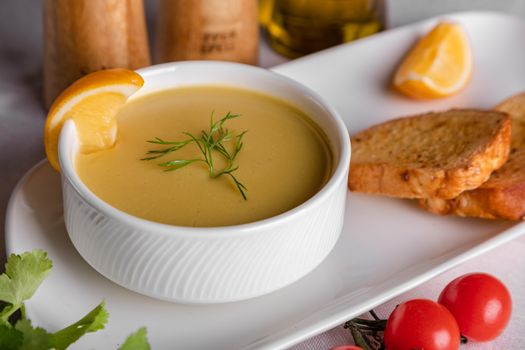
Photo: Dima Valkov / Pexels
Middle-Eastern
Mercimek Çorbası
The diets react (see scores below)
Common Ingredients
- red lentils
- onion
- carrots
- cumin
- paprika
- lemon juice
- olive oil
- mint
Specific recipes may vary.
Incompatible with 5 of 11 diets
Diet Ratings
Mercimek Çorbası is fundamentally incompatible with a ketogenic diet. Red lentils are the primary ingredient and are extremely high in net carbs — approximately 30-33g net carbs per 100g cooked. A standard bowl of this soup (250-300ml) would contain an estimated 25-40g of net carbs from lentils alone, likely consuming or exceeding the entire daily keto carb budget in a single serving. Carrots and onions add further carbohydrates. While olive oil and the spices are keto-friendly, they cannot offset the dominant high-carb legume base. This dish is structurally a legume-based soup and cannot be made keto-compatible without fundamentally changing the recipe.
Mercimek Çorbası (Turkish red lentil soup) is an exemplary whole-food plant-based dish. Every ingredient — red lentils, onion, carrots, cumin, paprika, lemon juice, olive oil, and mint — is entirely plant-derived. Red lentils provide substantial protein and fiber, while the spices and lemon juice add flavor without any animal-derived components. This is a traditional preparation that is naturally vegan with no substitutions required. The only minor nutritional caveat is the olive oil (a processed fat), which is why it scores 9 rather than a perfect 10, but this is a negligible concern within standard vegan dietary assessment.
Mercimek Çorbası is a traditional Turkish red lentil soup, and its primary ingredient — red lentils — is a legume, which is explicitly excluded from the paleo diet. Legumes are avoided due to their high lectin and phytic acid content, which paleo proponents argue impairs nutrient absorption and causes gut inflammation. There is no version of this dish that can be made paleo-compliant while retaining its identity, as lentils are the foundational ingredient. The remaining ingredients (onion, carrots, cumin, paprika, lemon juice, olive oil, mint) are all paleo-approved, but they cannot redeem the dish given that red lentils constitute the bulk of it.
Mercimek Çorbası is an exemplary Mediterranean-aligned dish. Red lentils are a premier legume source of plant-based protein and fiber, forming the cornerstone of Mediterranean eating patterns. The soup is built entirely on whole, minimally processed plant ingredients: lentils, onion, carrots, and aromatic herbs and spices. Olive oil is used as the primary fat, perfectly in line with Mediterranean principles. Lemon juice adds brightness while providing antioxidants. Cumin, paprika, and mint are traditional spice pairings common across Eastern Mediterranean and Middle Eastern cuisines that overlap heavily with Mediterranean dietary traditions. There are no refined grains, added sugars, processed ingredients, or animal products of concern. This soup could be eaten daily and would be celebrated in any Mediterranean diet framework.
Mercimek Çorbası is a traditional Turkish red lentil soup made entirely from plant-derived ingredients. Every single component — red lentils, onion, carrots, cumin, paprika, lemon juice, olive oil, and mint — is explicitly excluded on the carnivore diet. Red lentils are legumes, a food group particularly discouraged due to antinutrients like lectins and phytates. There is no animal product present whatsoever, not even as a minor ingredient. This dish is incompatible with carnivore at every level, including the most lenient interpretations.
Mercimek Çorbası (Turkish red lentil soup) contains red lentils as its primary ingredient. Lentils are explicitly listed as excluded legumes under the Whole30 program. All other ingredients — onion, carrots, cumin, paprika, lemon juice, olive oil, and mint — are fully compliant, but the foundational lentil base makes this dish incompatible with Whole30 regardless of preparation method.
Mercimek Çorbası contains two significant high-FODMAP ingredients that make it unsuitable during the elimination phase. Red lentils are high in GOS (galacto-oligosaccharides) and are high-FODMAP at typical serving sizes. While canned lentils have somewhat reduced GOS compared to dried, red lentil soup is typically made from dried lentils cooked in the broth, meaning all the GOS remains in the liquid. Onion is one of the highest-FODMAP foods tested by Monash, rich in fructans, and problematic even in small amounts — it is a core ingredient in this soup and cannot be simply removed or reduced to a safe level without fundamentally changing the dish. Carrots, cumin, paprika, lemon juice, olive oil, and mint are all low-FODMAP and pose no concern. However, the combination of red lentils and onion as foundational ingredients makes this dish a clear avoid during elimination phase.
Mercimek Çorbası (Turkish red lentil soup) is an excellent fit for the DASH diet. Red lentils are a DASH-emphasized legume rich in fiber, plant protein, potassium, magnesium, and folate — all nutrients central to the DASH eating plan. The supporting ingredients — onion, carrots, olive oil, lemon juice, cumin, paprika, and mint — are all DASH-compatible: vegetables contribute additional potassium and fiber, olive oil is a preferred unsaturated fat, and lemon juice adds brightness without sodium. There is no added salt inherent to the base recipe, no saturated fat, no red meat, no full-fat dairy, and no added sugars. This dish naturally fits the legumes/nuts/seeds category (4-5 servings/week on DASH) and contributes meaningfully to vegetable servings. The only consideration is that restaurant or packaged versions may add significant salt; home-prepared versions with minimal added sodium are ideal for both standard and low-sodium DASH targets.
Mercimek Çorbası (Turkish red lentil soup) is a nutritious dish with several Zone-friendly elements but requires careful portioning and protein supplementation to fit Zone protocol. Red lentils are a dual-macro food — they provide both carbohydrates and protein, but the carb-to-protein ratio skews heavily toward carbohydrates. A 1-cup serving of cooked red lentils contains roughly 28-30g net carbs and only 12-14g protein, making it difficult to hit the Zone's 40/30/30 ratio without adding lean protein on the side. The olive oil is an ideal Zone fat (monounsaturated), and the vegetables (onion, carrots) are low-glycemic Zone-favorable carbs. Spices, lemon juice, and mint are essentially free foods. The glycemic load is moderate — lentils have a lower GI than most legumes due to their fiber content, which is a positive factor. However, as a standalone meal, this soup is protein-deficient and carbohydrate-heavy, which is the primary Zone concern. To bring it into Zone balance, a portion of lean protein (e.g., chicken breast, fish, egg whites) should be added alongside or within the meal, and the lentil portion should be controlled (roughly 1/3 cup dry). The absence of a primary protein listing reinforces this gap.
Some Zone practitioners and Sears' later writing (particularly around polyphenols and the Mediterranean diet influence) would view lentil-based dishes more favorably. Lentils are high in resistant starch and fiber, which blunts their glycemic impact significantly. Their dual protein-carb nature, while imperfect for Zone block counting, does reduce the need for as much additional protein as pure-carb sources would require. A moderate bowl paired with a side of lean protein could comfortably fit a Zone meal template, and the anti-inflammatory spice profile (cumin, paprika) and olive oil base align well with Sears' later polyphenol-focused Zone messaging.
Mercimek Çorbası (Turkish red lentil soup) is an excellent anti-inflammatory dish. Red lentils are rich in fiber, plant protein, folate, and polyphenols that help reduce inflammatory markers like CRP. Onion and carrots contribute quercetin, beta-carotene, and other antioxidants. Cumin and paprika are anti-inflammatory spices with beneficial phytochemicals. Lemon juice provides vitamin C, which enhances iron absorption and acts as an antioxidant. Olive oil delivers oleocanthal and oleic acid, both well-documented anti-inflammatory compounds. Fresh mint adds additional polyphenols and antioxidant flavonoids. This dish has no red meat, no refined carbohydrates, no added sugar, no seed oils, and no processed ingredients. It is overwhelmingly plant-based, aligns closely with Dr. Weil's Anti-Inflammatory Food Pyramid emphasis on legumes, colorful vegetables, spices, and extra virgin olive oil, and has a strongly favorable omega-3 to omega-6 ratio for a legume-based meal. Nearly every ingredient in this soup is either emphasized or approved under anti-inflammatory dietary frameworks.
Mercimek Çorbası (Turkish red lentil soup) is a strong GLP-1-friendly choice. Red lentils provide approximately 9g of protein and 8g of fiber per cooked cup, making this soup a meaningful contributor to both daily protein and fiber targets despite having no dedicated animal protein source. The fiber content directly addresses constipation, a major GLP-1 side effect. Olive oil is used in a modest amount, providing unsaturated fat that is well-tolerated. The soup is inherently easy to digest given its blended or semi-blended texture and liquid base, making it ideal for patients experiencing slowed gastric emptying or GI sensitivity. High water content supports hydration. Cumin and paprika are mild enough to avoid triggering reflux or nausea. Lemon juice adds brightness without problematic ingredients. The dish is naturally low in saturated fat, free of fried elements, refined grains, and added sugar. It works well in small portions and is nutrient-dense per calorie. The primary limitation is that red lentils alone will not meet per-meal protein targets (15–30g), so pairing with a protein source such as a boiled egg, Greek yogurt on the side, or grilled chicken would be advisable.
*See how scores were generated at our methodology page.
Nutritional profile
Six traits that cut across every diet.
Fiber & Plants
How much whole-plant food and fiber it delivers.
Healthy Fats
The quality of its fats (unsaturated, omega-3).
Whole / Unprocessed
How close it is to its natural, unprocessed form.
Gut Gentle
How easy it is on digestion (low FODMAP, few irritants).
Low Glycemic
How little it spikes your blood sugar.
Protein Density
How much protein it packs per calorie.
Controversy Index
Higher controversy = more disagreement between diets.
Diet-Specific Tips
 Vegan — 9/10
View tips
- Red lentils: excellent plant-based protein and fiber source
- All aromatics and spices (onion, carrots, cumin, paprika, mint) are fully plant-based
- Lemon juice: plant-derived acidulant, no concerns
- Olive oil: minimally processed plant fat, fully vegan-compliant
- No animal products, dairy, eggs, or animal-derived additives present
- Whole-food dominant ingredient profile elevates score
 Mediterranean — 9/10
View tips
- Red lentils are a core Mediterranean legume, high in plant protein and fiber
- Extra virgin olive oil used as the primary fat source
- All ingredients are whole and minimally processed
- No animal products, refined grains, or added sugars
- Aromatic spices (cumin, paprika, mint) are traditional across Eastern Mediterranean cuisines
- Lemon juice adds acidity and antioxidant value
- Dish aligns with the plant-forward, legume-rich emphasis of the Mediterranean diet
 DASH — 9/10
View tips
- Red lentils are DASH-emphasized legumes rich in fiber, potassium, and magnesium
- No saturated fat, no red meat, no added sugar, no full-fat dairy
- Olive oil is the preferred DASH-compatible fat source
- Carrots and onion add vegetable servings and additional micronutrients
- Lemon juice replaces the need for added salt as a flavor enhancer
- Home-prepared version is naturally low in sodium; restaurant versions may be high in added salt
- Spices (cumin, paprika, mint) are DASH-neutral and add flavor without sodium penalty
 Zone — 6/10
View tips
- Red lentils are a dual protein-carb food with carbs dominating — approximately 2:1 carb-to-protein ratio by calories, making Zone block balancing challenging
- No dedicated lean protein source in the dish — Zone meals require approximately 25g of lean protein per meal
- Olive oil is an ideal Zone fat (monounsaturated) and correctly portioned at typical soup quantities
- Carrots and onions are Zone-favorable low-glycemic vegetables contributing to the carb block constructively
- Lentils have lower glycemic index than most carb sources due to high fiber content — net carbs are moderate
- Dish is anti-inflammatory in character: olive oil, polyphenol-rich spices, lemon juice all align with Sears' broader dietary philosophy
- As a standalone meal this dish is carb-heavy and protein-light; Zone compliance requires supplemental lean protein
 Anti-Inflammatory — 9/10
View tips
- Red lentils are an emphasized legume — high in fiber and polyphenols that reduce CRP
- Olive oil provides oleocanthal, a well-documented anti-inflammatory compound
- Cumin and paprika are anti-inflammatory spices with beneficial phytochemicals
- Onion and carrots add quercetin and beta-carotene (antioxidants)
- Lemon juice contributes vitamin C and antioxidant support
- Mint adds polyphenols and flavonoids
- No red meat, refined carbs, added sugar, seed oils, or processed ingredients
- Entirely plant-based with no pro-inflammatory components
 GLP-1 Friendly — 8/10
View tips
- Red lentils provide meaningful plant-based protein (~9g/cup) and high fiber (~8g/cup), supporting both key GLP-1 priorities
- High water content and liquid format support hydration, which GLP-1 patients commonly neglect
- Blended texture is easy to digest and well-suited for slowed gastric emptying
- Olive oil contributes unsaturated fat in a tolerable amount
- Mild spice profile (cumin, paprika, mint, lemon) unlikely to trigger nausea or reflux
- Protein per serving falls short of the 15–30g per-meal target — pairing with a protein source is recommended
- No fried components, no refined grains, no added sugar, no saturated fat concerns
- Small-portion friendly; satisfying in modest volume due to fiber and liquid bulk