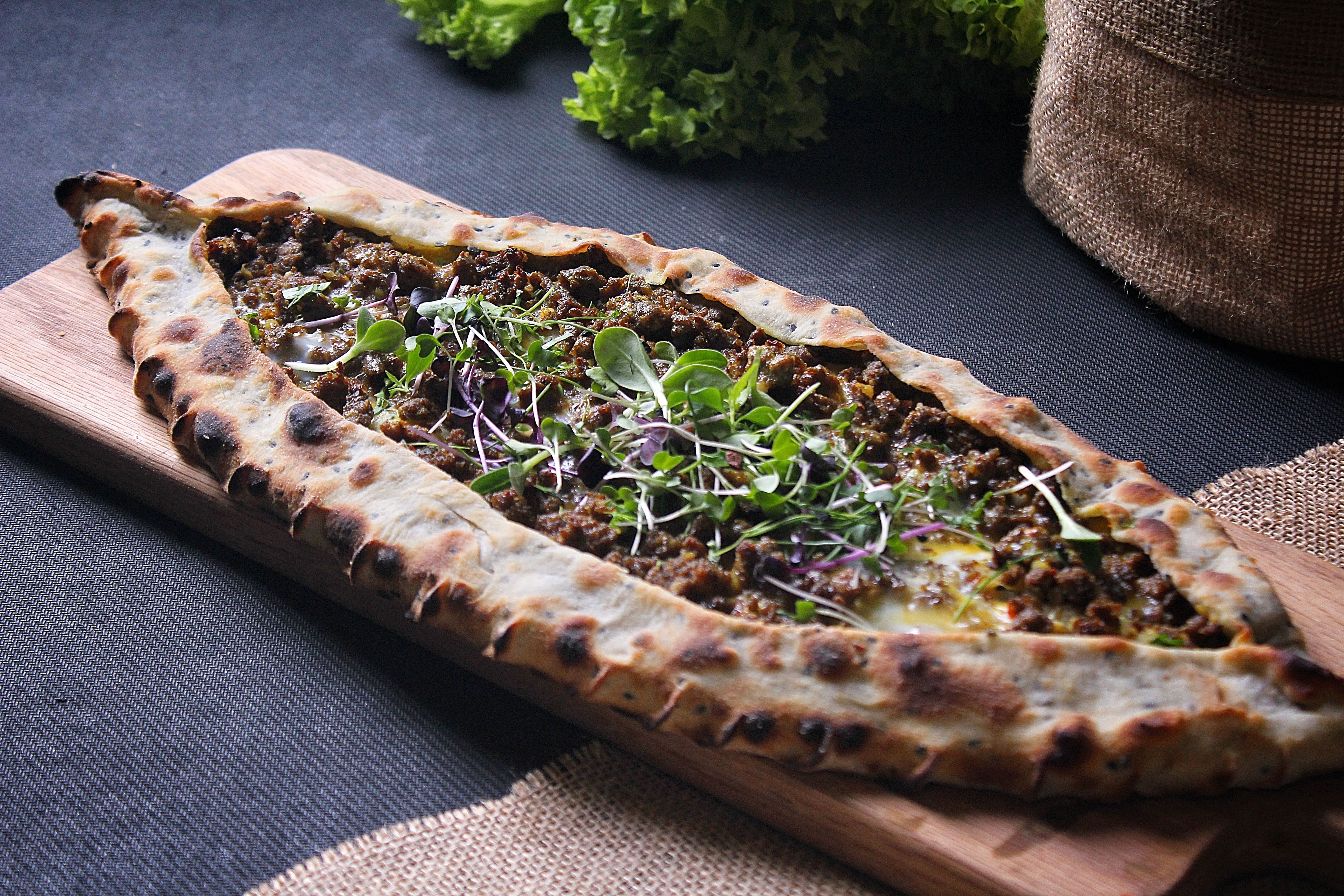
Photo: Shameel mukkath / Pexels
Middle-Eastern
Turkish Pide
The diets react (see scores below)
Common Ingredients
- bread dough
- ground beef
- cheese
- parsley
- onion
- tomato
- egg
- red pepper flakes
Specific recipes may vary.
Incompatible with 7 of 11 diets
Diet Ratings
Turkish Pide is fundamentally built on bread dough (wheat flour), which is one of the most keto-incompatible ingredients possible. A single serving of pide contains a substantial amount of refined grain-based carbohydrates — easily 40-80g of net carbs — far exceeding the entire daily keto allowance. While the toppings (ground beef, cheese, egg, parsley, onion, tomato) include several keto-friendly components, the bread base is non-negotiable and cannot be portioned away. This dish cannot be consumed in any practical serving size while maintaining ketosis.
Turkish Pide as described contains multiple animal-derived ingredients that are explicitly excluded from a vegan diet. Ground beef is meat (animal flesh), cheese is a dairy product, and egg is an animal product. All three are clear violations of vegan principles. This dish is unambiguously non-vegan with no meaningful debate within the vegan community.
Turkish Pide contains multiple core non-paleo ingredients that disqualify it entirely. Bread dough (wheat flour) is a grain-based product, one of the most clearly excluded foods in the paleo diet. Cheese is a dairy product, also firmly excluded. These two ingredients are foundational to the dish and cannot be separated from it. While several ingredients — ground beef, parsley, onion, tomato, egg, and red pepper flakes — are fully paleo-approved, they cannot redeem a dish whose structural base is wheat bread and whose topping includes dairy. This is not a borderline case.
Turkish Pide combines several elements that conflict with Mediterranean diet principles. The primary protein is ground beef or lamb (red meat), which should be limited to only a few times per month. The base is refined bread dough (white flour), a refined grain that Mediterranean guidelines discourage in favor of whole grains. Cheese adds saturated fat, and together with the red meat creates a high saturated fat profile. While several ingredients are Mediterranean-friendly — tomato, onion, parsley, red pepper flakes, and egg — these supportive elements are outweighed by the problematic combination of red meat and refined carbohydrates as the foundational components of the dish. As an occasional treat it is not catastrophic, but as a regular snack it clearly contradicts core Mediterranean diet principles.
Traditional Turkish and broader Eastern Mediterranean cuisines are considered part of the Mediterranean diet's cultural heritage, and moderate consumption of lamb in particular is deeply embedded in these traditions. Some Mediterranean diet researchers, including those from the Oldways Preservation Trust, acknowledge that lean red meat in small amounts within a predominantly plant-based pattern can be acceptable, meaning a small portion of pide eaten infrequently could fit within a flexible Mediterranean framework.
Turkish Pide is fundamentally incompatible with the carnivore diet. The dish is built on a bread dough base (wheat flour — a grain), which alone disqualifies it entirely. Beyond the bread, it contains multiple plant-derived ingredients: parsley (herb), onion (vegetable), tomato (fruit/vegetable), and red pepper flakes (spice). While ground beef and egg are carnivore-approved, and cheese is debated within the community, the overwhelming majority of this dish's structure and flavor profile is plant- and grain-based. No adaptation short of completely reconstructing the dish would make it carnivore-compatible.
Turkish Pide contains multiple Whole30-excluded ingredients. Bread dough is made from grains (wheat flour), which are explicitly excluded from the Whole30 program. Cheese is a dairy product, also explicitly excluded. Furthermore, even if these ingredients could somehow be substituted, pide is fundamentally a flatbread — a baked good that falls squarely into the prohibited 'recreating bread' category under Rule 4. This dish cannot be made Whole30-compliant without fundamentally changing what it is.
Turkish Pide contains multiple high-FODMAP ingredients that make it unsuitable during the elimination phase. The bread dough is wheat-based, making it high in fructans — the primary FODMAP concern. Onion is one of the highest-fructan foods tested by Monash University and is a major FODMAP offender at any typical serving size. Cheese varies by type, but if it is a soft or processed variety it may contain lactose. Ground beef itself is low-FODMAP, as are parsley, egg, red pepper flakes, and tomato (in standard servings). However, the combination of wheat bread dough and onion alone is sufficient to classify this dish as high-FODMAP and inappropriate for elimination phase consumption. There is no realistic modification that preserves the traditional dish while making it low-FODMAP without replacing the bread base and removing the onion entirely.
Turkish Pide contains several ingredients that create tension with DASH guidelines. The bread dough base is likely made from refined white flour rather than whole grain, which DASH discourages. Ground beef (especially if higher fat) is a red meat that DASH limits due to saturated fat content. Cheese adds saturated fat and sodium — both of which DASH restricts. On the positive side, the dish includes DASH-friendly vegetables (tomato, onion, parsley) and egg. The overall profile — refined carbohydrate base, red meat, cheese, and likely significant sodium from dough and cheese combined — places this in the caution zone. It is not categorically excluded, but it requires meaningful portion control and ideally modifications (whole grain dough, lean ground beef or substituting with turkey/chicken, reduced-fat cheese, minimal added salt) to better align with DASH principles.
NIH DASH guidelines explicitly limit red meat and full-fat cheese due to saturated fat and sodium concerns, making traditional Turkish Pide a poor fit. However, updated clinical interpretations note that small portions of lean beef or lamb within an otherwise DASH-compliant dietary pattern may be acceptable, and the vegetable-rich topping partially offsets concerns — some DASH-oriented dietitians would allow occasional consumption rather than categorically cautioning against it.
Turkish Pide presents a mixed Zone picture. The filling ingredients — ground beef or lamb, parsley, onion, tomato, and egg — have genuine Zone merit: lean protein (though ground beef/lamb can carry meaningful saturated fat), low-glycemic vegetables, and polyphenol-rich herbs. However, the foundation is bread dough, a refined, high-glycemic carbohydrate that Sears classifies as 'unfavorable' in Zone terminology. The cheese adds saturated fat rather than preferred monounsaturated fat. The overall macro ratio skews heavily toward carbohydrate and saturated fat, making it difficult to hit the 40/30/30 target without significant modification. As a snack category item, portions would be small enough to partially mitigate the glycemic load, but a typical pide portion still delivers too much refined carb relative to protein and Zone-favorable fat. With careful portioning — treating a small slice as a partial carb block alongside a protein-dominant meal — it can technically be incorporated, placing it firmly in 'caution' territory rather than 'avoid,' since the filling has real nutritional value.
Some Zone practitioners in later Sears methodology (The Anti-Inflammation Zone, Zone Perfect Meals in Minutes) take a more permissive view of whole-grain or flatbread-style doughs in small portions, noting that the protein and vegetable filling density can partially offset the glycemic impact of the bread. If the dough is made with whole-grain flour and the portion is limited to a few bites, some Zone adherents would rate this higher (5-6). The beef/lamb debate also matters: leaner ground beef brings this closer to Zone-favorable, while fattier lamb pulls it toward unfavorable.
Turkish Pide presents a mixed anti-inflammatory profile with several concerns and a few redeeming elements. On the pro-inflammatory side: the bread dough base is a refined carbohydrate with high glycemic impact, offering little fiber or nutritional complexity; ground beef (especially if higher-fat) is a red meat associated with arachidonic acid and saturated fat, both linked to elevated inflammatory markers; and cheese adds saturated fat. On the anti-inflammatory side: tomato provides lycopene and vitamin C; parsley is a notable source of flavonoids (apigenin, luteolin) and vitamin K; onion contributes quercetin, a well-studied anti-inflammatory polyphenol; red pepper flakes contain capsaicin, which has documented anti-inflammatory effects; and egg adds choline and selenium. The dish is not heavily processed or fried, and the vegetable/herb components are meaningful in quantity. However, the combination of refined bread dough + red meat + cheese tips the overall profile into cautionary territory. This would be better suited as an occasional dish rather than a regular one. Swapping beef for lamb does not meaningfully change the assessment, as both are red meats in the 'limit' category. No trans fats, HFCS, or artificial additives are present, keeping it out of 'avoid' territory.
Turkish Pide is a boat-shaped flatbread filled with spiced ground beef or lamb, cheese, egg, vegetables, and herbs. While it contains meaningful protein from the meat, egg, and cheese combination, several factors make it problematic for GLP-1 patients. The bread base is a refined grain with low fiber and nutrient density, occupying significant stomach capacity without delivering much nutritional value — a real concern given reduced appetite. Ground beef and lamb are moderate-to-high in saturated fat, and added cheese compounds the fat load further. High fat content per serving directly worsens GLP-1 side effects including nausea, bloating, and delayed gastric emptying. The red pepper flakes may also irritate some patients prone to reflux. On the positive side, the vegetable toppings (tomato, onion, parsley) add minor fiber and micronutrients, and the protein content is real. A small portion of pide is more defensible than a full serving — but portion control is difficult with a bread-based dish designed to be eaten whole. It is not nutritionally empty, but the fat-to-protein ratio, refined carbohydrate base, and GI risk profile place it firmly in caution territory.
Some GLP-1-focused dietitians may consider a half portion of pide with leaner ground beef and reduced cheese acceptable as an occasional culturally meaningful meal, arguing that dietary adherence and food satisfaction matter for long-term compliance. Others would steer patients away entirely due to the combined saturated fat and refined carbohydrate load worsening gastric emptying side effects, particularly in the early weeks of GLP-1 titration.
*See how scores were generated at our methodology page.
Nutritional profile
Six traits that cut across every diet.
Fiber & Plants
How much whole-plant food and fiber it delivers.
Healthy Fats
The quality of its fats (unsaturated, omega-3).
Whole / Unprocessed
How close it is to its natural, unprocessed form.
Gut Gentle
How easy it is on digestion (low FODMAP, few irritants).
Low Glycemic
How little it spikes your blood sugar.
Protein Density
How much protein it packs per calorie.
Controversy Index
Higher controversy = more disagreement between diets.
Diet-Specific Tips
 DASH — 4/10
View tips
- Refined flour bread dough rather than whole grain — not aligned with DASH whole grain emphasis
- Ground beef (red meat) limited on DASH due to saturated fat content
- Cheese contributes significant saturated fat and sodium — both restricted on DASH
- Tomato, onion, and parsley are DASH-friendly vegetables offering potassium and fiber
- Egg is acceptable in moderation under most current DASH interpretations
- Overall sodium load from dough, cheese, and seasoning likely high
- Portion size critical — pide is often consumed in large servings
- Modifications (whole grain dough, lean turkey, reduced-fat cheese) would improve DASH compatibility
 Zone — 4/10
View tips
- Bread dough is a refined, high-glycemic carbohydrate — classified 'unfavorable' in Zone
- Ground beef or lamb can carry saturated fat; leaner cuts improve Zone compatibility
- Cheese adds saturated fat rather than Zone-preferred monounsaturated fat
- Vegetables (tomato, onion, parsley) and egg contribute favorable Zone ingredients in the filling
- Macro ratio likely skews carb-heavy and saturated-fat-heavy, making 40/30/30 hard to achieve
- As a snack, small portions reduce absolute glycemic impact but do not fix the ratio problem
 Anti-Inflammatory — 4/10
View tips
- Refined bread dough base — high glycemic, low fiber, pro-inflammatory carbohydrate load
- Ground beef as primary protein — red meat in the 'limit' category due to saturated fat and arachidonic acid
- Cheese adds saturated fat, compounding the red meat concern
- Tomato provides lycopene and antioxidant vitamin C
- Onion contributes quercetin, a well-researched anti-inflammatory polyphenol
- Parsley is rich in flavonoids (apigenin, luteolin) with anti-inflammatory activity
- Red pepper flakes contribute capsaicin, which reduces pro-inflammatory cytokines
- Egg adds beneficial micronutrients (choline, selenium) with a mixed but not strongly pro-inflammatory profile
- No trans fats, high-fructose corn syrup, or artificial additives present
 GLP-1 Friendly — 4/10
View tips
- Refined bread base is low in fiber and displaces nutrient-dense calories
- Ground beef and lamb are moderate-to-high in saturated fat, worsening GLP-1 GI side effects
- Cheese adds additional saturated fat per serving
- Real but moderate protein contribution from meat, egg, and cheese
- Red pepper flakes may worsen reflux or nausea in sensitive patients
- Small portion reduces risk but difficult to portion-control in practice
- Vegetable toppings provide minor micronutrient and fiber benefit