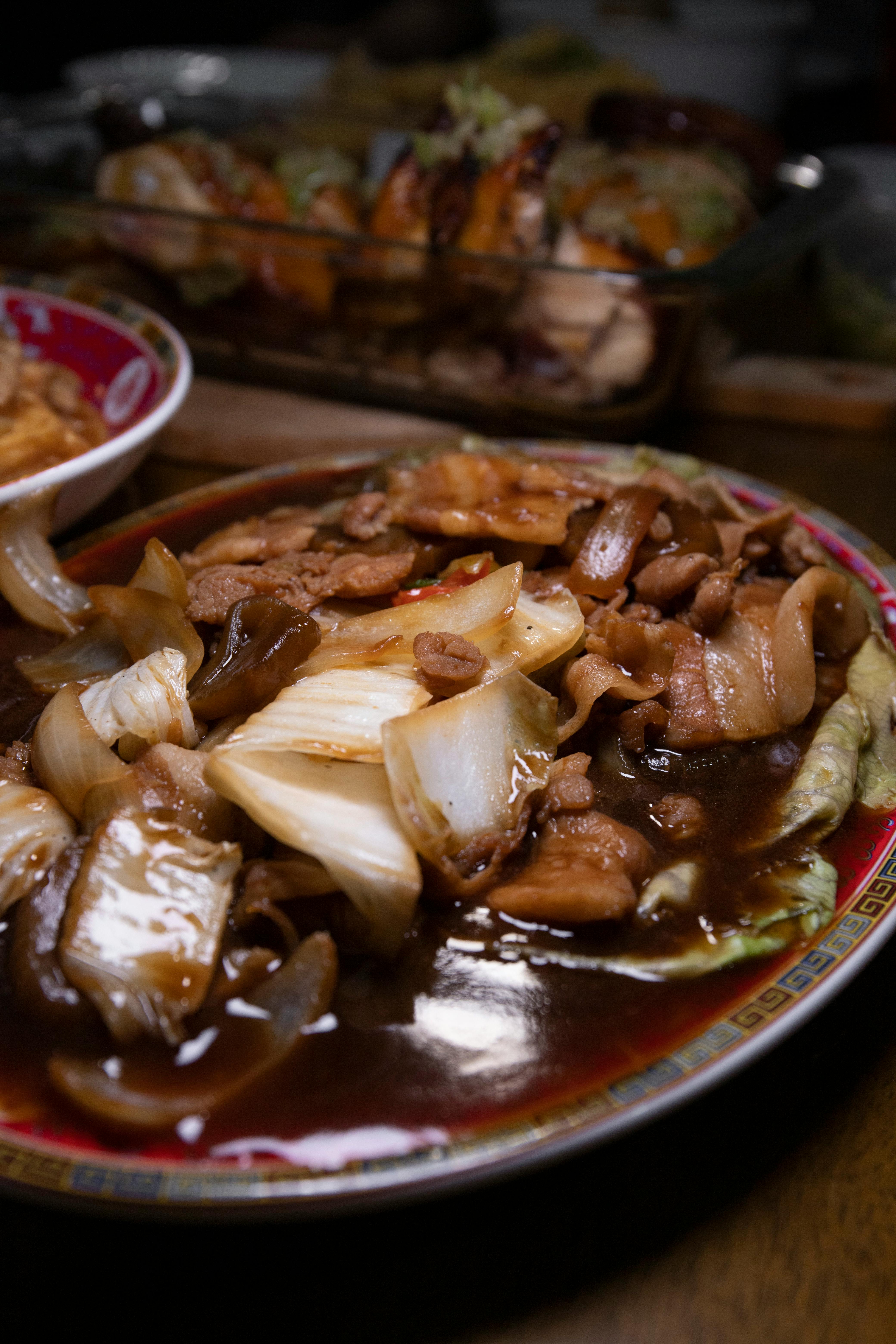
Photo: AMANDA LIM / Pexels
Chinese
Twice-Cooked Pork
The diets react (see scores below)
Common Ingredients
- pork belly
- leeks
- green bell pepper
- doubanjiang
- sweet bean sauce
- Sichuan peppercorns
- garlic
- Shaoxing wine
Specific recipes may vary.
Incompatible with 9 of 11 diets
Diet Ratings
Twice-Cooked Pork presents a mixed keto picture. The pork belly base is excellent — high fat, quality protein, zero carbs. However, the sauce components are problematic: sweet bean sauce (tianmianjiang) is made from fermented wheat flour and sugar, contributing meaningful carbs and gluten; doubanjiang adds moderate carbs; and Shaoxing wine contains residual sugars. Leeks and green bell pepper are relatively low-carb vegetables but still contribute net carbs. A standard restaurant serving likely pushes 15-25g net carbs, primarily from the sauces, which could consume most or all of a daily keto carb budget in one dish. Home-prepared versions with reduced or substituted sauces (omitting sweet bean sauce, minimizing Shaoxing wine) could bring this closer to keto-friendly territory, but as traditionally prepared it requires significant caution.
Some lazy keto practitioners may approve small portions of this dish, arguing the pork belly fat content and overall macro ratio still supports ketosis despite the sauces, especially if net carbs are tracked carefully within a 50g daily ceiling. Conversely, strict keto and clinical ketogenic protocol followers would avoid it entirely due to the wheat-based sweet bean sauce and added sugars, which they consider incompatible regardless of portion size.
Twice-Cooked Pork is entirely incompatible with a vegan diet. The primary protein is pork belly, a direct animal product, which alone disqualifies the dish under any interpretation of veganism. There is no ambiguity here — pork is unequivocally excluded from all vegan frameworks.
Twice-Cooked Pork contains multiple non-paleo ingredients that disqualify it outright. Doubanjiang (fermented bean paste) is a legume-based condiment, placing it firmly in the excluded legumes category. Sweet bean sauce is similarly grain/legume-derived and typically contains added sugar and salt. Shaoxing wine is a fermented grain alcohol, making it a processed grain product. While pork belly, leeks, green bell pepper, Sichuan peppercorns, and garlic are all paleo-approved, the core flavoring sauces that define this dish are fundamentally incompatible with paleo principles. This is not a borderline case — the dish cannot be prepared authentically without these non-paleo condiments.
Twice-Cooked Pork is a Sichuan dish centered on pork belly, one of the fattiest cuts of red meat, which is explicitly limited to only a few times per month in the Mediterranean diet. Pork belly is high in saturated fat, directly contradicting Mediterranean principles. The dish also relies on doubanjiang and sweet bean sauce, which are fermented/processed condiments high in sodium and added sugars, further misaligning with Mediterranean guidelines that emphasize minimal processed foods. There is no olive oil, whole grains, or legumes involved. While garlic, leeks, and green bell pepper are Mediterranean-friendly vegetables, they are minor components that do not offset the dominant pork belly base. This dish is fundamentally incompatible with Mediterranean diet principles.
Twice-Cooked Pork is fundamentally incompatible with the carnivore diet. While pork belly is an excellent carnivore-approved ingredient, the dish is overwhelmingly plant-based in its flavor and composition. Leeks and green bell pepper are plant vegetables that are strictly excluded. Doubanjiang (fermented broad bean and chili paste) and sweet bean sauce are fermented legume/grain-based condiments — entirely plant-derived. Shaoxing wine is a grain-based alcohol. Sichuan peppercorns and garlic are plant spices/aromatics. The pork belly itself is the only carnivore-compliant ingredient, and it is cooked in a marinade and sauce that are entirely plant-based. This dish cannot be adapted to carnivore without removing virtually every defining ingredient that makes it Twice-Cooked Pork.
Twice-Cooked Pork contains multiple excluded ingredients. Shaoxing wine is a rice wine (alcohol made from grains — both alcohol and grains are excluded). Sweet bean sauce (甜面酱) is made from fermented wheat flour and contains added sugar, violating both the grain and added sugar rules. Doubanjiang (豆瓣酱) is a fermented broad bean and chili paste — broad beans are legumes and most commercial versions also contain wheat and added sugar. These are not minor or trace exclusions; they are primary, defining ingredients of the dish. The pork belly, leeks, green bell pepper, Sichuan peppercorns, and garlic are themselves compliant, but the sauce components make this dish fundamentally incompatible with Whole30.
Twice-Cooked Pork contains multiple high-FODMAP ingredients that make it unsuitable during the elimination phase. Garlic is one of the highest-FODMAP foods tested by Monash University (high in fructans even in tiny amounts). Leeks are high-FODMAP at standard serving sizes (the white/light green parts contain significant fructans; only the dark green tops are low-FODMAP in small portions). Doubanjiang (spicy bean paste) is fermented broad bean and chili paste — broad beans/fava beans are high in GOS, and commercial doubanjiang almost universally contains garlic as a core ingredient. Sweet bean sauce (甜面酱) is wheat-based, making it high in fructans. These four ingredients alone — garlic, leeks (white parts), doubanjiang, and sweet bean sauce — are each independently high-FODMAP, and they appear as primary flavoring agents in this dish, not trace additions. Pork belly, green bell pepper, Sichuan peppercorns, and Shaoxing wine are generally low-FODMAP, but they cannot offset the cumulative FODMAP load from the sauce and aromatics. This dish is not modifiable to low-FODMAP status without fundamentally altering its character.
Twice-Cooked Pork is fundamentally incompatible with DASH diet principles across multiple dimensions. Pork belly is one of the highest saturated fat and total fat cuts of meat, directly contradicting DASH's emphasis on lean proteins and strict limits on saturated fat. The dish's primary condiments — doubanjiang (fermented chili bean paste) and sweet bean sauce — are both extremely high in sodium, easily contributing 800–1,500mg of sodium per serving from condiments alone, well above what DASH allows in a single dish. Shaoxing wine adds modest sodium and sugar. The cooking method (boiling then stir-frying in rendered fat) amplifies the fat content further. While leeks and green bell pepper are DASH-friendly vegetables, they cannot offset the core nutritional concerns. This dish would be difficult to modify into a DASH-compatible form without fundamentally changing its character — substituting pork belly with lean pork loin and dramatically reducing or replacing the high-sodium sauces would create an entirely different dish.
Twice-Cooked Pork is a classic Sichuan dish that presents notable challenges for Zone compliance, primarily due to pork belly as the protein source. Pork belly is high in saturated fat and total fat, making it a poor Zone protein choice — the Zone calls for lean proteins around 25g per meal. The fat content of pork belly will dramatically skew the macro ratio away from 30/30/40, pushing fat calories well above the 30% target. However, the dish has some Zone-favorable elements: leeks and green bell peppers are low-glycemic vegetables (favorable Zone carbs), and garlic and Sichuan peppercorns offer anti-inflammatory polyphenols. The sauces (doubanjiang, sweet bean sauce) add fermented food benefits but also contribute sodium and some sugar, which adds unfavorable glycemic load in quantity. Shaoxing wine adds minimal carbs in cooking quantities. The fundamental problem is structural: pork belly cannot easily be portioned into a Zone-balanced meal without dramatically reducing the serving size to the point where it loses its character as a dish. A small portion (2-3 oz) over a large bed of stir-fried low-glycemic vegetables with minimal sauce could approximate Zone ratios, but the dish as traditionally prepared skews heavily toward fat and is low in favorable carbohydrates relative to Zone targets.
Some Zone practitioners in later Sears writings (particularly post-'The Zone Diet and Athletic Performance') acknowledge that not all saturated fat is equally problematic, and pork belly eaten in a very small portion alongside ample vegetables could be viewed as a workable fat block + protein block combination rather than a disqualifying ingredient. The vegetable content (leeks, bell peppers) and fermented ingredients (doubanjiang) also align with Sears' anti-inflammatory and polyphenol focus in his later work.
Twice-Cooked Pork (hui guo rou) is a Sichuan classic built around pork belly, which is one of the highest-fat cuts available and a primary source of saturated fat. The anti-inflammatory framework consistently flags full-fat pork belly as pro-inflammatory due to its saturated fat content and unfavorable omega-6 to omega-3 ratio. The dish is further burdened by doubanjiang and sweet bean sauce, both of which are high in sodium and typically contain refined ingredients and preservatives that the anti-inflammatory diet discourages. On the positive side, the dish does contain meaningful anti-inflammatory contributors: garlic provides allicin and organosulfur compounds with well-documented anti-inflammatory effects; Sichuan peppercorns contain hydroxy-alpha-sanshool and antioxidants; green bell pepper contributes vitamin C and carotenoids; leeks offer prebiotic fiber and flavonoids; and Shaoxing wine, like other fermented foods, has modest polyphenol content. However, these positives are substantially outweighed by the pork belly's saturated fat load, the high sodium from fermented sauces, and the fact that pork belly is prepared by boiling and then stir-frying, concentrating the fat. The dish as traditionally prepared would be consumed in portions where pork belly is the dominant macronutrient contributor. For the general population following anti-inflammatory principles, this dish warrants avoidance or significant modification (e.g., substituting a leaner pork cut). A low score of 3 reflects the pork belly and high-sodium sauce burden tempered slightly by the genuinely anti-inflammatory spice and vegetable components.
Some anti-inflammatory researchers and traditional food advocates note that pork belly from pasture-raised pigs has a better fatty acid profile than conventionally raised pork, and that fermented bean pastes like doubanjiang may offer probiotic and prebiotic benefits. Dr. Weil's framework does not strictly exclude pork and allows moderate red meat, which some practitioners extend to include occasional pork in culturally significant preparations; however, pork belly specifically — due to its exceptionally high saturated fat density — sits outside what most anti-inflammatory protocols would consider 'lean' or acceptable pork.
Twice-Cooked Pork is centered on pork belly, one of the fattiest cuts of meat available, with fat content typically ranging from 35-50% of total calories per serving. The dish involves boiling then stir-frying the pork belly, which does not reduce its high saturated fat load significantly. The doubanjiang and Sichuan peppercorns introduce significant spice and heat, which can aggravate reflux and GI discomfort — common side effects of GLP-1 medications. Sweet bean sauce adds sugar and sodium with minimal nutritional benefit. Protein density per calorie is poor relative to lean alternatives; while pork belly does contain protein, the majority of its calories come from fat. The dish scores marginally above a 1 only because it contains vegetables (leeks, green bell pepper) that provide some fiber and micronutrients, and the cooking method (boiling before stir-frying) is somewhat less calorie-dense than deep frying.
*See how scores were generated at our methodology page.
Nutritional profile
Six traits that cut across every diet.
Fiber & Plants
How much whole-plant food and fiber it delivers.
Healthy Fats
The quality of its fats (unsaturated, omega-3).
Whole / Unprocessed
How close it is to its natural, unprocessed form.
Gut Gentle
How easy it is on digestion (low FODMAP, few irritants).
Low Glycemic
How little it spikes your blood sugar.
Protein Density
How much protein it packs per calorie.
Controversy Index
Higher controversy = more disagreement between diets.
Diet-Specific Tips
 Keto — 4/10
View tips
- Pork belly is high-fat and keto-ideal
- Sweet bean sauce contains fermented wheat and sugar — significant carb source
- Doubanjiang adds moderate carbs from fermented bean paste
- Shaoxing wine contains residual sugars
- Leeks are higher-carb than most alliums
- Standard serving likely 15-25g net carbs from sauces alone
- Traditional preparation as-is is borderline to incompatible; modified versions more viable
 Zone — 4/10
View tips
- Pork belly is high in saturated fat and total fat, severely skewing Zone macro ratios away from 30% fat calories
- Pork belly is not a lean protein — the Zone strongly favors skinless poultry, fish, and low-fat cuts over fatty pork
- Green bell peppers and leeks are favorable low-glycemic Zone carbohydrates
- Sweet bean sauce contributes added sugars, raising glycemic concern
- Doubanjiang provides fermented food benefits and polyphenols aligned with Sears' anti-inflammatory focus
- Dish as traditionally served lacks sufficient favorable carbohydrate volume to balance fat content
- Small portion over abundant stir-fried vegetables could approximate Zone ratios but alters the dish substantially