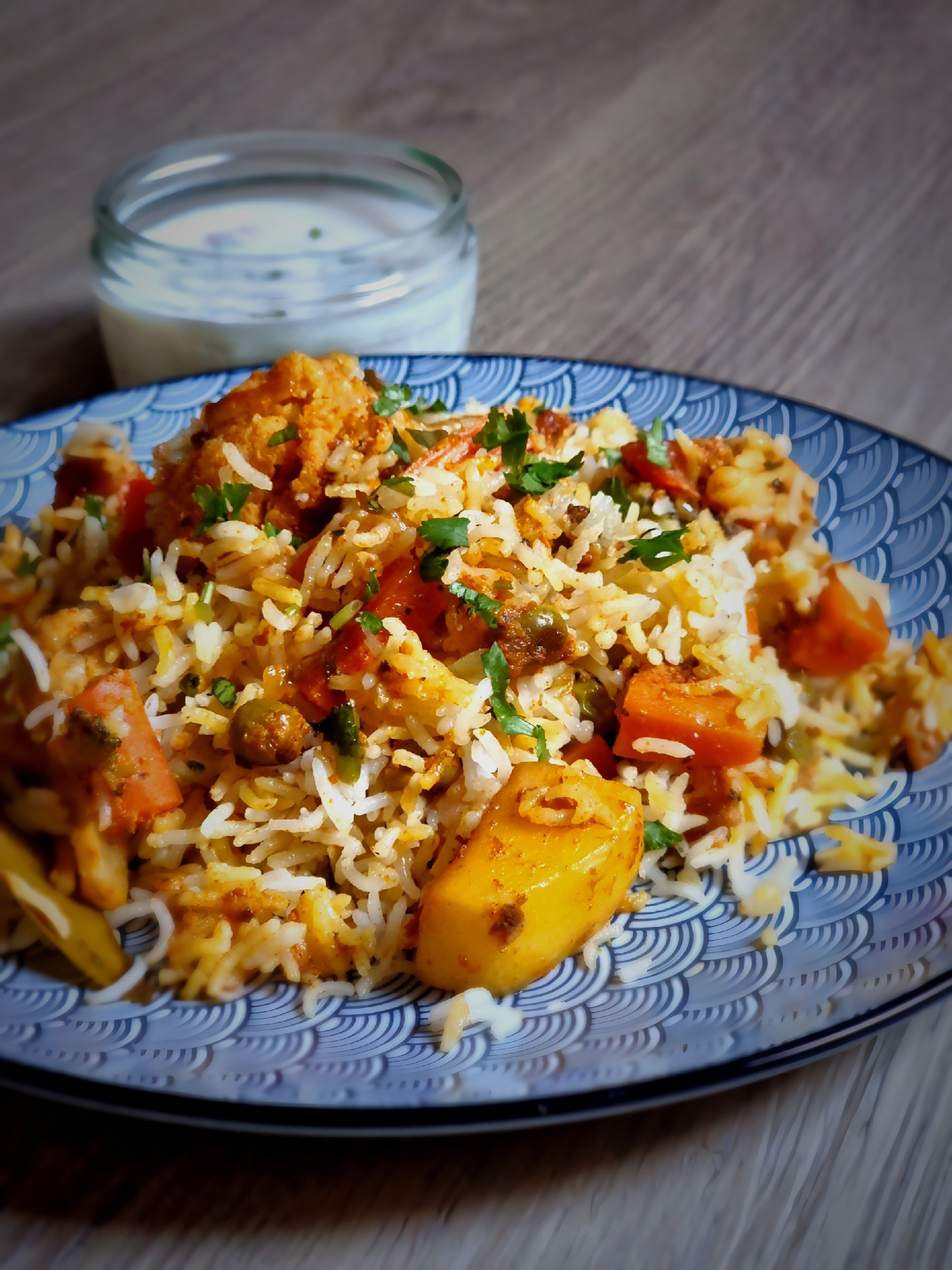
Photo: Tharun Thejus / Pexels
Indian
Vegetable Biryani
The diets react (see scores below)
Common Ingredients
- basmati rice
- mixed vegetables
- yogurt
- fried onions
- saffron
- mint
- ginger
- whole spices
Specific recipes may vary.
Incompatible with 6 of 11 diets
Diet Ratings
Vegetable Biryani is fundamentally incompatible with a ketogenic diet. The primary ingredient, basmati rice, is a high-glycemic grain that delivers approximately 45-50g of net carbs per single cup cooked serving — immediately exceeding or entirely consuming the daily keto carb limit on its own. Fried onions also contribute additional carbs. There is no meaningful fat content or protein source to offset this carbohydrate load. The vegetables, yogurt, and spices are minor components that cannot rescue the dish from its grain foundation. No reasonable portion size of traditional Vegetable Biryani is compatible with maintaining ketosis.
Vegetable Biryani as listed contains yogurt, which is a dairy product derived from cow's milk and is strictly excluded under vegan dietary rules. Despite all other ingredients — basmati rice, mixed vegetables, fried onions, saffron, mint, ginger, and whole spices — being fully plant-based, the inclusion of yogurt disqualifies this dish from vegan compliance. Traditional biryani recipes commonly use yogurt as a marinade and moisture base, making it a core ingredient rather than an incidental one. A vegan version is achievable by substituting yogurt with a plant-based alternative such as coconut yogurt or cashew cream, but the dish as described cannot be approved.
Vegetable Biryani is fundamentally incompatible with the Paleo diet. Its base ingredient — basmati rice — is a grain and is explicitly excluded under strict Paleo guidelines. Yogurt is a dairy product, also prohibited. Fried onions typically involve seed oils (such as sunflower or vegetable oil), which are excluded. While some individual ingredients — mixed vegetables, saffron, mint, ginger, and whole spices — are fully Paleo-approved, the core structural components of this dish (rice, yogurt, seed-oil-fried onions) make it impossible to classify as anything other than avoid. The dish cannot be considered Paleo even in a lenient interpretation, as grains and dairy are among the most consistently excluded food categories across all major Paleo frameworks.
Vegetable Biryani contains mostly Mediterranean-compatible ingredients — abundant mixed vegetables, yogurt, and aromatic spices (ginger, saffron, mint, whole spices) all align well with Mediterranean principles. However, the base is white basmati rice, a refined grain that Mediterranean guidelines prefer to limit in favor of whole grains. Fried onions also introduce a concern, as they are typically deep-fried in oil (often not olive oil) and add extra calories and potentially less healthy fats. The dish is vegetable-forward with no red meat, which is positive, and yogurt is an acceptable moderate dairy component. Overall it is a reasonable choice but not a Mediterranean staple due to the refined rice base and frying method.
Some Mediterranean diet practitioners, particularly those drawing on Middle Eastern and Eastern Mediterranean culinary traditions, are more accepting of white rice as a vehicle for vegetables and legumes, viewing it as preferable to processed convenience foods. In this context, a vegetable-heavy biryani with yogurt could be considered a reasonably compatible meal if olive oil were substituted for the frying fat.
Vegetable Biryani is entirely incompatible with the carnivore diet. The dish is plant-based at its core, with basmati rice as a grain carbohydrate, mixed vegetables, fried onions, saffron, mint, ginger, and whole spices — all strictly excluded plant foods. Even the yogurt, the sole animal-derived ingredient, is a minor and debated component. There is no animal protein source whatsoever. This dish violates virtually every foundational rule of the carnivore diet simultaneously: it contains grains, vegetables, plant spices, and plant-derived aromatics. No modification short of a complete reconstruction would make this carnivore-compatible.
Vegetable Biryani contains multiple Whole30-excluded ingredients. Basmati rice is a grain and is explicitly excluded from the Whole30 program. Yogurt is a dairy product and is also explicitly excluded. Fried onions are commonly prepared with flour or other coatings (grains) and often cooked in non-compliant oils. These are not minor or debatable violations — grains and dairy are core exclusions of the Whole30 program, making this dish clearly non-compliant regardless of how the other ingredients (vegetables, saffron, mint, ginger, whole spices) are all individually compliant.
Vegetable Biryani as traditionally prepared contains multiple high-FODMAP ingredients that make it unsuitable during the elimination phase. Fried onions are a major concern — onions are among the highest-fructan foods and are frequently used in generous amounts in biryani as both a base and garnish. Yogurt contributes lactose (high-FODMAP at standard serving sizes used in biryani marinades, typically 100g+). 'Mixed vegetables' in biryani often include cauliflower, peas, or mushrooms, which are moderate-to-high FODMAP. While basmati rice is low-FODMAP, ginger and saffron are low-FODMAP, and whole spices (cardamom, cloves, bay leaf, cinnamon) are low-FODMAP at culinary amounts, the combination of fried onions and yogurt alone is disqualifying. Even with substitutions, the dish as described cannot be considered low-FODMAP.
Vegetable Biryani contains several DASH-friendly components — basmati rice (a refined but relatively low-glycemic grain), mixed vegetables, yogurt (a DASH-approved low-fat dairy if using low-fat version), and anti-inflammatory spices like ginger, saffron, and mint. However, fried onions are a notable concern, as deep-frying adds significant oil and fat content, potentially including saturated fat depending on the cooking oil used. Traditional biryani preparations can also be moderately high in sodium depending on spice blends and added salt. The yogurt component is a positive element (calcium, protein), though full-fat yogurt would be less ideal for DASH. The dish lacks a lean protein source but compensates with vegetables. Overall, it is an acceptable DASH option if prepared with low-fat yogurt, minimal added salt, baked or lightly sautéed onions instead of deep-fried, and a DASH-friendly oil like canola or olive oil — but as traditionally prepared, the fried onions and potential sodium load warrant caution.
NIH DASH guidelines emphasize whole grains over refined grains like white basmati rice; some DASH clinicians would suggest substituting brown basmati rice for improved fiber and nutrient density. Conversely, updated clinical interpretations note that basmati rice has a lower glycemic index than many other white rices, and that a vegetable-heavy, spice-rich dish like biryani — when prepared with healthy oils and low-fat dairy — aligns reasonably well with DASH principles in practice.
Vegetable Biryani presents a significant Zone challenge primarily because basmati rice — even as the lower-GI rice option — is a high-carbohydrate, grain-based foundation that dominates the dish. In Zone terminology, grains are 'unfavorable' carbohydrates, and white basmati rice is limited to 0-1 servings per day. The dish is also carbohydrate-heavy overall, making it very difficult to achieve the 40/30/30 ratio without radical portion reduction. The mixed vegetables are Zone-favorable and contribute polyphenols and low-glycemic carbs, and yogurt adds a modest protein contribution. Fried onions add some saturated fat and additional carbohydrates. The spices (ginger, saffron, mint, whole spices) are anti-inflammatory and Zone-positive. However, with no designated lean protein source, the dish would need significant supplementation — a portion of fish, chicken, or tofu added alongside — to approach Zone balance. The macro profile as served is carbohydrate-dominant with inadequate protein and likely insufficient quality fat. A very small portion (perhaps 1/4 to 1/3 cup of rice-based biryani) alongside a lean protein could be worked into a Zone meal, but the dish as a standalone main is problematic.
Some Zone practitioners note that basmati rice has a relatively lower glycemic index compared to other white rices (GI ~50-58), and Sears' later writings emphasize the overall glycemic load and anti-inflammatory profile of a meal rather than rigid exclusion of any single grain. The abundant vegetables, yogurt, and anti-inflammatory spices (ginger, saffron) partially offset concerns. A small-portioned biryani with added protein could be considered a reasonable 'caution' choice rather than near-avoid territory. Additionally, vegetarian Zone adaptations allow slightly more flexibility with carbohydrate sources when plant-based protein is being used.
Vegetable Biryani has a genuinely mixed anti-inflammatory profile. On the positive side, it contains several standout anti-inflammatory components: ginger and whole spices (cumin, cardamom, cloves, cinnamon, bay leaf) are well-established anti-inflammatory agents; saffron contains crocin and safranal with documented antioxidant activity; mint provides rosmarinic acid and flavonoids; and mixed vegetables contribute antioxidants, fiber, and phytonutrients. Yogurt, a moderate food in this framework, adds probiotics that can support gut health and reduce systemic inflammation. Basmati rice, while a refined-adjacent carbohydrate, has a lower glycemic index than most white rices due to its amylose content, making it less inflammatory than standard white rice. The main concerns are the fried onions, which introduce cooking oils (often refined seed oils high in omega-6) and acrylamide from high-heat frying, and the overall carbohydrate load of a rice-dominant dish. The dish contains no significant omega-3 sources. Ghee, commonly used in biryani preparation, is not listed here but its absence keeps the saturated fat profile in check. Overall, this is a spice-rich, vegetable-inclusive dish that lands in 'caution' territory — genuinely beneficial elements are present, but the refined carbohydrate base and fried component prevent a full approval.
Some anti-inflammatory advocates, particularly those following lower-glycemic or grain-free protocols (e.g., Autoimmune Protocol or functional medicine practitioners like Dr. Mark Hyman), would rate this more cautiously due to the white rice base driving blood sugar spikes and insulin response, which can promote inflammatory signaling. Conversely, proponents of Dr. Weil's broader framework would likely rate it more favorably, emphasizing the dense spice profile — ginger, saffron, and whole spices — as meaningfully anti-inflammatory, and noting that basmati rice consumed in the context of a vegetable- and spice-rich meal has a blunted glycemic impact.
Vegetable Biryani is a mixed bag for GLP-1 patients. The basmati rice base provides moderate glycemic carbohydrates with relatively low fiber, and the dish is notably low in protein with no primary protein source listed — a significant drawback given that protein is the top priority on GLP-1 medications. The mixed vegetables contribute some fiber and micronutrients, and yogurt adds a small amount of protein and probiotics. Whole spices (cardamom, cloves, bay leaf, cinnamon) are generally well-tolerated and may even support digestion. However, fried onions are a concern — they add fat and can worsen nausea or bloating in GLP-1 patients due to slowed gastric emptying. Saffron, mint, and ginger are neutral to beneficial (ginger may actually help with nausea). The dish can be nutrient-dense if loaded with vegetables, but basmati rice as the dominant ingredient means the calorie profile skews toward refined carbohydrates rather than protein or fiber. For a GLP-1 patient eating small portions, this dish risks using up limited stomach capacity on carbohydrate-heavy calories without delivering adequate protein. It can be made more suitable by reducing rice, increasing vegetable volume, swapping fried onions for caramelized or raw onions, adding a protein source (paneer, tofu, chickpeas, or a side of Greek yogurt), and keeping portions modest.
Some GLP-1-focused dietitians are more permissive with basmati rice specifically because it has a lower glycemic index than many other white rices and can be part of a balanced small-portion meal, particularly when paired with a protein source at the same sitting. Others flag the fried onion component and the low protein density as meaningful concerns that make this a poor standalone main for GLP-1 patients without significant modification.
*See how scores were generated at our methodology page.
Nutritional profile
Six traits that cut across every diet.
Fiber & Plants
How much whole-plant food and fiber it delivers.
Healthy Fats
The quality of its fats (unsaturated, omega-3).
Whole / Unprocessed
How close it is to its natural, unprocessed form.
Gut Gentle
How easy it is on digestion (low FODMAP, few irritants).
Low Glycemic
How little it spikes your blood sugar.
Protein Density
How much protein it packs per calorie.
Controversy Index
Higher controversy = more disagreement between diets.
Diet-Specific Tips
 Mediterranean — 5/10
View tips
- White basmati rice is a refined grain, not preferred over whole grains in Mediterranean guidelines
- High proportion of mixed vegetables is strongly Mediterranean-compatible
- Yogurt is an acceptable moderate dairy component
- Fried onions add extra fat, likely not from olive oil
- No red meat or processed ingredients
- Aromatic spices and herbs (saffron, mint, ginger) align with Mediterranean flavor profiles
 DASH — 6/10
View tips
- Fried onions add significant fat and potentially saturated fat depending on oil used
- Mixed vegetables are a strong DASH-positive element
- Basmati rice is a refined grain; brown basmati would better align with DASH whole-grain guidance
- Yogurt provides calcium and protein — low-fat version preferred for DASH
- Spices (ginger, saffron, mint, whole spices) are sodium-free and DASH-compatible
- Sodium content depends heavily on preparation — added salt and spice blends can raise levels significantly
- No animal protein present, reducing saturated fat concerns
- Dish can be DASH-compliant with modifications: low-fat yogurt, healthy oil, reduced salt, baked onions
 Zone — 4/10
View tips
- Basmati rice is an 'unfavorable' Zone carbohydrate — grain-based and high glycemic load in typical serving sizes
- No primary lean protein source makes achieving 30% protein calories very difficult without supplementation
- Mixed vegetables are Zone-favorable and contribute low-glycemic carbs and polyphenols
- Yogurt provides modest protein and fits Zone dairy guidelines if low-fat
- Fried onions add saturated fat and extra glycemic carbohydrates
- Anti-inflammatory spices (ginger, saffron, mint) align well with Zone's polyphenol focus
- Dish is carbohydrate-dominant — very small portions required to maintain Zone ratios
- Would require pairing with lean protein (fish, chicken, tofu) to approach Zone balance
 Anti-Inflammatory — 6/10
View tips
- Ginger: well-documented anti-inflammatory compound (gingerols inhibit COX enzymes)
- Whole spices (cumin, cardamom, cloves, cinnamon): rich in polyphenols and antioxidants
- Saffron: contains crocin and safranal with antioxidant and anti-inflammatory properties
- Mixed vegetables: contribute fiber, carotenoids, and phytonutrients
- Mint: source of rosmarinic acid and flavonoids
- Basmati rice: lower GI than standard white rice but still a refined carbohydrate base
- Fried onions: likely cooked in refined seed oils high in omega-6; high-heat frying is a concern
- Yogurt: moderate food; probiotics may support gut-driven anti-inflammatory pathways
- No omega-3 sources present in this dish
 GLP-1 Friendly — 4/10
View tips
- No primary protein source — fails the #1 GLP-1 dietary priority
- Basmati rice dominates calorie profile with moderate glycemic carbohydrates
- Fried onions add fat and may worsen nausea or bloating
- Mixed vegetables contribute fiber and micronutrients but volume is variable
- Yogurt provides modest protein and probiotics — beneficial
- Whole spices are well-tolerated and digestive-friendly
- Ginger may help mitigate GLP-1-related nausea
- Small portions likely, but limited stomach capacity wasted on low-protein carbs
- Easily upgraded with chickpeas, tofu, or paneer to boost protein significantly