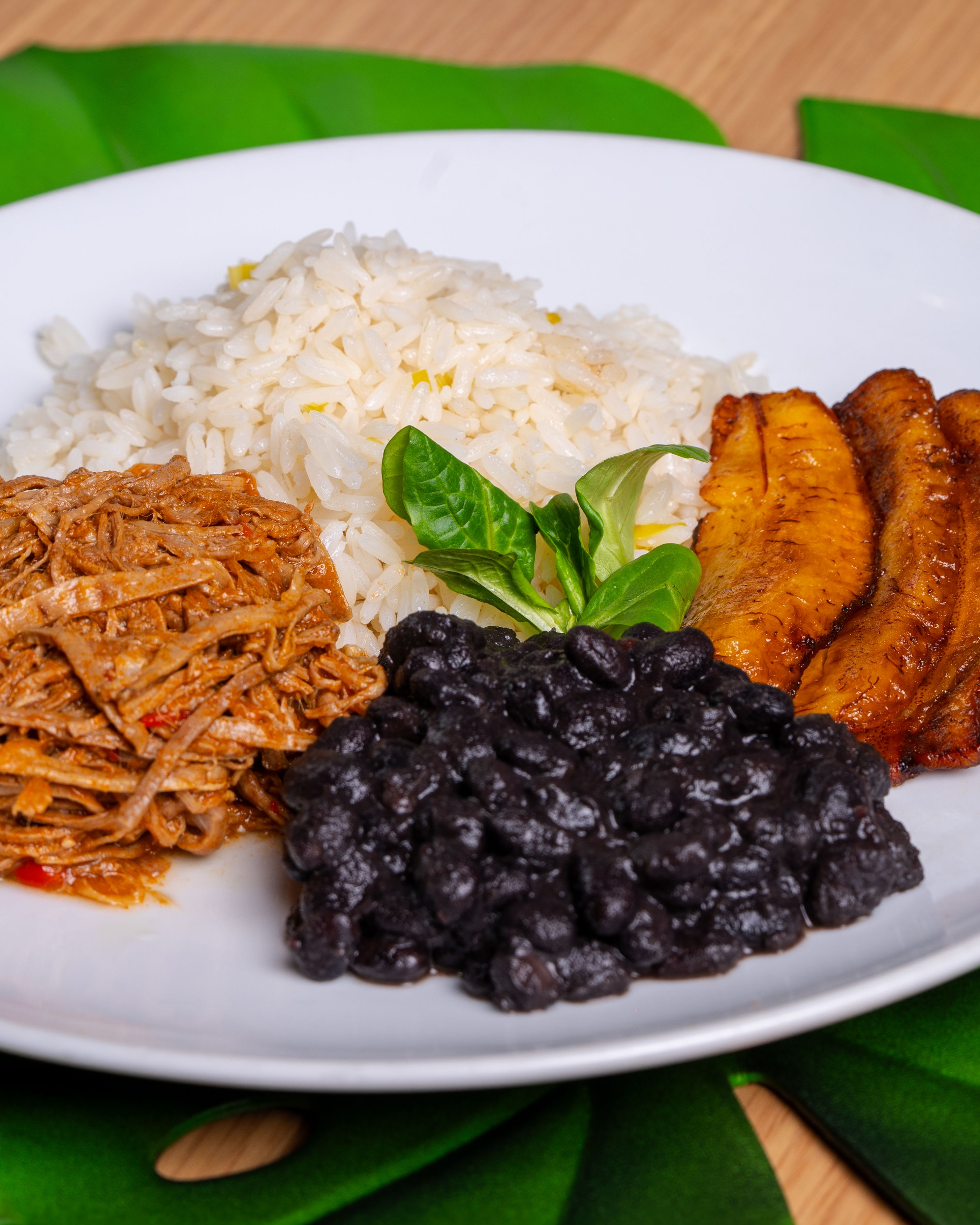
Photo: Nano Erdozain / Pexels
Latin-American
Pabellón Criollo
The diets react (see scores below)
Common Ingredients
- shredded beef
- black beans
- white rice
- fried plantains
- onion
- tomato sauce
- garlic
- cumin
Specific recipes may vary.
Incompatible with 7 of 11 diets
Diet Ratings
Pabellón Criollo is a Venezuelan national dish built around three high-carbohydrate components that are each individually incompatible with ketosis. White rice is a pure starch with virtually no fiber, contributing roughly 45g net carbs per cup. Black beans, while containing some fiber, still deliver around 20-25g net carbs per half-cup serving. Fried plantains (tostones or amarillos) add another 25-30g net carbs per serving. Together, a standard plate easily exceeds 80-100g net carbs, which is 2-5 times the entire daily keto allowance. The shredded beef component is keto-friendly, as are the aromatics (onion, garlic, cumin) in the small amounts typically used, but they cannot salvage this dish. This is not a matter of portion control — the dish's identity and structure are inseparable from its carbohydrate base. There is no realistic modification that preserves the dish while making it keto-compatible without completely replacing the core ingredients.
Pabellón Criollo is a traditional Venezuelan national dish whose defining component is shredded beef (carne mechada), an animal product that is categorically excluded from a vegan diet. While the accompanying elements — black beans, white rice, fried plantains, onion, tomato sauce, garlic, and cumin — are all plant-based, the presence of beef as the primary protein makes the dish as a whole incompatible with vegan principles. There is no ambiguity here: beef is animal flesh, and no vegan framework permits its inclusion.
Pabellón Criollo is built around three ingredients that are firmly excluded by paleo: black beans (a legume), white rice (a grain), and tomato sauce (likely processed with added salt/sugar). The shredded beef, onion, garlic, and cumin are paleo-approved, and fried plantains occupy a gray area (acceptable as a whole fruit/starch in moderation). However, the foundational components of this dish — beans and rice — represent exactly the foods the paleo framework was designed to eliminate. There is no meaningful paleo adaptation possible here without fundamentally deconstructing the dish into something unrecognizable as Pabellón Criollo. The legume and grain violations alone are enough to render a clear avoid verdict with high confidence.
Pabellón Criollo is a traditional Venezuelan dish that conflicts with several core Mediterranean diet principles. The primary protein is shredded beef, which is a red meat limited to only a few times per month under Mediterranean guidelines. The dish also features white rice (a refined grain) rather than a whole grain, and fried plantains add extra saturated or trans fat depending on cooking oil. On the positive side, the black beans are an excellent Mediterranean-compatible legume, and aromatics like onion, garlic, tomato sauce, and cumin are plant-based and encouraged. However, the combination of red meat as the central protein, refined white rice, and frying technique collectively push this dish outside acceptable Mediterranean diet territory for regular consumption.
Some Mediterranean diet practitioners argue that the black beans and vegetable components (onion, tomato, garlic) represent a plant-forward base worthy of a 'caution' rating rather than 'avoid,' especially if portions of beef are kept small. Additionally, plantains are a whole fruit, and if fried in olive or avocado oil in modest amounts, their impact could be considered less problematic by more flexible interpretations of the diet.
Pabellón Criollo is fundamentally incompatible with the carnivore diet. While it does contain shredded beef as its protein base, the dish is overwhelmingly composed of plant-based foods that are strictly excluded. Black beans are a legume — a category carnivore explicitly bans. White rice is a grain, also fully excluded. Fried plantains are a fruit/starchy plant food, excluded. The dish is seasoned with onion, garlic, tomato sauce, and cumin — all plant-derived ingredients forbidden on carnivore. Only the shredded beef itself would be permissible, but as a complete dish, Pabellón Criollo cannot be considered carnivore-compatible in any tier, including the most lenient 'animal-based' approach.
Pabellón Criollo contains multiple Whole30-excluded ingredients. Black beans are legumes, which are explicitly prohibited on the Whole30 program. White rice is a grain, also explicitly excluded. These two components are foundational to the dish and cannot be substituted without fundamentally changing it. The remaining components — shredded beef, fried plantains, onion, tomato sauce, garlic, and cumin — are largely Whole30-compatible (assuming the tomato sauce has no added sugar, and the plantains are fried in compliant oil), but the presence of both black beans and white rice makes this dish a clear avoid.
Pabellón Criollo contains multiple high-FODMAP ingredients that make it unsuitable during the elimination phase. Black beans are high in GOS (galacto-oligosaccharides) and are high-FODMAP at any standard serving size. Garlic is one of the highest-FODMAP foods, rich in fructans. Onion is similarly very high in fructans. Tomato sauce at typical serving sizes often exceeds low-FODMAP thresholds. While white rice and shredded plain beef are low-FODMAP, and ripe plantains are low-FODMAP at small servings, the combination of black beans, garlic, and onion as core structural ingredients makes this dish a clear avoid during elimination. There is no realistic way to modify this dish to low-FODMAP standards without fundamentally changing its character.
Pabellón Criollo is a mixed dish with both DASH-friendly and DASH-cautionary components. Black beans are an excellent DASH food — rich in fiber, potassium, magnesium, and plant protein. Fried plantains offer potassium and some fiber but add fat from frying. White rice is acceptable but refined (whole grain rice would score higher). Shredded beef is the main concern: it is red meat, which DASH limits, though a lean cut like flank or sirloin prepared without excessive sodium is more acceptable than fatty cuts. Tomato sauce, onion, garlic, and cumin are all DASH-compatible aromatics, though canned tomato sauce can contribute meaningful sodium. The overall dish is nutritionally diverse and not inherently unhealthy, but the combination of red meat, white rice (instead of whole grain), and fried plantains means it falls into the moderate/caution category rather than a core DASH meal. Sodium management and lean cut selection are key determinants of how DASH-compatible any individual preparation is.
NIH DASH guidelines categorically limit red meat and recommend low-fat protein sources, which would push shredded beef toward avoidance. However, updated clinical interpretations note that lean cuts of beef in modest portions (3–4 oz) fit within DASH's weekly red meat allowance, and the high fiber and potassium load from black beans and plantains meaningfully offset some cardiovascular risk — some DASH-oriented dietitians would consider this dish acceptable with whole grain rice and low-sodium tomato sauce substitutions.
Pabellón Criollo is a Venezuelan national dish combining shredded beef, black beans, white rice, and fried plantains. From a Zone Diet perspective, it presents significant macro-ratio challenges. The carbohydrate load is heavy and predominantly high-glycemic: white rice is a classic 'unfavorable' Zone carb with a high glycemic index, and fried plantains (especially ripe/sweet ones) are high in sugar and glycemic impact. Together these two components dominate the plate and push the carbohydrate ratio far above the Zone's 40% target while also skewing the glycemic quality. Black beans are a more favorable carb source — low glycemic, high fiber, and also contribute protein — and are a bright spot in this dish. Shredded beef (likely flank or chuck) is a moderate protein source; lean cuts are Zone-acceptable but some cuts carry higher saturated fat than preferred. The tomato sauce, onion, garlic, and cumin are Zone-friendly, low-glycemic flavor builders. In its traditional form, the carb-to-protein-to-fat ratio is badly imbalanced (carbs dominate, fat from frying plantains is often omega-6 vegetable oil), making it very difficult to eat as served in the Zone. However, a modified version — smaller rice portion, skipping or minimizing plantains, emphasizing beans and beef — could be brought closer to Zone ratios, which prevents a lower score.
Pabellón Criollo is a traditional Venezuelan dish with a mixed anti-inflammatory profile. On the positive side, black beans are an excellent anti-inflammatory food — high in fiber, plant protein, polyphenols, and associated with reduced inflammatory markers. Garlic, cumin, onion, and tomato sauce all contribute anti-inflammatory phytochemicals (allicin, quercetin, lycopene, antioxidants). Plantains provide resistant starch, potassium, and some antioxidants. These components meaningfully support anti-inflammatory eating. The problematic elements are the shredded beef and white rice. Beef is a 'limit' food in anti-inflammatory frameworks due to saturated fat and arachidonic acid content, which can promote inflammatory eicosanoids; however, lean cuts used for shredding (like flank or brisket, well-trimmed) moderate this concern. White rice is a refined carbohydrate that contributes to glycemic load without the fiber and micronutrient benefits of whole grains, though it is not inherently toxic or pro-inflammatory. The dish lacks omega-3 sources, extra virgin olive oil (cooking fat is unspecified and could be neutral or problematic), and has no leafy greens or cruciferous vegetables. Overall, the dish is a balanced traditional meal that skews neutral-to-moderate: the legume and spice components partially offset the red meat and refined carb concerns. It fits within the anti-inflammatory framework as an occasional meal rather than a dietary staple.
A stricter anti-inflammatory interpretation — as seen in protocols emphasizing minimal red meat and whole grains only — would rate this lower, citing beef's saturated fat and white rice's glycemic impact as meaningful inflammatory drivers. Conversely, researchers like Dr. David Katz who focus on dietary patterns rather than individual foods would note that the overall meal pattern here (legumes + vegetables + spices + modest meat) resembles the Mediterranean and MIND diet structures with documented anti-inflammatory benefits.
Pabellón Criollo is a nutritionally mixed dish for GLP-1 patients. The black beans are a genuine strength — they provide both plant protein and meaningful fiber (roughly 7-8g fiber and 7-8g protein per half cup), supporting two of the top priorities. The shredded beef contributes solid protein (roughly 20-25g per 3oz serving), though it carries moderate saturated fat depending on the cut used (flank or brisket are common). The white rice is a refined carbohydrate with low fiber and nutrient density, occupying stomach space that could be used for more nutrient-dense foods. The fried plantains are the most problematic element — sweet, higher in sugar, and fried in oil, adding calories and fat with limited protein or fiber payoff, and potentially worsening nausea or reflux in GLP-1 patients. The tomato-based sauce with onion, garlic, and cumin is digestively reasonable and adds micronutrients. As traditionally plated, this dish is large and calorie-dense across four distinct components, which conflicts with the small-portion, high-nutrient-density requirements of GLP-1 patients. A modified version — larger beans portion, smaller rice, skipping or baking the plantains, leaner beef cut — would score meaningfully higher.
Some GLP-1-focused dietitians would view the beans-and-beef combination favorably as a complementary protein and fiber pairing worth keeping, while others flag the overall glycemic load of rice plus sweet plantains as likely to cause blood sugar spikes and rebound hunger in a reduced-calorie context. Individual tolerance for the fried plantains varies significantly, with some GLP-1 patients reporting increased nausea from fried sweet foods while others tolerate them well in small amounts.
*See how scores were generated at our methodology page.
Nutritional profile
Six traits that cut across every diet.
Fiber & Plants
How much whole-plant food and fiber it delivers.
Healthy Fats
The quality of its fats (unsaturated, omega-3).
Whole / Unprocessed
How close it is to its natural, unprocessed form.
Gut Gentle
How easy it is on digestion (low FODMAP, few irritants).
Low Glycemic
How little it spikes your blood sugar.
Protein Density
How much protein it packs per calorie.
Controversy Index
Higher controversy = more disagreement between diets.
Diet-Specific Tips
 DASH — 5/10
View tips
- Black beans are a core DASH food: high in fiber, potassium, and magnesium
- Shredded beef is red meat, which DASH limits — lean cut and small portions matter
- White rice is refined grain; brown rice would be more DASH-aligned
- Fried plantains add potassium but also fat from frying oil
- Tomato sauce may contribute significant sodium depending on preparation
- Garlic, onion, and cumin are DASH-friendly flavor enhancers
- Dish provides a broad nutrient profile but requires portion control on beef and rice
 Zone — 4/10
View tips
- White rice is a high-glycemic 'unfavorable' Zone carbohydrate that elevates the glycemic load
- Fried plantains add additional high-glycemic, high-sugar carbs and likely omega-6 frying oil — both problematic for Zone
- Black beans are a Zone-favorable low-GI carb with fiber and protein, partially offsetting the other carbs
- Shredded beef provides Zone-acceptable protein but portion control is needed to hit ~25g protein/meal
- Traditional plate composition is heavily carb-dominant, making the 40/30/30 ratio very difficult to achieve without modification
- Aromatic base (onion, garlic, tomato sauce, cumin) is Zone-neutral to favorable
 Anti-Inflammatory — 5/10
View tips
- Black beans are a strong anti-inflammatory ingredient — high in fiber, polyphenols, and associated with reduced CRP
- Garlic, onion, cumin, and tomato provide meaningful anti-inflammatory phytochemicals (allicin, quercetin, lycopene)
- Shredded beef is a 'limit' food in anti-inflammatory frameworks due to saturated fat and arachidonic acid
- White rice is a refined carbohydrate with high glycemic impact — whole grain rice or brown rice would be preferable
- Plantains offer resistant starch and antioxidants, a mild positive contribution
- Cooking fat unspecified — use of neutral or inflammatory oils would worsen the profile; EVOO would improve it
- No omega-3 sources, leafy greens, or cruciferous vegetables present
- Dish is nutritionally balanced as a whole but lacks the anti-inflammatory-dense components that would push it to 'approve'
 GLP-1 Friendly — 5/10
View tips
- Black beans are a high-value fiber and plant protein source — a clear positive
- Shredded beef provides solid protein but carries moderate saturated fat depending on cut
- White rice is a refined carb with low fiber and nutrient density — occupies limited stomach space poorly
- Fried plantains add fat, sugar, and calories with minimal protein or fiber benefit and may worsen GI side effects
- Traditional serving size is large across four components — conflicts with small-portion GLP-1 guidance
- Dish is modifiable: reducing rice, skipping or baking plantains, and using lean beef improves the profile substantially