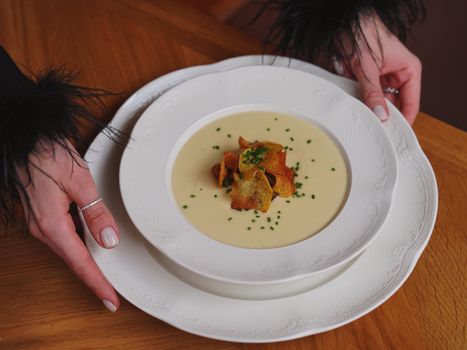
The diets react (see scores below)
Common Ingredients
- leeks
- potatoes
- onion
- chicken stock
- heavy cream
- butter
- chives
- white pepper
Specific recipes may vary.
Incompatible with 8 of 11 diets
Diet Ratings
Vichyssoise is fundamentally incompatible with ketogenic diet due to its primary ingredient: potatoes. Potatoes are a high-starch vegetable with approximately 15-17g net carbs per 100g, and they form the bulk of this soup's body and thickening. A single serving of vichyssoise could easily contain 200-300g of cooked potato, delivering 30-50g net carbs from that ingredient alone — potentially blowing the entire daily keto carb budget in one bowl. Leeks and onions also contribute moderate carbs (around 5-7g net carbs per 100g), compounding the problem. While the heavy cream and butter are perfectly keto-friendly, they cannot offset the disqualifying carb load from the starchy base. This dish cannot be made keto-compatible through portion control alone without fundamentally altering the recipe (e.g., replacing potatoes with cauliflower or celeriac).
Vichyssoise contains multiple animal-derived ingredients that make it clearly incompatible with a vegan diet. Chicken stock is an animal product derived from boiling chicken bones and meat. Heavy cream and butter are dairy products derived from cow's milk. With three distinct animal-derived ingredients, this dish fails vegan standards comprehensively. A vegan version could theoretically be made by substituting vegetable stock, coconut cream or cashew cream, and vegan butter, but the traditional recipe as listed here is not vegan.
Vichyssoise is a classic French cold potato-leek soup that contains multiple non-paleo ingredients. Heavy cream and butter are dairy products excluded under standard paleo rules. White potatoes are themselves a debated ingredient — discouraged by Cordain's original framework and The Paleo Diet's official guide, though accepted by some modern practitioners. White pepper is generally acceptable as a spice. The leeks, onion, chicken stock, and chives are all paleo-compliant. However, the combination of dairy (heavy cream, butter) as core structural ingredients — not incidental additions — makes this dish fundamentally non-paleo regardless of the potato debate. Even substituting ghee and coconut cream would be a significant reformulation, not the dish as presented.
Mark Sisson and some modern paleo practitioners accept both white potatoes and ghee, and would permit coconut cream as a dairy substitute — a reformulated version of this dish could reach 'caution' territory. However, as traditionally prepared with heavy cream and butter, no mainstream paleo authority would approve it.
Vichyssoise contains several Mediterranean-compatible ingredients (leeks, potatoes, onion, chives) but is built on a foundation of heavy cream and butter as primary fat sources, which directly conflicts with the Mediterranean diet's emphasis on olive oil as the principal fat. Heavy cream is high in saturated fat and is not a traditional Mediterranean ingredient. Chicken stock is acceptable in moderation. The vegetables (leeks, onion, potatoes) are positive components, but the creamy, butter-enriched preparation style is characteristic of classic French cuisine rather than Mediterranean traditions. The dish is not processed or high in added sugars, which prevents a lower score, but the dairy fat load keeps it firmly in caution territory.
Some Mediterranean diet practitioners note that moderate dairy consumption is acceptable, and a small serving of this soup could fit within a weekly dairy allowance. Traditional Mediterranean cuisines in southern France (Provence) do incorporate some cream-based preparations, and if portion-controlled, the vegetable base provides nutritional value.
Vichyssoise is a plant-dominant soup that fundamentally violates carnivore principles. The primary ingredients — leeks, potatoes, and onion — are all plant foods explicitly excluded from the carnivore diet. Potatoes are a starchy carbohydrate, leeks and onions are allium vegetables, and chives and white pepper are plant-derived garnishes/spices. While the dish does contain animal-derived components (chicken stock, heavy cream, butter), these are minor supporting ingredients in a dish whose entire identity and bulk is built on vegetables. No amount of animal-derived additions can redeem a dish that is structurally a vegetable purée. This is not a borderline case — it is a plant-based soup with animal condiments.
Vichyssoise contains two clearly excluded ingredients: heavy cream (dairy) and butter (dairy). Both are explicitly prohibited on the Whole30 program. Ghee or clarified butter is the only dairy exception allowed, and heavy cream has no compliant substitute in this context. The remaining ingredients — leeks, potatoes, onion, chicken stock, chives, and white pepper — are all Whole30-compliant, but the dairy components make this dish non-compliant as traditionally prepared.
Vichyssoise contains multiple high-FODMAP ingredients that make it unsuitable during the elimination phase. Leeks (the green tops are low-FODMAP in small amounts, but the white/light green parts are high in fructans), onion (one of the highest-FODMAP foods — significant fructan source, avoid at any quantity), and the combination of both together creates a heavily fructan-loaded dish. Potatoes are low-FODMAP, heavy cream is low-FODMAP at standard servings (fat-based, low lactose), butter is low-FODMAP, chives are low-FODMAP in small amounts, and white pepper is fine. However, leeks (white portion) and onion are foundational to this dish's flavor base — they cannot be omitted or reduced to trace quantities without fundamentally changing the soup. The dish is disqualified primarily by onion and the white portion of leeks.
Vichyssoise is a French cold soup made with leeks, potatoes, and onion — vegetables that are DASH-friendly and rich in potassium and fiber. However, the dish is defined by its heavy cream and butter base, both of which are high in saturated fat, directly conflicting with DASH guidelines that limit saturated fat and specify fat-free or low-fat dairy. Chicken stock adds moderate sodium depending on preparation (commercial stock can be very high in sodium). The combination of heavy cream and butter makes this a high saturated fat dish that DASH would not recommend in standard form. It scores low within caution because while the vegetable base is positive, the fat profile is problematic enough to nearly push it into avoid territory. A DASH-modified version using low-sodium stock and substituting heavy cream with low-fat milk or fat-free half-and-half would score significantly higher (6-7).
NIH DASH guidelines explicitly limit saturated fat and specify low-fat or fat-free dairy, making heavy cream and butter clearly problematic. However, some updated clinical interpretations note that full-fat dairy consumption has not been consistently linked to worse cardiovascular outcomes in recent meta-analyses, and a small serving of vichyssoise as a first course may fit within overall daily saturated fat limits if the rest of the day's diet is DASH-compliant.
Vichyssoise is fundamentally incompatible with Zone Diet principles on multiple fronts. Potatoes are explicitly classified as 'unfavorable' (high-glycemic) carbohydrates in Zone methodology — Dr. Sears specifically lists them among foods to avoid due to their rapid conversion to glucose and high glycemic load. Heavy cream and butter contribute significant saturated fat with virtually no monounsaturated fat, directly conflicting with Zone's fat quality guidelines. The dish provides essentially no lean protein (chicken stock contributes negligible protein), meaning the 40/30/30 macro ratio cannot be achieved even with heavy portioning manipulation. The fat-to-protein ratio is wildly skewed — this is primarily a high-glycemic carb and saturated fat dish. While the leeks and onions are Zone-acceptable alliums, they represent a small fraction of the dish's macro contribution. Even a small serving cannot be meaningfully balanced into a Zone meal because the carbohydrate source (potato) is explicitly unfavorable, the fat source (cream, butter) is saturated, and there is no adequate protein anchor. This is one of the rare cases where the Zone framework genuinely cannot accommodate the dish without fundamentally changing what makes it vichyssoise.
Vichyssoise is a classic French cold soup built around leeks and potatoes, which are nutritionally decent — leeks contain polyphenols and prebiotics, and potatoes offer vitamin C and potassium — but the dish is defined by its generous use of heavy cream and butter, both of which are saturated-fat-rich dairy products that anti-inflammatory guidelines recommend limiting. These ingredients elevate the saturated fat load considerably, which at high intake can promote inflammatory signaling. Chicken stock is relatively neutral and may offer some beneficial compounds. Chives provide minor antioxidant value, and white pepper has mild anti-inflammatory properties. However, there are no meaningful sources of omega-3s, anti-inflammatory polyphenols, or antioxidants at therapeutic levels. The dish is not aggressively pro-inflammatory — it contains no trans fats, refined sugar, high-fructose corn syrup, or seed oils — but the heavy cream and butter are the limiting factors that prevent an 'approve' verdict. This is an indulgent comfort dish that fits the 'limit' rather than 'avoid' category of saturated fat sources. Acceptable occasionally, but not aligned with anti-inflammatory principles as a regular dish.
Vichyssoise is a poor fit for GLP-1 patients. The dish is built on a base of heavy cream and butter, making it high in saturated fat — exactly the category that worsens GLP-1 side effects including nausea, bloating, and reflux. It offers negligible protein (no meaningful protein source in the ingredient list), low fiber relative to its calorie load, and is essentially calorie-dense with poor nutrient density per calorie. With slowed gastric emptying already a physiological effect of GLP-1 medications, a fat-heavy, cream-based soup will sit heavily in the stomach and is likely to trigger or amplify GI discomfort. Leeks and potatoes contribute some fiber and micronutrients, but not enough to offset the fat profile. The dish fails on three of the top four priorities: protein, low fat, and nutrient density per calorie.
*See how scores were generated at our methodology page.
Nutritional profile
Six traits that cut across every diet.
Fiber & Plants
How much whole-plant food and fiber it delivers.
Healthy Fats
The quality of its fats (unsaturated, omega-3).
Whole / Unprocessed
How close it is to its natural, unprocessed form.
Gut Gentle
How easy it is on digestion (low FODMAP, few irritants).
Low Glycemic
How little it spikes your blood sugar.
Protein Density
How much protein it packs per calorie.
Controversy Index
Higher controversy = more disagreement between diets.
Diet-Specific Tips
 Mediterranean — 4/10
View tips
- Heavy cream is a primary ingredient — high saturated fat, not Mediterranean-compatible as a fat source
- Butter used instead of olive oil, contradicting the core fat principle
- Leeks, onion, and potatoes are wholesome, Mediterranean-friendly vegetables
- Chicken stock is acceptable in moderation
- No processed ingredients or added sugars
- French culinary tradition, not Mediterranean in preparation style
- Could be adapted by substituting olive oil and reducing or eliminating cream
 DASH — 5/10
View tips
- Heavy cream is high in saturated fat — directly conflicts with DASH low-fat dairy requirement
- Butter adds additional saturated fat load
- Leeks, potatoes, and onion are DASH-approved vegetables providing potassium and fiber
- Chicken stock (especially commercial) can contribute significant sodium
- No lean protein present to offset nutritional concerns
- DASH-friendly modification possible: substitute low-fat milk for heavy cream and use low-sodium stock
- Portion size matters — a small first-course serving is less problematic than a main-course bowl
 Anti-Inflammatory — 4/10
View tips
- Heavy cream is high in saturated fat — a 'limit' ingredient under anti-inflammatory guidelines
- Butter adds additional saturated fat load
- Leeks provide prebiotic fiber and polyphenols — a modest positive
- Potatoes are a neutral starchy vegetable with some micronutrient value
- No omega-3 fatty acids present
- No significant anti-inflammatory spices (white pepper is minimal)
- No trans fats, added sugars, or seed oils — not aggressively pro-inflammatory