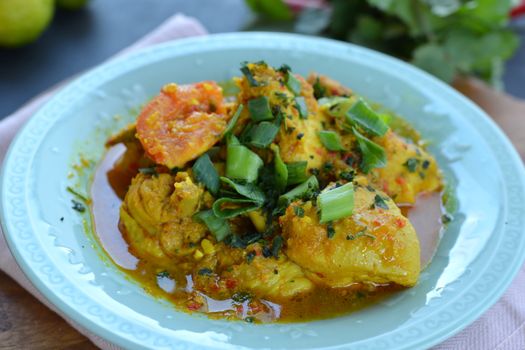
Photo: Nonik Yench / Pexels
Vietnamese
Vietnamese Chicken Curry (Cà Ri Gà)
The diets react (see scores below)
Common Ingredients
- chicken
- coconut milk
- sweet potato
- carrots
- lemongrass
- curry powder
- onion
- French bread
Specific recipes may vary.
Incompatible with 6 of 11 diets
Diet Ratings
Vietnamese Chicken Curry (Cà Ri Gà) is fundamentally incompatible with a ketogenic diet in its traditional form. The dish contains multiple high-carb ingredients that collectively push net carbs far beyond keto limits. Sweet potato is a starchy root vegetable with roughly 17-20g net carbs per 100g serving. Carrots add additional sugar and starch (~7g net carbs/100g). Onion contributes moderate carbs as well. Most critically, French bread (bánh mì) is served alongside as a traditional dipping component, adding a large bolus of grain-based carbohydrates. While chicken and coconut milk are keto-friendly, and lemongrass and curry powder are negligible, the starchy vegetables and bread make this dish a clear avoid. A heavily modified version (substituting sweet potato with cauliflower or zucchini, omitting carrots and bread) could potentially be keto-adapted, but the traditional dish as described is not.
Vietnamese Chicken Curry (Cà Ri Gà) is unambiguously non-vegan. Chicken is an animal product and the primary protein of this dish, making it incompatible with a vegan diet under any interpretation. There is no debate within the vegan community about the status of chicken — it is animal flesh and strictly excluded. The remaining ingredients (coconut milk, sweet potato, carrots, lemongrass, curry powder, onion, French bread) are predominantly plant-based, but the presence of chicken alone disqualifies the dish entirely.
Vietnamese Chicken Curry (Cà Ri Gà) is disqualified from a paleo perspective primarily due to the French bread (bánh mì), which is a wheat-based grain product and a clear paleo violation with no debate. The remaining ingredients are largely paleo-compatible: chicken is fully approved, coconut milk is paleo-friendly, sweet potato is an approved tuber, carrots and onion are whole vegetables, and lemongrass is a permitted herb. Curry powder is generally acceptable as a spice blend, though commercially prepared versions may contain added salt or fillers. Despite the strong base of paleo-compliant ingredients, the French bread — an integral serving component of the traditional dish — makes this an avoid. To make this dish paleo, simply omit the bread and serve as a standalone stew.
Vietnamese Chicken Curry is a mixed dish from a Mediterranean diet perspective. Chicken is an acceptable moderate protein (poultry is allowed a few times per week), and the vegetables—sweet potato, carrots, onion, lemongrass—are genuinely positive plant-forward components. However, coconut milk is a significant concern: it is high in saturated fat and is not part of Mediterranean dietary tradition, which uses extra virgin olive oil as the primary fat. The French bread component (refined grain) further detracts, as the Mediterranean diet emphasizes whole grains. The curry powder and aromatics are neutral to positive. Overall, the dish has good vegetable content and lean protein, but the coconut milk and refined bread pull it away from Mediterranean principles.
Some modern Mediterranean diet interpretations are more flexible about plant-derived saturated fats like coconut milk, viewing it as preferable to animal fats. Additionally, a strict traditionalist might note that bread is culturally central in many Mediterranean cuisines, though whole-grain or sourdough varieties are strongly preferred over refined baguette-style bread.
Vietnamese Chicken Curry (Cà Ri Gà) is almost entirely incompatible with the carnivore diet. While chicken is an acceptable animal protein, the dish is built around a foundation of plant-based ingredients: sweet potato and carrots are starchy vegetables explicitly excluded from carnivore; coconut milk is a plant-derived fat/liquid; lemongrass, curry powder, and onion are all plant-based aromatics and spices; and French bread is a grain-based food that is among the most prohibited items on any carnivore protocol. The only carnivore-compatible ingredient is the chicken itself. This dish represents a classic plant-heavy curry that cannot be modified into a carnivore meal without being fundamentally reconstructed.
Vietnamese Chicken Curry (Cà Ri Gà) is traditionally served with French bread (bánh mì), which is a wheat-based grain product and is explicitly excluded on the Whole30. Grains, including wheat, are among the core eliminated food groups for the full 30 days. All other components of this dish — chicken, coconut milk, sweet potato, carrots, lemongrass, curry powder, and onion — are Whole30-compliant. However, the inclusion of French bread makes the dish as described non-compliant. If the French bread is omitted and the curry is served on its own or over a compliant base (such as cauliflower rice or additional vegetables), the dish would be fully approvable.
Vietnamese Chicken Curry (Cà Ri Gà) contains multiple high-FODMAP ingredients that make it unsuitable during the elimination phase. Onion is one of the highest-fructan foods known and is a clear 'avoid' at any standard serving. French bread (wheat-based) is high in fructans and must be avoided. Sweet potato becomes high-FODMAP at portions above 70g (due to mannitol/GOS), and standard curry servings typically include far more than this threshold. Coconut milk can be low-FODMAP at 1/2 cup but many recipes use larger quantities. Chicken, carrots, lemongrass, and most curry powder blends are low-FODMAP. However, the presence of onion alone is a disqualifying factor — it cannot be simply reduced to a 'safe' amount — and the wheat-based French bread compounds the problem significantly. Even without the bread, standard preparation with onion makes this dish high-FODMAP.
Vietnamese Chicken Curry (Cà Ri Gà) contains a mix of DASH-friendly and DASH-problematic ingredients. On the positive side, chicken (lean protein), sweet potato, carrots, onion, lemongrass, and curry powder are all well-aligned with DASH principles — providing potassium, fiber, magnesium, and anti-inflammatory compounds. However, coconut milk is a significant concern: it is high in saturated fat from a tropical oil, which DASH guidelines explicitly limit. Full-fat coconut milk can contain 20-25g of saturated fat per cup, far exceeding DASH's emphasis on minimizing saturated fat. Additionally, French bread (bánh mì) served alongside adds refined carbohydrates with minimal fiber, displacing whole grain options preferred by DASH. Curry powder itself is sodium-contributing depending on blend, and the dish's overall sodium load from seasoning can be moderate to high. The dish is not categorically off-limits — the vegetables and lean chicken are strong DASH positives — but the coconut milk base and French bread make this a moderation food requiring meaningful modifications to fully align with DASH.
NIH DASH guidelines explicitly restrict tropical oils like coconut milk due to saturated fat content, recommending vegetable oils instead. However, some updated clinical interpretations note that coconut milk's saturated fat profile (rich in lauric acid and MCTs) may not raise LDL cholesterol in the same manner as long-chain saturated fats, and some DASH-oriented dietitians allow light coconut milk in small portions — though the AHA and standard DASH protocol have not formally revised this position.
Vietnamese Chicken Curry has a mixed Zone profile. The chicken is an excellent lean protein source that aligns perfectly with Zone principles. However, several components create challenges: (1) Coconut milk is high in saturated fat, conflicting with Zone's preference for monounsaturated fats — while Sears' later anti-inflammatory writings have softened somewhat on saturated fat, coconut milk's fat profile remains 'unfavorable' in classic Zone terminology. (2) Sweet potato is a higher-glycemic carbohydrate that Sears classifies as 'unfavorable' (though usable in small portions). (3) French bread is a classic Zone 'avoid' carb — high-glycemic, highly processed white bread that rapidly spikes blood glucose. (4) Carrots, lemongrass, onion, and curry powder (with its polyphenol/anti-inflammatory spices) are Zone-positive elements. The dish as traditionally served — ladled over or alongside French bread (bánh mì) — is the core problem. The coconut milk base also makes fat block management difficult since you're loading saturated fat rather than monounsaturated fat. With modification (skip the bread, reduce coconut milk or substitute with a lighter base, reduce sweet potato portion), this dish could become a 6. As traditionally served, it sits at 4.
Some Zone practitioners in Sears' later framework (particularly post-2011 'Zone Diet' refinements emphasizing polyphenols and anti-inflammatory focus) argue that coconut milk's medium-chain triglycerides have a different metabolic profile than long-chain saturated fats, and that the anti-inflammatory spices (curry powder, lemongrass) add meaningful polyphenol value. This view would rate the dish slightly higher (5-6) if bread is omitted and portions of sweet potato are controlled, treating it as a manageable 'caution' rather than borderline.
Vietnamese Chicken Curry presents a genuinely mixed anti-inflammatory profile. On the positive side, the dish contains several strongly anti-inflammatory ingredients: lemongrass (contains citral, anti-inflammatory terpenoids), curry powder (typically contains turmeric/curcumin, one of the most researched anti-inflammatory compounds, plus coriander, cumin, and chili), sweet potato (rich in beta-carotene, vitamin C, and anthocyanins), carrots (carotenoids), and onion (quercetin, a polyphenol with well-documented anti-inflammatory effects). Lean chicken as the primary protein is categorized as a 'moderate' food in anti-inflammatory frameworks. The problematic element is full-fat coconut milk, which is high in saturated fat (primarily lauric acid). While coconut milk's saturated fat profile is debated — lauric acid behaves differently than long-chain saturated fats — most mainstream anti-inflammatory authorities including Dr. Weil recommend limiting it rather than emphasizing it. The French bread (baguette, bánh mì-style) is a refined carbohydrate with a high glycemic index, which can promote post-meal inflammatory signaling and contributes no fiber or phytonutrients. The bread is a culturally authentic but nutritionally weak component. Overall, the dish's substantial anti-inflammatory spice and vegetable base is partially offset by coconut milk's saturated fat and the refined bread component. Swapping in whole grain bread or reducing bread would meaningfully improve the profile.
Coconut milk's role is the main source of debate here. Some anti-inflammatory researchers and Paleo/AIP-aligned practitioners (e.g., Chris Kresser, Mark Hyman) consider coconut milk acceptable or even beneficial, arguing lauric acid supports immune function and the MCT content has neutral-to-positive metabolic effects. Dr. Weil and mainstream anti-inflammatory guidance, however, place full-fat coconut milk in the 'use sparingly' category due to its saturated fat load, recommending light versions or less frequent use.
Vietnamese Chicken Curry has a genuinely mixed GLP-1 profile. The chicken is an excellent lean protein source and the vegetables (sweet potato, carrots, onion) add fiber, micronutrients, and water content. However, coconut milk is the central concern: it is high in saturated fat and calories, and fatty foods directly worsen GLP-1 side effects including nausea, bloating, and slowed gastric emptying. The French bread is a refined carbohydrate with low protein and fiber density, adding empty calories that crowd out more nutritious choices in a small-appetite context. Lemongrass and mild curry powder are generally well-tolerated. The dish can be made GLP-1-friendlier by substituting light coconut milk, reducing bread or swapping it for a high-fiber grain, and ensuring chicken portions are generous relative to other components. As typically prepared in a restaurant or traditional home recipe, the full-fat coconut milk content tips this into caution territory.
Some GLP-1-focused dietitians allow moderate full-fat coconut milk in small servings, noting that the medium-chain triglycerides (MCTs) in coconut fat may digest somewhat more readily than long-chain saturated fats, and that the overall meal can still meet protein targets if portioned carefully. Others are stricter, flagging any high-saturated-fat component as a GI risk for GLP-1 patients given slowed gastric emptying.
*See how scores were generated at our methodology page.
Nutritional profile
Six traits that cut across every diet.
Fiber & Plants
How much whole-plant food and fiber it delivers.
Healthy Fats
The quality of its fats (unsaturated, omega-3).
Whole / Unprocessed
How close it is to its natural, unprocessed form.
Gut Gentle
How easy it is on digestion (low FODMAP, few irritants).
Low Glycemic
How little it spikes your blood sugar.
Protein Density
How much protein it packs per calorie.
Controversy Index
Higher controversy = more disagreement between diets.
Diet-Specific Tips
 Mediterranean — 4/10
View tips
- Chicken is acceptable poultry protein, allowed in moderation per Mediterranean guidelines
- Coconut milk is high in saturated fat and not a traditional Mediterranean ingredient—olive oil is the canonical fat source
- Sweet potato, carrots, onion, and lemongrass are positive plant-based ingredients
- French bread is a refined grain, contradicting the preference for whole grains
- Dish is minimally processed and home-cooked, which aligns with Mediterranean eating patterns
- No red meat, added sugars, or highly processed ingredients present
 DASH — 4/10
View tips
- Coconut milk is high in saturated fat from a tropical oil — explicitly limited by DASH guidelines
- Chicken (lean protein) is a core DASH-approved food
- Sweet potato and carrots provide potassium, fiber, and key DASH micronutrients
- French bread is a refined grain, not aligned with DASH's whole grain emphasis
- Curry powder and seasoning may contribute moderate sodium depending on preparation
- Dish can be modified toward DASH compliance by substituting light coconut milk or low-fat evaporated milk and serving with whole grain bread
- Vegetables and lean protein components are genuinely DASH-positive elements
 Zone — 4/10
View tips
- French bread is a high-glycemic 'unfavorable' Zone carb that significantly disrupts the 40/30/30 ratio
- Coconut milk is high in saturated fat, conflicting with Zone's monounsaturated fat preference
- Sweet potato is an 'unfavorable' higher-glycemic carb in Zone terminology, though usable in small blocks
- Chicken is an ideal Zone lean protein source
- Carrots and onion are acceptable Zone carbohydrates
- Curry powder and lemongrass provide anti-inflammatory polyphenols aligned with Zone principles
- Dish can be modified for Zone compliance by eliminating bread and reducing sweet potato/coconut milk portions
 Anti-Inflammatory — 5/10
View tips
- Curry powder contains turmeric (curcumin) — a top anti-inflammatory compound in research
- Lemongrass provides anti-inflammatory terpenoids (citral, geraniol)
- Sweet potato and carrots deliver beta-carotene and antioxidant carotenoids
- Onion contributes quercetin, a well-studied anti-inflammatory flavonoid
- Lean chicken is an acceptable moderate protein in anti-inflammatory frameworks
- Full-fat coconut milk is high in saturated fat — recommended for limited use by most anti-inflammatory authorities
- French bread (baguette) is a refined carbohydrate with high glycemic index and no significant anti-inflammatory value
- No omega-3-rich ingredients present; dish lacks that key anti-inflammatory pillar
 GLP-1 Friendly — 5/10
View tips
- Chicken provides good lean protein — strong positive
- Full-fat coconut milk is high in saturated fat and may worsen nausea, bloating, and reflux on GLP-1 medications
- Sweet potato and carrots contribute fiber, micronutrients, and easy digestibility
- French bread is a refined grain with minimal protein and fiber — low nutrient density per calorie
- Meal can be significantly improved by using light coconut milk and omitting or minimizing bread
- Curry spices at typical Vietnamese mild levels are generally well-tolerated
- Portion sensitivity high — a small serving of the curry (without bread) is more GLP-1-appropriate than a full restaurant portion