Mediterranean
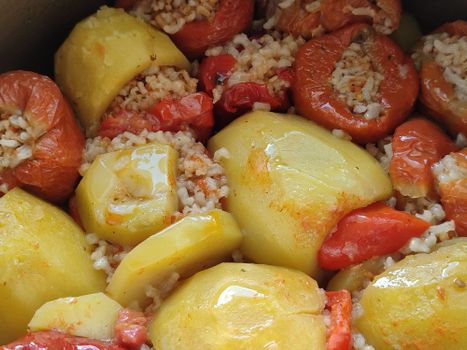
Yemista (Stuffed Vegetables)
The diets react (see scores below)
Common Ingredients
- tomatoes
- bell peppers
- rice
- onion
- herbs
- pine nuts
- olive oil
- potatoes
Specific recipes may vary.
Incompatible with 5 of 11 diets
Diet Ratings
Yemista is fundamentally incompatible with a ketogenic diet. The dish is built around rice as the primary filling ingredient, which is a high-carb grain containing roughly 45g of net carbs per cooked cup. Potatoes, another core ingredient, add approximately 15-20g net carbs per 100g. Even the vegetable vessels (tomatoes and bell peppers) contribute meaningful carbs. Combined, a standard serving of Yemista could easily deliver 60-90g of net carbs, far exceeding the entire daily keto limit of 20-50g in a single dish. There is no practical way to consume a meaningful portion of this dish while maintaining ketosis.
Yemista is a classic Greek/Mediterranean dish consisting entirely of whole plant foods. Tomatoes and bell peppers serve as the edible vessels, stuffed with a mixture of rice, onion, fresh herbs (typically parsley, mint, dill), pine nuts, and olive oil, with potatoes often roasted alongside to absorb the cooking juices. Every ingredient is unambiguously plant-derived with no animal products whatsoever. The dish is predominantly whole foods with minimal processing, and olive oil is a traditional, widely accepted vegan ingredient. Pine nuts add healthy fats and a modest protein contribution. This is an excellent example of naturally vegan Mediterranean cuisine that requires no substitutions or modifications.
Yemista contains rice as a primary ingredient, which is a grain and explicitly excluded from the paleo diet. Rice is a non-negotiable avoid across virtually all paleo frameworks, including Cordain, Sisson, and Wolf. The dish also includes white potatoes, which are debated but generally discouraged in stricter paleo interpretations. The remaining ingredients — tomatoes, bell peppers, onion, herbs, pine nuts, and olive oil — are all paleo-approved. However, rice is the structural filling of this dish and cannot be omitted without fundamentally changing it. The dish as traditionally prepared is not paleo-compatible.
Yemista is a classic Greek dish that exemplifies Mediterranean eating: abundant vegetables (tomatoes, bell peppers, potatoes) as the vessel and base, olive oil as the primary fat, herbs for flavor, and pine nuts adding healthy fats and texture. The only mild concern is the use of white rice as the stuffing grain, which is traditional but less optimal than a whole grain alternative under modern Mediterranean diet guidelines. Overall, this is a plant-forward, minimally processed dish with no red meat, no added sugars, and no refined ingredients beyond the rice, making it a strong Mediterranean staple.
Modern clinical Mediterranean diet guidelines (e.g., those from the PREDIMED study framework) favor whole grains over white rice, so some practitioners would slightly downgrade this dish or recommend substituting brown rice or farro. However, traditional Greek and broader Eastern Mediterranean practice has long used white rice in yemista without issue, and within a varied diet the white rice component is not a significant concern.
Yemista is entirely plant-based with zero animal-derived ingredients. Every single component — tomatoes, bell peppers, rice, onion, herbs, pine nuts, olive oil, and potatoes — is explicitly excluded on the carnivore diet. This dish contains grains (rice), vegetables, plant oils, nuts, and herbs, all of which violate the core carnivore principle of eating exclusively animal products. There is no debate within any tier of the carnivore community about this dish; it is completely incompatible.
Yemista contains rice, which is a grain and explicitly excluded on the Whole30 program. Rice is listed among the prohibited grains (wheat, oats, rice, corn, quinoa, etc.) and must be eliminated for the full 30 days. All other ingredients — tomatoes, bell peppers, onion, herbs, pine nuts, olive oil, and potatoes — are fully compliant on their own, but the inclusion of rice as a core stuffing ingredient makes the dish non-compliant as traditionally prepared.
Yemista contains onion as a primary filling ingredient, which is high in fructans and must be avoided during the elimination phase at any meaningful quantity. Onion is one of the highest-fructan foods tested by Monash University and cannot be made safe simply by reducing portion size within the context of a stuffed vegetable dish. The dish also typically uses pine nuts, which become high-FODMAP above ~1 tablespoon (due to GOS), and the portion consumed in a stuffed vegetable filling often exceeds this threshold. The remaining ingredients — tomatoes (caution above ~65g due to excess fructose accumulation), bell peppers (low-FODMAP in moderate serves), white rice (low-FODMAP), potatoes (low-FODMAP), olive oil (low-FODMAP), and herbs (generally low-FODMAP) — are mostly safe, but the onion alone disqualifies this dish during elimination. There is no practical way to substitute or remove onion from Yemista without fundamentally altering the dish's identity.
Yemista is a Greek dish of vegetables (tomatoes, bell peppers, potatoes) stuffed with rice, herbs, pine nuts, onion, and olive oil. The ingredient profile aligns strongly with DASH principles: abundant vegetables provide potassium, fiber, and micronutrients; olive oil is a heart-healthy unsaturated fat explicitly compatible with DASH; herbs add flavor without sodium; and rice provides carbohydrate energy. Pine nuts contribute healthy fats, magnesium, and some protein. The dish is naturally low in sodium (assuming no added salt beyond modest seasoning), contains no saturated fat, no red meat, no added sugar, and no processed ingredients. The main caution is portion control around white rice (a refined grain) and olive oil quantity, both of which can add calories. Substituting brown rice would improve the whole-grain profile. Overall this is a vegetable-forward, plant-based main dish very well suited to DASH.
NIH DASH guidelines emphasize whole grains over refined grains; traditional Yemista uses white rice, which is less preferred. Some DASH-oriented dietitians would rate this higher if brown rice were used, while others accept white rice in moderation as part of an otherwise nutrient-dense dish — particularly given the high vegetable content offsetting the refined grain concern.
Yemista presents several Zone Diet challenges. The dish is essentially carbohydrate-dominant with no protein source listed, making it structurally imbalanced from a Zone perspective. Rice is an 'unfavorable' carbohydrate in Zone terminology — moderately high glycemic index with limited fiber. Potatoes are explicitly flagged by Dr. Sears as a high-glycemic vegetable to avoid, similar to corn and bananas. The tomatoes and bell peppers are excellent Zone-favorable vegetables (low-glycemic, high in polyphenols), and olive oil is an ideal Zone monounsaturated fat. Pine nuts add some healthy fat and a small amount of protein. However, the overall macro profile skews heavily toward carbohydrates, with the rice and potatoes together creating a significant glycemic load, and no meaningful lean protein to anchor the 30% protein block. To make this Zone-compatible, one would need to substantially reduce or eliminate the rice and potatoes, add a lean protein (e.g., ground turkey or legumes), and keep the olive oil portion measured. As served traditionally, this dish is difficult to balance within Zone ratios without significant modification.
Yemista is a traditional Greek dish of vegetables stuffed with rice, herbs, pine nuts, and olive oil — a profile that aligns well with anti-inflammatory principles. Tomatoes and bell peppers are rich in antioxidants including lycopene, vitamin C, and carotenoids, all associated with reduced inflammatory markers. Extra virgin olive oil contributes oleocanthal, a natural COX inhibitor with ibuprofen-like anti-inflammatory action. Pine nuts provide monounsaturated fats and some omega-3s (ALA). Onion and herbs (typically parsley, mint, dill) supply quercetin and flavonoids. Potatoes are a mild starchy component — not inflammatory in whole form but also not especially beneficial. The main limitation is white rice, a refined carbohydrate that is largely neutral but offers little fiber; substituting brown rice would improve the profile. The dish is plant-forward, uses healthy fats, and contains no processed ingredients, trans fats, or added sugars — making it a solid anti-inflammatory choice.
Nightshade ingredients (tomatoes, bell peppers, potatoes) are embraced by mainstream anti-inflammatory frameworks like Dr. Weil's pyramid for their high antioxidant content, but Autoimmune Protocol (AIP) advocates and researchers like Dr. Tom O'Bryan argue that lectins and solanine in nightshades can trigger intestinal permeability and inflammation in sensitive or autoimmune-prone individuals. For the general population this concern is minimal, but those with autoimmune conditions may want to modify the dish.
Yemista is a traditional Mediterranean stuffed vegetable dish that has real nutritional merit but falls short as a GLP-1 primary protein source. The vegetable vessels (tomatoes, bell peppers) provide fiber, micronutrients, and high water content — all positives for GLP-1 patients. Olive oil contributes heart-healthy unsaturated fat in moderate amounts. However, the filling is rice-dominant with no primary protein source listed, making this a carbohydrate-heavy main dish. Pine nuts add healthy fats but also caloric density in a small volume. Potatoes on the side add further refined starch load. For a GLP-1 patient eating small portions, this dish delivers limited protein per serving, which is the #1 dietary priority. The fiber content from vegetables is a genuine benefit, and the dish is easy to digest and not greasy, which suits GLP-1 GI tolerance well. As a side dish or paired with a lean protein (grilled chicken, fish, or legumes added to the filling), this would rate higher. As a standalone main, it underdelivers on the protein target of 15-30g per meal.
Some GLP-1-focused dietitians working within Mediterranean dietary patterns accept rice-stuffed vegetables as an acceptable main when portion size is small, arguing the vegetable fiber and olive oil quality offset the low protein density. Others would recommend modifying the recipe to include lentils or ground lean protein in the filling to bring it in line with GLP-1 protein priorities.
*See how scores were generated at our methodology page.
Nutritional profile
Six traits that cut across every diet.
Fiber & Plants
How much whole-plant food and fiber it delivers.
Healthy Fats
The quality of its fats (unsaturated, omega-3).
Whole / Unprocessed
How close it is to its natural, unprocessed form.
Gut Gentle
How easy it is on digestion (low FODMAP, few irritants).
Low Glycemic
How little it spikes your blood sugar.
Protein Density
How much protein it packs per calorie.
Controversy Index
Higher controversy = more disagreement between diets.
Diet-Specific Tips
 Vegan — 9/10
View tips
- All ingredients are whole plant foods — no animal products present
- Tomatoes and bell peppers as stuffed vessels are nutrient-dense vegetables
- Rice provides complex carbohydrates as the primary filling base
- Pine nuts contribute healthy unsaturated fats and plant protein
- Olive oil is universally accepted as vegan
- Potatoes add satiety and complement the dish nutritionally
- No processed or mock-meat ingredients — qualifies as whole-food plant-based
- Naturally vegan as prepared in traditional Greek cuisine — no adaptation needed
 Mediterranean — 8/10
View tips
- Abundant vegetables as primary components (tomatoes, bell peppers, potatoes)
- Extra virgin olive oil as the cooking and flavoring fat
- Pine nuts add heart-healthy monounsaturated and polyunsaturated fats
- Herbs contribute antioxidants and flavor without added sodium
- White rice is traditional but a refined grain; whole grain substitution would improve score
- No animal protein, red meat, or processed ingredients
- Authentic Greek Mediterranean dish with deep traditional roots
 DASH — 8/10
View tips
- High vegetable content (tomatoes, bell peppers, potatoes) provides potassium, fiber, and antioxidants
- Olive oil is a DASH-compatible unsaturated fat
- Naturally low sodium — no processed or cured ingredients
- White rice is a refined grain; brown rice substitution would better align with DASH whole-grain emphasis
- Pine nuts add magnesium and healthy fats in small amounts
- No saturated fat, red meat, added sugar, or high-sodium components
- Olive oil quantity should be moderate to manage caloric density
 Zone — 4/10
View tips
- No lean protein source — dish is structurally deficient in the 30% protein block requirement
- Rice is an 'unfavorable' Zone carbohydrate with moderate glycemic index
- Potatoes are explicitly identified by Dr. Sears as a high-glycemic vegetable to avoid
- Tomatoes and bell peppers are excellent Zone-favorable, low-glycemic, polyphenol-rich vegetables
- Olive oil is an ideal Zone monounsaturated fat source
- Overall macro ratio skews heavily carbohydrate with insufficient protein and the fat from pine nuts and olive oil cannot compensate for the missing protein block
- Dish would require significant reformulation (remove potatoes, reduce rice, add lean protein) to fit Zone parameters
 Anti-Inflammatory — 8/10
View tips
- Tomatoes and bell peppers high in lycopene, carotenoids, and vitamin C
- Extra virgin olive oil provides oleocanthal with COX-inhibiting anti-inflammatory properties
- Pine nuts contribute monounsaturated fats and trace omega-3s (ALA)
- Onion and herbs supply quercetin and polyphenolic flavonoids
- White rice is a mild negative — low fiber, refined carbohydrate
- Potatoes are neutral — whole food starch, no additives
- Entirely plant-based with no processed ingredients or added sugars
- Nightshades may be a concern for autoimmune-sensitive individuals (low population-level risk)
 GLP-1 Friendly — 5/10
View tips
- No primary protein source — fails the 15-30g protein per meal target
- Rice-dominant filling is carbohydrate-heavy with limited nutrient density per calorie
- Vegetable vessels provide fiber, water content, and micronutrients — positives for GLP-1 patients
- Olive oil and pine nuts contribute healthy unsaturated fats but add caloric density
- Easy to digest, not greasy — suits GLP-1 GI tolerance
- Potatoes in the dish add additional starch load
- Easily upgraded by adding lentils, ground turkey, or white beans to the filling