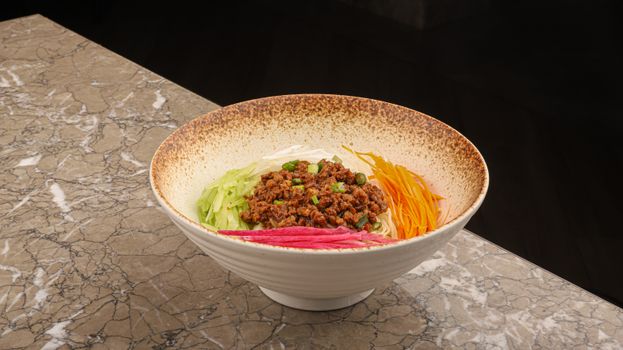
Photo: Change C.C / Pexels
Chinese
Zha Jiang Mian
The diets react (see scores below)
Common Ingredients
- wheat noodles
- ground pork
- sweet bean sauce
- yellow soybean paste
- cucumber
- scallions
- ginger
- garlic
Specific recipes may vary.
Incompatible with 8 of 11 diets
Diet Ratings
Zha Jiang Mian is fundamentally incompatible with a ketogenic diet. The primary component — wheat noodles — is a high-carb grain product that alone would exceed most people's entire daily net carb budget in a single serving (a typical portion contains 60-80g of net carbs). The sweet bean sauce and yellow soybean paste add significant additional sugars and carbohydrates. There is no realistic portion size or modification that makes this dish keto-compatible in its traditional form; the noodles are structural to the dish, not incidental.
Zha Jiang Mian as described contains ground pork, a direct animal product, making it clearly incompatible with a vegan diet. There is no ambiguity here — pork is animal flesh and is excluded under all definitions of veganism. The remaining ingredients (wheat noodles, sweet bean sauce, yellow soybean paste, cucumber, scallions, ginger, garlic) are plant-based, meaning a vegan adaptation is possible by substituting the pork with a plant protein such as crumbled tofu, tempeh, or mushrooms, but the dish as listed cannot be approved.
Zha Jiang Mian is fundamentally incompatible with the paleo diet. The dish is built on wheat noodles, a grain that is unambiguously excluded from all paleo frameworks. The two defining sauces — sweet bean sauce and yellow soybean paste — are both legume-based (soy) and heavily processed, double-failing paleo rules. These are not incidental ingredients; they are the core flavor base of the dish. While the supporting ingredients (ground pork, cucumber, scallions, ginger, garlic) are individually paleo-compliant, they cannot redeem a dish whose structural and flavor foundations are entirely non-paleo. There is no realistic paleo adaptation of this dish without replacing every primary component.
Zha Jiang Mian conflicts with Mediterranean diet principles on multiple fronts. The primary protein is ground pork, a red meat that should be limited to only a few times per month. The noodles are refined wheat noodles rather than whole grain. The fermented bean sauces (sweet bean sauce, yellow soybean paste) are high in sodium and sugar, constituting processed condiments. There is no olive oil, no legumes, no significant vegetables beyond garnish-level cucumber and scallions, and no fish or plant-forward protein. The dish is essentially a refined-carb, red-meat-heavy bowl with salty processed sauces — nearly the opposite of Mediterranean diet ideals.
Zha Jiang Mian is fundamentally incompatible with the carnivore diet. The dish is built almost entirely on plant-derived and processed ingredients. Wheat noodles are a grain-based food, completely excluded on carnivore. Sweet bean sauce and yellow soybean paste are fermented legume/grain products with added sugars and plant compounds. Cucumber, scallions, ginger, and garlic are all plant foods explicitly excluded. The only carnivore-compatible ingredient is the ground pork, which represents a small fraction of the dish. This is essentially a plant-heavy noodle dish with a pork topping — the opposite of a carnivore meal.
Zha Jiang Mian contains multiple Whole30-excluded ingredients. Wheat noodles are a grain product and explicitly excluded. Sweet bean sauce and yellow soybean paste are soy-based condiments, and soy is a legume that is fully excluded from Whole30. This dish is fundamentally incompatible with the program in its traditional form and cannot be made compliant without replacing the core ingredients that define the dish.
Zha Jiang Mian is heavily problematic from a FODMAP perspective due to multiple high-FODMAP ingredients stacked together. Wheat noodles are the base of the dish and are high in fructans — a primary FODMAP trigger. Garlic is one of the highest-FODMAP foods tested by Monash University, with even tiny amounts exceeding safe thresholds. Scallions (white parts) are also high in fructans, though the green tops are low-FODMAP. Sweet bean sauce and yellow soybean paste are made from fermented soybeans and wheat, both of which contribute significant GOS and fructans. Ground pork itself is low-FODMAP, as are cucumber and ginger. However, the combination of wheat noodles + garlic + high-FODMAP fermented bean sauces makes this dish essentially unavoidable for IBS sufferers in the elimination phase. There is no realistic way to make a traditional Zha Jiang Mian low-FODMAP without fundamentally changing the dish (substituting rice or gluten-free noodles, eliminating garlic, and replacing the bean sauces).
Zha Jiang Mian is a high-sodium dish that conflicts with core DASH principles in multiple areas. The two primary sauce components — sweet bean sauce and yellow soybean paste — are heavily fermented, salt-cured condiments that together can contribute 1,500–2,500mg of sodium per serving, potentially exceeding the entire daily DASH sodium allowance in a single meal. Ground pork adds saturated fat and cholesterol. Refined wheat noodles (non-whole grain) provide minimal fiber and no meaningful potassium, calcium, or magnesium. While the dish does include DASH-friendly aromatics and vegetables (cucumber, scallions, ginger, garlic), these represent a small fraction of the overall dish and do not offset the sodium and saturated fat burden. The overall nutritional profile is fundamentally misaligned with DASH goals of low sodium, low saturated fat, and nutrient-dense whole foods.
Zha Jiang Mian presents significant Zone Diet challenges but isn't categorically incompatible. The primary structural problem is wheat noodles, which are high-glycemic and would dominate the carbohydrate blocks, spiking insulin response — the opposite of Zone's low-glycemic carb philosophy. Ground pork is a moderately favorable protein but tends to be fattier than ideal Zone proteins (skinless chicken, fish), introducing more saturated fat. Sweet bean sauce and yellow soybean paste add fermented soybean complexity — the pastes contribute sodium and some sugar, raising the glycemic load of the dish further. On the positive side, cucumber provides a favorable low-glycemic vegetable component, and scallions, garlic, and ginger offer polyphenol benefits Sears would appreciate for their anti-inflammatory properties. A Zone-adapted version could substitute shirataki noodles or reduce noodle portion dramatically while increasing cucumber volume, swap ground pork for leaner ground turkey or chicken, and use a smaller amount of the paste sauces to control added sugars. As traditionally prepared, the noodle-to-protein ratio is heavily skewed toward high-GI carbohydrates, the fat profile leans saturated rather than monounsaturated, and the 40/30/30 macro balance would be difficult to achieve without significant modification.
Some Zone practitioners note that traditional Zha Jiang Mian, when portioned carefully with a modest noodle serving and generous pork-sauce topping, can approximate Zone blocks — particularly if served as a smaller portion within a meal that includes additional low-glycemic vegetables on the side. Sears' later writings also acknowledge that polyphenol-rich fermented foods (like soybean paste) have anti-inflammatory benefits that partially offset glycemic concerns. The dish's fermented soybean components may also have a lower effective glycemic impact than pure refined carb sources.
Zha Jiang Mian presents a mixed inflammatory profile. On the positive side, garlic and ginger are well-established anti-inflammatory spices, scallions provide quercetin and flavonoids, and cucumber adds antioxidants and hydration. The fermented soybean-based sauces (sweet bean sauce and yellow soybean paste) contain beneficial probiotics and isoflavones from soy, which have some anti-inflammatory support. However, several factors push this dish toward caution: (1) Ground pork is red meat, which anti-inflammatory guidelines consistently recommend limiting due to saturated fat content and associations with elevated CRP and IL-6; (2) Wheat noodles are refined carbohydrates with minimal fiber, likely contributing to glycemic load and insulin response; (3) Sweet bean sauce typically contains added sugar, which is pro-inflammatory; (4) The fermented sauces are also high in sodium, which at excessive intake is associated with endothelial inflammation. The dish is not categorically inflammatory — it has real redeeming qualities from the aromatics and fermented soy — but the combination of red meat, refined noodles, and high-sugar/sodium sauces makes it a moderate-caution food as prepared traditionally.
Some anti-inflammatory researchers (including those influenced by traditional Asian dietary patterns) would rate fermented soybean pastes more favorably, citing their probiotic activity and isoflavone content as meaningfully anti-inflammatory — potentially offsetting concerns about the pork component. Conversely, stricter anti-inflammatory protocols like AIP or those emphasizing glycemic control would rate this dish lower, flagging both wheat (gluten) and the sugar in sweet bean sauce as significant inflammatory triggers, particularly for individuals with autoimmune conditions or metabolic syndrome.
Zha Jiang Mian presents a mixed nutritional profile for GLP-1 patients. The ground pork provides meaningful protein, but it is a fatty cut — traditional recipes use a significant amount of pork fat that renders into the sauce, raising the overall saturated fat content per serving and increasing risk of GLP-1 side effects like nausea, bloating, and reflux. The wheat noodles are refined carbohydrates with low fiber and low protein density, which is a poor use of limited caloric capacity. The fermented soybean pastes (sweet bean sauce, yellow soybean paste) add sodium and a small amount of protein but also contribute sugar and processed ingredients. On the positive side, the cucumber and scallion garnishes add hydration and modest fiber, and the dish is not fried. However, the combination of high refined starch, moderate-to-high fat from the pork sauce, and low fiber overall makes this a suboptimal choice for GLP-1 patients. A modified version — lean ground chicken or turkey, reduced sauce quantity, added vegetables, and substituting whole wheat or high-protein noodles — would score considerably higher.
Some GLP-1-focused dietitians may rate this more favorably when portion size is tightly controlled, noting that the fermented paste ingredients have probiotic-adjacent properties and the dish provides a reasonable protein hit if meat-to-noodle ratio is high. Others flag ground pork fat content as a consistent GI trigger in patients with slowed gastric emptying and would recommend avoiding it entirely regardless of portion.
*See how scores were generated at our methodology page.
Nutritional profile
Six traits that cut across every diet.
Fiber & Plants
How much whole-plant food and fiber it delivers.
Healthy Fats
The quality of its fats (unsaturated, omega-3).
Whole / Unprocessed
How close it is to its natural, unprocessed form.
Gut Gentle
How easy it is on digestion (low FODMAP, few irritants).
Low Glycemic
How little it spikes your blood sugar.
Protein Density
How much protein it packs per calorie.
Controversy Index
Higher controversy = more disagreement between diets.
Diet-Specific Tips
 Zone — 4/10
View tips
- Wheat noodles are high-glycemic, classified as 'unfavorable' carbohydrates in Zone terminology
- Ground pork contains more saturated fat than ideal Zone lean proteins
- Sweet bean sauce and soybean paste add sugar and sodium, increasing glycemic load
- Cucumber provides a favorable low-glycemic Zone vegetable component
- Garlic, ginger, and scallions contribute anti-inflammatory polyphenols valued by Sears
- Macro ratio skews heavily toward carbohydrates, disrupting 40/30/30 balance
- Dish is salvageable with portion reduction of noodles and addition of non-starchy vegetables
 Anti-Inflammatory — 4/10
View tips
- Ground pork (red meat) — limited in anti-inflammatory guidelines due to saturated fat
- Refined wheat noodles — high glycemic load, low fiber, minimal anti-inflammatory value
- Sweet bean sauce — contains added sugars, pro-inflammatory at higher quantities
- Fermented soybean paste — probiotic activity and isoflavones offer modest anti-inflammatory benefit
- Garlic and ginger — well-documented anti-inflammatory spices (allicin, gingerols)
- High sodium content from fermented sauces — associated with vascular inflammation at excess
- Fresh cucumber and scallions — provide antioxidants and flavonoids
 GLP-1 Friendly — 4/10
View tips
- Ground pork is a moderate-to-high fat protein source; saturated fat content increases nausea and bloating risk with slowed gastric emptying
- Wheat noodles are refined carbohydrates — low fiber, low protein density, poor nutrient density per calorie
- Sweet bean sauce and soybean paste add sodium and sugar; high sodium is a concern for GLP-1 patients managing blood pressure
- Cucumber and scallion garnishes add hydration and minimal fiber — a small positive
- Dish is not fried, reducing one major GLP-1 risk factor
- Overall fiber content is low, failing the GLP-1 fiber priority of 25-30g daily
- High carbohydrate-to-protein ratio is unfavorable for muscle preservation during GLP-1-driven weight loss
- Portion sensitivity: even a small serving delivers a significant refined carb load relative to its nutritional return