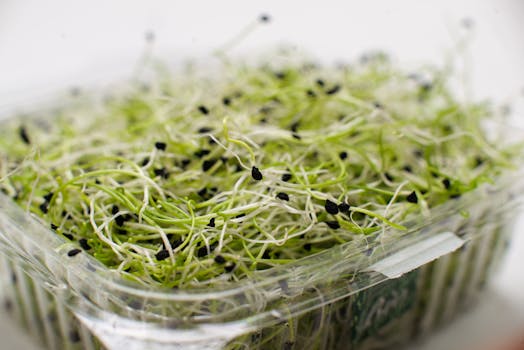
The diets react (see scores below)
Diet Ratings
Alfalfa sprouts contain only 0.7g net carbs per 100g with excellent nutrient density and bioavailability. They are a keto staple for salads and wraps with virtually zero carb impact and high micronutrient content.
Whole plant food, unprocessed, no animal products or derivatives. Excellent whole-food vegan staple with high nutrient density.
Sprouts are technically unprocessed plant foods, but alfalfa is a legume. While sprouting reduces anti-nutrients, the legume classification creates ambiguity. Fresh sprouts have minimal processing but legume origin is problematic.
Some paleo practitioners accept alfalfa sprouts because sprouting significantly reduces phytic acid and lectins, and the amount consumed is typically minimal. Others strictly exclude all legume-derived foods regardless of preparation method.
Nutrient-dense sprout with high vitamin K and antioxidants. Whole, unprocessed food. Excellent in salads with olive oil dressing. Minimal calories, high nutritional density.
Alfalfa sprouts are plant-derived and excluded on carnivore diet. No animal-derived content. Incompatible with carnivore framework.
Whole, unprocessed vegetable sprout with no excluded ingredients. Fully compliant.
Monash University rates alfalfa sprouts as low-FODMAP at 33g serving. Sprouting process reduces oligosaccharides. Minimal FODMAP content.
Very low sodium, low-calorie vegetable with good fiber, potassium, and phytonutrients. Minimal processing. Excellent DASH-compliant addition to salads and meals.
Minimal net carbs (~1.3g per 100g). Excellent source of plant-based polyphenols and phytoestrogens. Very low calorie density. Sprouts provide bioavailable micronutrients. Ideal for unlimited Zone vegetable consumption. Dr. Sears explicitly recommends sprouts.
Nutrient-dense with vitamin K, folate, and some antioxidants. However, raw sprouts carry higher food safety risk (bacterial contamination). Contains saponins which may interfere with nutrient absorption in some individuals. Cooked sprouts are safer. Minimal inflammatory markers but safety concerns warrant caution.
Dr. Weil and mainstream nutrition support sprouts as nutrient-dense foods. The AIP protocol excludes legume sprouts due to lectin content, though alfalfa is technically not a legume. Food safety concerns are the primary caution rather than inflammatory properties.
Extremely low-calorie (23 calories per 100g) with minimal carbs (2g per 100g), good fiber (1.9g per 100g), and moderate protein (2.9g per 100g). High water content (91%) supports hydration. Raw sprouts are easy to digest and nutrient-dense. Excellent for adding volume to meals without caloric burden. Ideal GLP-1 companion food.
Nutritional profile
Six traits that cut across every diet.
Fiber & Plants
How much whole-plant food and fiber it delivers.
Healthy Fats
The quality of its fats (unsaturated, omega-3).
Whole / Unprocessed
How close it is to its natural, unprocessed form.
Gut Gentle
How easy it is on digestion (low FODMAP, few irritants).
Low Glycemic
How little it spikes your blood sugar.
Protein Density
How much protein it packs per calorie.
Controversy Index
Score range: 1–9/10. Higher controversy = more disagreement between diets.
Diet-Specific Tips for Alfalfa sprouts
 Keto — 9/10
- 0.7g net carbs per 100g
- Excellent nutrient bioavailability
- Virtually zero ketosis impact
- Versatile keto ingredient
 Vegan — 9/10
- Whole plant food
- Unprocessed
- No animal products
- Nutrient-dense
- Sprouted legume
 Paleo — 5/10
- Legume-derived
- Sprouted form
- Reduced anti-nutrients
- Minimal processing
 Mediterranean — 7/10
- whole plant food
- high nutrient density
- raw preparation
- excellent salad component
 Whole30 — 9/10
- Whole food source
- No excluded ingredients
- Nutrient-dense
 Low-FODMAP — 8/10
- Low GOS content after sprouting
- Low fructan content
- Monash-tested
 DASH — 8/10
- very low sodium
- good fiber content
- high potassium
- minimal processing
- rich in phytonutrients
 Zone — 9/10
- Minimal net carbs
- High polyphenol density
- Bioavailable micronutrients
- Unlimited consumption
 Anti-Inflammatory — 5/10
- High in vitamin K and folate
- Contains some antioxidants
- Raw food safety concerns
- Contains saponins
- Minimal inflammatory markers
 GLP-1 Friendly — 7/10
- Extremely low calorie density
- Very low carbohydrate load
- Good fiber content
- Moderate protein for a vegetable
- High water content
- Adds meal volume without calories