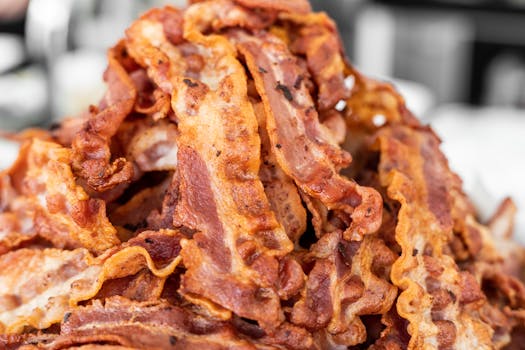
The diets react (see scores below)
Diet Ratings
Bacon is zero-carb with exceptional fat content (~40% fat) and moderate protein. Ideal for keto macros, adds flavor, and provides satiety. Unprocessed varieties preferred.
Bacon is cured pork meat, explicitly excluded from all vegan diets. It is an animal product with no plant-based alternative consideration.
Bacon is processed pork with added salt and often nitrates/nitrites. While some paleo practitioners accept uncured, unsalted bacon, most mainstream paleo sources recommend limiting processed meats due to additives and high sodium.
Some paleo authorities, including Mark Sisson, accept high-quality, minimally processed bacon (uncured, no nitrates) as an occasional paleo food. However, Loren Cordain and strict paleo interpretations discourage all processed meats.
Bacon is a processed meat product high in saturated fat, sodium, and often contains added sugars and preservatives. It directly contradicts Mediterranean principles minimizing processed foods and limiting red meat. Not a traditional Mediterranean food.
Bacon is animal-derived pork fat and meat. High-quality bacon with minimal additives (salt and smoke only, no sugar or plant-based fillers) is approved. Check labels for added sugars or plant-based ingredients.
Bacon is technically compliant if it contains no added sugar or other excluded ingredients. However, many commercial bacon products contain added sugar or curing agents. Check ingredient labels carefully—compliant bacon exists but requires verification.
Melissa Urban and official Whole30 guidelines state that uncured, sugar-free bacon is compliant. However, the majority of retail bacon contains added sugar or questionable curing agents, making it a practical caution item for most consumers.
Bacon is cured pork with no FODMAPs. Monash University confirms plain bacon as low-FODMAP at any reasonable serving size.
Extremely high in saturated fat, sodium (300-400mg per 2 slices), and processed. Directly contradicts DASH guidelines limiting processed meats, saturated fat, and sodium.
Bacon is 40-50% fat, predominantly saturated. Two slices (~14g) provide only ~3g protein but ~11g fat. Incompatible with Zone ratios and pro-inflammatory. Dr. Sears explicitly recommends avoiding fatty processed meats.
Processed meat with high saturated fat, sodium, and often nitrates/nitrites. Curing process creates inflammatory compounds. Strong association with increased inflammation markers and cardiovascular disease. Should be strictly avoided in anti-inflammatory diet.
Bacon is extremely high in saturated fat (9g per 2 slices), calories (80-100 per 2 slices), and sodium, with minimal protein (6g per 2 slices) relative to fat content. It is a processed meat with poor nutrient density per calorie. High fat content significantly worsens GLP-1 side effects. It provides no clinical benefit for GLP-1 patients and should be avoided entirely.
Nutritional profile
Six traits that cut across every diet.
Fiber & Plants
How much whole-plant food and fiber it delivers.
Healthy Fats
The quality of its fats (unsaturated, omega-3).
Whole / Unprocessed
How close it is to its natural, unprocessed form.
Gut Gentle
How easy it is on digestion (low FODMAP, few irritants).
Low Glycemic
How little it spikes your blood sugar.
Protein Density
How much protein it packs per calorie.
 DASH+4
 Anti-Inflammatory+4
 Mediterranean+3+2 more
 Paleo−3
 Carnivore−3
 Keto−2
Similar on the other 3 diets
Swaps into 51 dishes
Controversy Index
Score range: 1–10/10. Higher controversy = more disagreement between diets.
Diet-Specific Tips for Bacon
Keto — 10/10- Zero net carbs
- 40% fat content
- High satiety
- Flavor enhancer for other foods
Paleo — 5/10- Processed meat
- Added salt
- Potential nitrates/nitrites
- High sodium content
- Quality varies significantly
Carnivore — 8/10- animal-derived
- high fat content
- check for additives
- avoid sugar-cured varieties
 Whole30 — 6/10
- meat-based
- often contains added sugar
- curing agents vary
- label-dependent
 Low-FODMAP — 9/10
- Pure protein and fat, no carbohydrates
- No fermentable components
- Safe at any portion
Editor's Picks
As an Amazon Associate, FoodRef.ai earns from qualifying purchases. This does not affect our ratings.