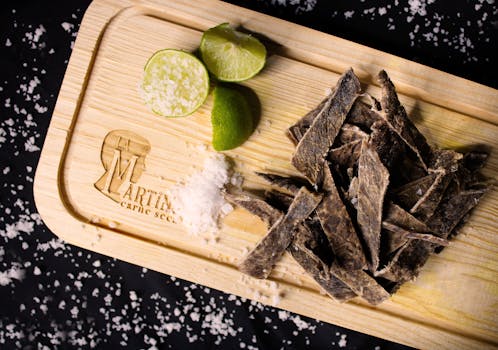
The diets react (see scores below)
Diet Ratings
Beef jerky often contains 3-5g net carbs per serving due to added sugars and marinades. Quality varies significantly. Some brands use sugar-free options (better), but most commercial jerky is problematic.
Some keto practitioners accept sugar-free beef jerky brands, while others avoid all jerky due to processing and typical sugar content in mainstream products.
Beef jerky is dried beef meat, a direct animal product that violates vegan principles.
Dried beef can be paleo-compliant if made without added sugar, nitrates, or seed oils. However, most commercial beef jerky contains added sugars and preservatives.
Strict paleo excludes all processed meats including jerky due to added salt and potential additives. However, some practitioners accept homemade jerky made with salt alone as a preservation method ancestral humans used.
Beef jerky is a processed meat product high in sodium, saturated fat, and often contains added sugars and preservatives. It contradicts Mediterranean diet principles emphasizing whole, minimally processed foods. Not a traditional Mediterranean food.
Beef jerky quality varies significantly. Many commercial versions contain added sugars, spices, and preservatives. Pure beef jerky with salt only would rate higher, but most products are problematic for strict carnivore adherence.
Some carnivore practitioners accept quality beef jerky as a convenient portable option if verified to contain only beef, salt, and approved curing agents without sugar or plant-based additives.
Most commercial beef jerky contains added sugar and other non-compliant additives. Even 'sugar-free' versions often contain artificial sweeteners or other problematic ingredients.
Processed and dried beef. While beef is low-FODMAP, jerky often contains garlic powder, onion powder, soy sauce, and other high-FODMAP seasonings. Monash testing is limited for beef jerky. Many commercial brands are problematic.
Monash University has limited specific testing on beef jerky. Clinical FODMAP practitioners note that most commercial beef jerky contains garlic and/or onion powder. Plain jerky without these additives may be acceptable in standard portions.
Beef jerky is a processed red meat with extremely high sodium (>400mg per ounce). High in saturated fat and cholesterol. Violates DASH sodium limits even in small portions. Processed meat category with cardiovascular risk.
Beef jerky is processed with high sodium and often contains added sugars or honey. Protein is concentrated (~10-12g per oz) but lacks accompanying carbs/fats for balanced Zone meals. Difficult to integrate into 40/30/30 without additional components. Inflammatory additives present.
Some Zone practitioners accept unsweetened, low-sodium beef jerky as convenient protein for snacking, provided it's paired with low-glycemic carbs and fat. Others avoid due to processing and sodium load.
Processed meat product with high sodium, often containing nitrates/nitrites and inflammatory additives. Processing and curing methods override any benefit from lean beef. High salt content problematic for inflammation.
Provides concentrated protein (12-15g per 1oz) and is shelf-stable, but ultra-processed with very high sodium (400-600mg per 1oz) and often contains added sugars or spicy seasonings. Spice may trigger reflux. Quality varies significantly by brand. Some RDs recommend it for convenience; others avoid due to sodium and processing.
Some RDs recommend beef jerky as convenient portable protein for GLP-1 patients; others limit it due to high sodium, processing, and potential spice-triggered reflux. Individual tolerance depends on sodium sensitivity and GI side effect severity.
Nutritional profile
Six traits that cut across every diet.
Fiber & Plants
How much whole-plant food and fiber it delivers.
Healthy Fats
The quality of its fats (unsaturated, omega-3).
Whole / Unprocessed
How close it is to its natural, unprocessed form.
Gut Gentle
How easy it is on digestion (low FODMAP, few irritants).
Low Glycemic
How little it spikes your blood sugar.
Protein Density
How much protein it packs per calorie.
Controversy Index
Score range: 1–5/10. Higher controversy = more disagreement between diets.
Diet-Specific Tips for Beef jerky
 Keto — 5/10
- 3-5g net carbs typical
- Added sugars common
- Processed/dried
- Brand-dependent quality
 Paleo — 5/10
- Processed/dried meat
- Often contains added sugar
- Added salt
- Potential preservatives
- Homemade vs. commercial varies
 Carnivore — 5/10
- Often contains added sugars
- Spice content variable
- Processing method critical
- Brand-dependent quality
- Convenience factor
 Low-FODMAP — 5/10
- Potential garlic or onion powder
- Soy sauce may contain FODMAPs
- Multiple seasonings and additives
- Brand-dependent formulation
 Zone — 4/10
- Processed with additives
- High sodium content
- Concentrated protein
- Often contains added sugars
 GLP-1 Friendly — 5/10
- high protein density
- very high sodium
- ultra-processed
- often spiced (triggers reflux)
- quality varies by brand