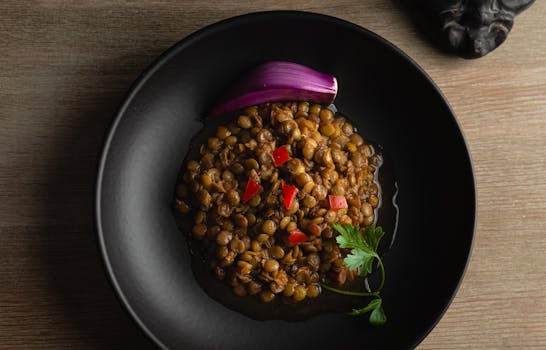
The diets react (see scores below)
Diet Ratings
Black lentils contain approximately 20g net carbs per 100g cooked serving. A typical 1-cup serving (198g) delivers ~40g net carbs, consuming the entire daily carb allowance for most keto practitioners. Legumes are fundamentally incompatible with ketogenic macros.
Whole plant legume, nutrient-dense, unprocessed, universally vegan-compliant.
Lentils are legumes, explicitly excluded from paleo diet due to high lectin and phytic acid content that damages gut lining and inhibits nutrient absorption. No meaningful nutritional advantage over paleo-approved foods justifies inclusion.
Legumes are a cornerstone of the Mediterranean diet, emphasized for daily consumption. Black lentils are nutrient-dense, high in fiber and plant-based protein, with minimal processing.
Legumes are plant-derived seeds and explicitly excluded from carnivore diet. High in carbohydrates and antinutrients (phytates, lectins). No animal-derived component.
Lentils are legumes and explicitly excluded from Whole30 for the full 30 days. No exceptions apply to lentils.
Lentils are legumes containing significant GOS (galacto-oligosaccharides), a fermentable oligosaccharide. Black lentils are high-FODMAP at all standard serving sizes per Monash University testing.
Excellent DASH food. High in fiber, plant-based protein, potassium, magnesium, and iron. Minimal sodium when prepared without added salt. Supports blood pressure control and cardiovascular health.
Black lentils are legumes with moderate glycemic impact (~20g carbs, 9g protein per cooked cup). While lower-glycemic than many beans, they require careful portioning to maintain 40/30/30 ratio. High fiber content helps, but carb-to-protein ratio is suboptimal for Zone without additional lean protein pairing.
Excellent source of plant-based protein, fiber, and polyphenols. Low glycemic index, rich in antioxidants. Legumes are a cornerstone of anti-inflammatory diets per Dr. Weil's pyramid.
Excellent protein density (18g per cooked cup), high fiber (16g per cup), low fat, nutrient-dense, easy to digest in small portions. Supports all GLP-1 dietary priorities.
Nutritional profile
Six traits that cut across every diet.
Fiber & Plants
How much whole-plant food and fiber it delivers.
Healthy Fats
The quality of its fats (unsaturated, omega-3).
Whole / Unprocessed
How close it is to its natural, unprocessed form.
Gut Gentle
How easy it is on digestion (low FODMAP, few irritants).
Low Glycemic
How little it spikes your blood sugar.
Protein Density
How much protein it packs per calorie.
Controversy Index
Score range: 1–9/10. Higher controversy = more disagreement between diets.
Diet-Specific Tips for Black lentils (beluga)
 Vegan — 9/10
- whole food
- legume
- high protein
- no additives
 Mediterranean — 9/10
- Plant-based protein source
- High fiber content
- Minimal processing
- Daily consumption encouraged
 DASH — 9/10
- High fiber content
- Plant-based protein
- Rich in potassium and magnesium
- Low sodium when unsalted
- Supports healthy cholesterol
 Zone — 5/10
- Moderate glycemic load despite fiber
- Incomplete protein (low lysine)
- Requires precise portioning
- Better as carb block than protein block
 Anti-Inflammatory — 9/10
- High fiber content
- Plant-based protein
- Polyphenol antioxidants
- Low glycemic index
 GLP-1 Friendly — 9/10
- high protein per calorie
- high fiber content
- low fat
- nutrient-dense
- small portion friendly