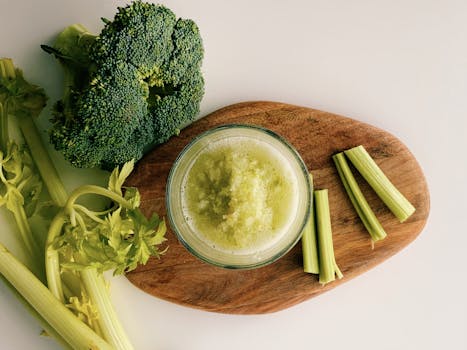
The diets react (see scores below)
Diet Ratings
Celery juice contains minimal carbs (1-2g net carbs per 8 oz serving) but lacks the fiber of whole celery. It is technically keto-compatible but offers little nutritional advantage over whole vegetables and may spike blood sugar slightly in sensitive individuals.
Some keto practitioners avoid juices entirely due to concentrated sugars and lack of fiber; others accept celery juice as a low-carb option if portion-controlled.
Celery juice is extracted from celery, a plant. No animal products or derivatives. Whole plant-based beverage.
Fresh celery juice is extracted from a paleo-approved vegetable. Unprocessed, nutrient-dense, and available to hunter-gatherers. No additives or processing concerns.
Whole celery is Mediterranean-approved vegetable, but juicing removes fiber and concentrates sugars. Whole celery consumption preferred. Juice form lacks nutritional advantages of whole vegetable.
Some Mediterranean diet practitioners accept fresh vegetable juices as convenient nutrient delivery, though whole vegetables remain optimal. Juice trend is modern, not traditional.
Plant-derived juice with no animal products. Directly violates carnivore exclusion of all plant foods regardless of processing or concentration.
Celery juice is 100% fruit/vegetable juice with no added ingredients. Per official Whole30 guidance, 100% juice is compliant both as a standalone drink and as a recipe ingredient.
Celery contains fructans and is high-FODMAP. Juicing concentrates FODMAPs and removes fiber, making it worse than whole celery. High-FODMAP at any serving size.
Removes beneficial fiber from whole celery while concentrating natural sugars and sodium. NIH DASH emphasizes whole vegetables over juices. Whole celery is superior for potassium and fiber.
Some practitioners promote celery juice for sodium regulation; however, NIH DASH guidelines recommend whole vegetables over juices to preserve fiber and avoid concentrated sugars.
Celery is low-glycemic vegetable, but juicing removes fiber and concentrates carbs. 1 cup celery juice ≈ 5-6g carbs (1 carb block). Lacks protein/fat for standalone meal; useful as beverage with protein/fat.
Some Zone practitioners avoid juices entirely due to fiber loss and carb concentration. Whole celery (8 oz) is preferred. However, small portions fit Zone if paired with protein/fat.
Celery contains beneficial compounds (luteolin, apigenin) with some anti-inflammatory properties. However, juicing removes fiber and concentrates sugars. Whole celery is preferable. Celery juice lacks robust clinical evidence for specific anti-inflammatory benefits beyond whole vegetable consumption.
Some alternative medicine practitioners (including some influenced by Medical Medium claims) attribute significant anti-inflammatory and detoxification properties to celery juice. Mainstream research does not support these specific claims, though celery itself is anti-inflammatory.
Celery juice is low-calorie and hydrating, supporting fluid intake when GLP-1 reduces thirst. However, it lacks the fiber of whole celery (fiber removed during juicing) and provides minimal protein or satiety. Whole celery is nutritionally superior. Juice format may cause rapid gastric transit issues.
Some practitioners view celery juice as a beneficial hydration tool for GLP-1 patients; others argue that whole vegetables are always preferable and juice removes critical fiber needed for GLP-1 constipation prevention.
Nutritional profile
Six traits that cut across every diet.
Fiber & Plants
How much whole-plant food and fiber it delivers.
Healthy Fats
The quality of its fats (unsaturated, omega-3).
Whole / Unprocessed
How close it is to its natural, unprocessed form.
Gut Gentle
How easy it is on digestion (low FODMAP, few irritants).
Low Glycemic
How little it spikes your blood sugar.
Protein Density
How much protein it packs per calorie.
Controversy Index
Score range: 1–9/10. Higher controversy = more disagreement between diets.
Diet-Specific Tips for Celery juice
 Keto — 4/10
- 1-2g net carbs per 8 oz
- lacks fiber of whole celery
- minimal nutritional advantage
- potential blood sugar spike in sensitive individuals
 Vegan — 9/10
- Plant-based
- No animal products
- Minimally processed
- Whole food source
 Paleo — 8/10
- vegetable-based
- unprocessed
- nutrient-dense
- no additives
 Mediterranean — 5/10
- fiber loss in processing
- whole vegetable preferred
- modern trend
- nutrient concentration
 Whole30 — 8/10
- 100% vegetable juice
- No added sugar
- Officially compliant
 DASH — 5/10
- Fiber removed
- Natural sugars concentrated
- Sodium present
- Whole celery superior
- Juice format problematic
 Zone — 5/10
- low-glycemic vegetable
- fiber removed
- carb concentration
- requires pairing
 Anti-Inflammatory — 5/10
- removes beneficial fiber
- concentrates natural sugars
- contains some polyphenols
- lacks robust clinical evidence
- whole celery preferable
 GLP-1 Friendly — 4/10
- low calorie
- hydrating
- fiber removed
- no protein
- minimal satiety