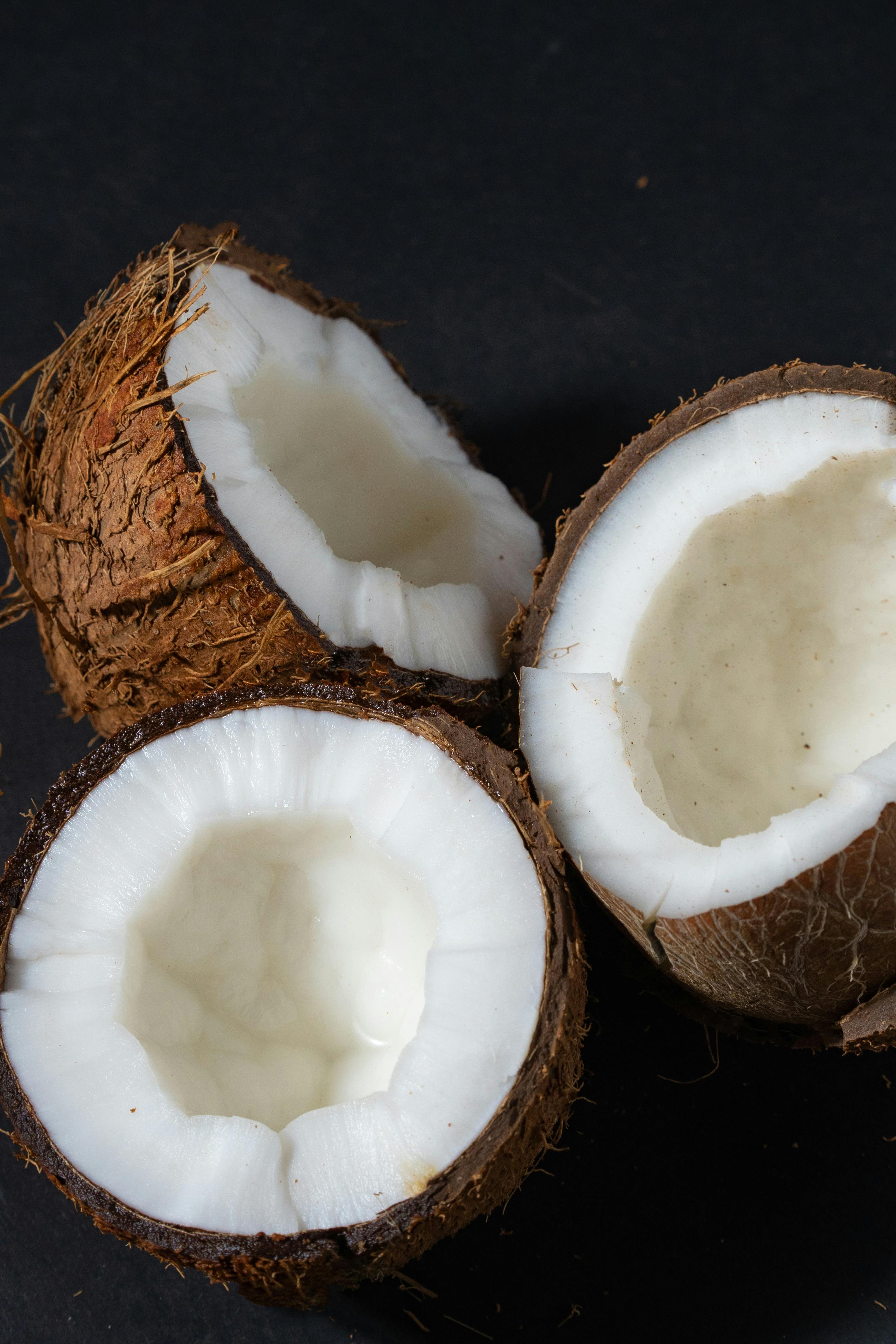
The diets react (see scores below)
Diet Ratings
Fresh coconut meat contains approximately 9g net carbs per 100g with 35g fat, providing excellent fat-to-carb ratio. High in MCTs and fiber, making it ideal for ketogenic diets when consumed in measured portions.
Plant-based whole food from coconut palm. No animal products or derivatives. Minimally processed when fresh.
Whole coconut meat is a paleo staple. Rich in healthy fats, fiber, and minerals. Unprocessed and available to coastal Paleolithic populations.
High in saturated fat (though some research suggests medium-chain triglycerides may have neutral effects). Not traditional to Mediterranean regions. Can be consumed in small amounts but olive oil remains preferred fat source.
Some modern Mediterranean diet interpretations include coconut in moderation, particularly in regions with tropical trade influences. Emerging research on MCT metabolism creates debate about saturation concerns.
Coconut meat is technically plant-derived but occupies a unique position in low-carb and carnivore communities. Some practitioners include it for its fat content and minimal carbohydrates; strict carnivores exclude it as a plant product. Paul Saladino's animal-based approach may include coconut oil but not meat; pure carnivore excludes it.
Strict carnivore practitioners argue coconut is plant-derived and violates the 'only animal products' rule. However, some low-carb carnivore practitioners include coconut fat for its MCT profile and minimal net carbs.
Whole food from coconut. Explicitly allowed as a natural fat source and compliant ingredient.
Monash University confirms coconut meat is low-FODMAP at standard serving sizes (approximately 45g). Low in all FODMAP categories.
High in saturated fat (tropical oil). DASH guidelines explicitly limit coconut and other tropical oils due to LDL cholesterol elevation. Contradicts core DASH principles despite being a whole food.
High in saturated fat (not monounsaturated preferred in Zone). While contains some fiber and polyphenols, macronutrient profile skews heavily toward fat. 1 oz (~10g fat, 3g carbs) requires careful integration. Better alternatives exist for fat blocks.
High in saturated fat (lauric acid), which has mixed inflammatory effects. Some research suggests lauric acid may be less inflammatory than other saturated fats, but mainstream anti-inflammatory guidance recommends moderation. Fiber and polyphenols present but offset by saturated fat content.
Some researchers (including proponents of traditional diets) argue coconut's medium-chain triglycerides and lauric acid have neutral or beneficial metabolic effects. However, Dr. Weil's pyramid emphasizes limiting saturated fat sources.
High saturated fat (24g per 100g) and high calorie density (354 cal per 100g) directly contradict GLP-1 dietary guidelines. Fat worsens nausea, bloating, and reflux. Low protein (3.3g per 100g). Small portions feel large in the stomach due to fat content, triggering GI distress.
Nutritional profile
Six traits that cut across every diet.
Fiber & Plants
How much whole-plant food and fiber it delivers.
Healthy Fats
The quality of its fats (unsaturated, omega-3).
Whole / Unprocessed
How close it is to its natural, unprocessed form.
Gut Gentle
How easy it is on digestion (low FODMAP, few irritants).
Low Glycemic
How little it spikes your blood sugar.
Protein Density
How much protein it packs per calorie.
Controversy Index
Score range: 2–9/10. Higher controversy = more disagreement between diets.
Diet-Specific Tips for Coconut meat
 Keto — 8/10
- 9g net carbs per 100g
- 35g fat (primarily MCTs)
- High fiber content
- Whole, unprocessed food
- Portion control recommended
 Vegan — 8/10
- 100% plant-based
- Whole food
- High in saturated fat (not a vegan concern but nutritional consideration)
 Paleo — 9/10
- Whole food
- Healthy saturated fats
- Fiber-rich
- Mineral content
 Mediterranean — 5/10
- high saturated fat content
- not traditional Mediterranean
- calorie-dense
- limited research on health effects
 Carnivore — 5/10
- Plant-derived but fat-focused
- Low net carbohydrate content
- Debated within community
 Whole30 — 9/10
- Whole food
- Natural fat
- No processing
 Low-FODMAP — 8/10
- Low fructose content
- Minimal polyol content
- Monash-tested and approved
 Zone — 5/10
- saturated fat dominant
- not preferred monounsaturated source
- high caloric density
- requires portion discipline
 Anti-Inflammatory — 5/10
- High saturated fat (lauric acid)
- Medium-chain triglycerides
- Dietary fiber
- Polyphenols present