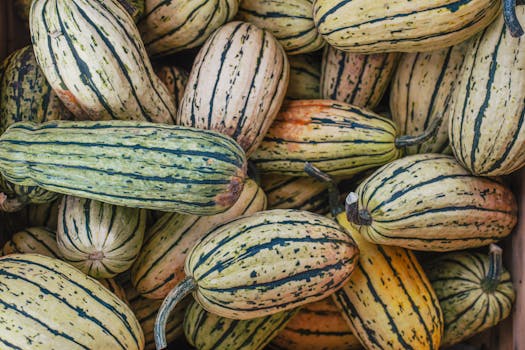
The diets react (see scores below)
Diet Ratings
Delicata squash contains approximately 7g net carbs per 100g. Small portions (3-4 oz) are manageable within daily limits, but it requires careful tracking. Some strict keto practitioners avoid all winter squashes; others allow modest amounts.
Strict/clinical keto protocols often exclude all winter squashes due to cumulative carb load and glycemic response, while flexible keto practitioners permit small portions as part of vegetable variety.
Whole plant food, unprocessed, no animal products or derivatives. Excellent whole-food vegan staple.
Winter squash with edible skin, nutrient-dense, low anti-nutrient profile. Unprocessed and available to Paleolithic humans. Excellent source of vitamins and minerals.
Whole, unprocessed winter squash rich in fiber, vitamins A and C. Fits Mediterranean vegetable emphasis. Can be roasted with olive oil for authentic preparation.
Squash is a plant food and excluded on carnivore diet. No animal-derived content. Incompatible with carnivore framework regardless of carbohydrate content.
Whole, unprocessed winter squash with no excluded ingredients. Fully compliant.
Limited specific Monash testing on delicata squash. Related winter squashes show variable FODMAP content depending on ripeness and preparation. Conservative approach suggests caution at larger portions.
Monash University has not formally tested delicata squash; clinical practitioners often approve small portions (75-100g) based on similar squash profiles, while others recommend avoidance due to fructan variability in winter squashes.
Winter squash with excellent nutrient profile: potassium, magnesium, fiber, and vitamin A. Very low sodium. Edible skin adds fiber. Core DASH vegetable.
Moderate glycemic impact (~9g net carbs per 100g). More favorable than butternut but higher than spaghetti squash. Usable in Zone if portioned carefully (roughly 1/2 cup = 1 carb block). Dr. Sears generally categorizes winter squashes as acceptable but not preferred vegetables.
Some Zone practitioners treat all winter squashes as 'caution' due to higher carb density compared to non-starchy vegetables. Portion control is critical.
Nutrient-dense winter squash with high carotenoid content (beta-carotene, lutein), vitamin C, and fiber. Anti-inflammatory polyphenols present. Edible skin adds additional fiber and nutrients. Moderate natural sugar content is offset by fiber and antioxidant profile.
Higher carbohydrate content (11g per 100g) with minimal protein (1g per 100g). While it contains fiber (1.1g per 100g) and is easier to digest than some squashes, the carb-to-protein ratio is poor for GLP-1 patients. Better as an occasional side in small portions rather than a primary vegetable.
Nutritional profile
Six traits that cut across every diet.
Fiber & Plants
How much whole-plant food and fiber it delivers.
Healthy Fats
The quality of its fats (unsaturated, omega-3).
Whole / Unprocessed
How close it is to its natural, unprocessed form.
Gut Gentle
How easy it is on digestion (low FODMAP, few irritants).
Low Glycemic
How little it spikes your blood sugar.
Protein Density
How much protein it packs per calorie.
Controversy Index
Score range: 1–9/10. Higher controversy = more disagreement between diets.
Diet-Specific Tips for Delicata squash
 Keto — 5/10
- 7g net carbs per 100g
- Requires portion control
- Edible skin adds fiber
- Moderate glycemic impact
 Vegan — 9/10
- Whole plant food
- Unprocessed
- No animal products
- Nutrient-dense
 Paleo — 9/10
- Winter squash variety
- Edible skin
- Low anti-nutrients
- Nutrient-dense
 Mediterranean — 8/10
- whole plant food
- rich in fiber
- edible skin
- traditional preparation methods
 Whole30 — 9/10
- Whole vegetable
- No excluded ingredients
- Nutrient-dense
 Low-FODMAP — 5/10
- Winter squash with variable fructan content
- Ripeness affects FODMAP load
- Limited Monash data
 DASH — 9/10
- very low sodium
- high potassium and magnesium
- excellent fiber source
- rich in beta-carotene
- edible skin increases nutrients
 Zone — 5/10
- Moderate net carbs
- Winter squash category
- Requires careful portioning
- Better than butternut but not optimal
 Anti-Inflammatory — 8/10
- High in carotenoids and beta-carotene
- Rich in vitamin C
- Excellent fiber content
- Edible skin increases nutrient density
- Anti-inflammatory polyphenols
 GLP-1 Friendly — 5/10
- Moderate carbohydrate content
- Very low protein
- Modest fiber
- Portion-dependent suitability