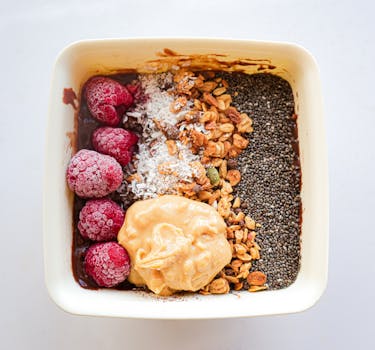
Granola (keto-friendly)
Rated by 11 diets
The diets react (see scores below)
Diet Ratings
Keto-friendly granolas vary widely. Quality brands use nuts/seeds with sugar alcohols, yielding 3-8g net carbs per serving. Requires label verification and strict portion control.
Some strict keto practitioners avoid all granola products due to processing, seed oils, and potential hidden carbs or sugar alcohol sensitivities, preferring whole nuts instead.
Keto granolas often contain nuts, seeds, and oils (plant-based), but many brands include honey as sweetener or butter for binding. Requires label verification. Heavily processed.
Some vegans accept honey-containing products if sourced from ethical beekeepers, though mainstream vegan organizations exclude honey.
Keto-friendly granola typically replaces grains with nuts, seeds, and sugar alcohols or alternative sweeteners. While ingredients may be paleo-compliant individually, the processing and inclusion of sweeteners (even natural ones) contradicts paleo philosophy of whole foods. Requires ingredient verification.
Strict paleo avoids all processed foods and sweetened products regardless of ingredient source; however, some modern paleo practitioners accept minimally processed nut-based granolas with monk fruit or stevia as occasional treats.
Keto-friendly granolas typically replace grains with nuts and seeds (Mediterranean-friendly) but often contain sugar alcohols, processed oils, and lack whole grains that Mediterranean diet emphasizes. Traditional granola with whole oats would score higher.
Some Mediterranean diet practitioners accept low-carb alternatives if made with extra virgin olive oil and minimal additives, particularly for those managing blood sugar.
Granola is grain-based (oats) with nuts, seeds, and plant oils. Keto-friendly label does not change plant origin. Fundamentally incompatible with carnivore diet.
Even keto-friendly granola typically contains excluded ingredients such as grains, nuts processed with added oils, or sugar alcohols. Granola itself is a processed food that recreates a junk food category. Most commercial granolas contain non-compliant sweeteners or ingredients.
Keto granolas typically replace grains with nuts and seeds (low-FODMAP) but often contain sugar alcohols (polyols like erythritol, xylitol) or dried fruit. FODMAP status depends on specific ingredients and sweetener used.
Monash University has limited testing on keto granolas specifically. Clinical practitioners note that polyol sweeteners (xylitol, sorbitol) are high-FODMAP, while erythritol is better tolerated. Ingredient verification is essential.
Keto granolas typically use nuts, seeds, and sugar alcohols. Lower sugar than regular granola, but often high in saturated fat from coconut oil and nuts. Sodium varies. Portion control critical.
NIH DASH guidelines emphasize whole grains; keto granolas often replace grains with high-fat nuts/seeds. Updated clinical interpretation recognizes nuts as acceptable if portion-controlled and saturated fat monitored.
Keto granola typically uses nuts, seeds, and sugar alcohols with minimal net carbs. Macro profile depends heavily on specific formulation. Can work if net carbs are truly low and fats are primarily monounsaturated, but many brands use inflammatory seed oils.
Dr. Sears emphasizes whole-food carbs over processed alternatives. Even low-carb granola may contain polycose or other processed sweeteners that trigger insulin response in sensitive individuals. Whole oats with berries preferred.
Keto granolas typically replace sugar with sugar alcohols and use nuts/seeds (omega-3 potential) but often rely on coconut oil and may contain inflammatory seed oils. Nutrient density varies widely by brand.
Some low-carb advocates view keto granolas favorably for blood sugar control. However, Dr. Weil emphasizes whole grains over processed alternatives, even low-carb versions.
Keto granolas are typically high fat (nuts, oils) and low protein despite lower carbs. Calorie-dense with modest satiety. Some RDs approve small portions as fiber source; others avoid due to fat content and portion-control difficulty.
Some GLP-1 specialists recommend small portions of keto granola for fiber and satiety; others argue the high fat and calorie density make it counterproductive when appetite is already suppressed, and whole foods are preferable.
Nutritional profile
Six traits that cut across every diet.
Fiber & Plants
How much whole-plant food and fiber it delivers.
Healthy Fats
The quality of its fats (unsaturated, omega-3).
Whole / Unprocessed
How close it is to its natural, unprocessed form.
Gut Gentle
How easy it is on digestion (low FODMAP, few irritants).
Low Glycemic
How little it spikes your blood sugar.
Protein Density
How much protein it packs per calorie.
Controversy Index
Score range: 2–6/10. Higher controversy = more disagreement between diets.
Diet-Specific Tips for Granola (keto-friendly)
 Keto — 5/10
- Highly brand-dependent
- Often contains sugar alcohols (erythritol, xylitol)
- Portion control critical
- Label verification essential
 Vegan — 5/10
- Honey presence likely
- Heavily processed
- Label-dependent
- Butter possible
 Paleo — 4/10
- Processing level
- Type of sweetener used
- Seed oil content
- Ingredient transparency
 Mediterranean — 4/10
- lacks whole grains
- processed sweeteners
- oil quality variable
- nuts and seeds positive
 Low-FODMAP — 5/10
- Sugar alcohol type determines FODMAP status
- Presence of dried fruit increases FODMAP load
- Nuts and seeds are low-FODMAP base
 DASH — 5/10
- High fat content (often saturated)
- Coconut oil common (tropical oil)
- Sugar alcohols may cause GI issues
- Portion-sensitive
 Zone — 6/10
- Formulation-dependent
- Often contains seed oils
- Sugar alcohol impact variable
- Processed food
 Anti-Inflammatory — 5/10
- Sugar alcohol sweeteners (digestive effects variable)
- Nut and seed content provides some omega-3s
- Often high in saturated fat from coconut oil
- Processed nature limits whole grain benefits
- Brand-dependent quality variation
 GLP-1 Friendly — 4/10
- high fat content
- low protein
- moderate fiber
- calorie-dense
- portion-control challenge