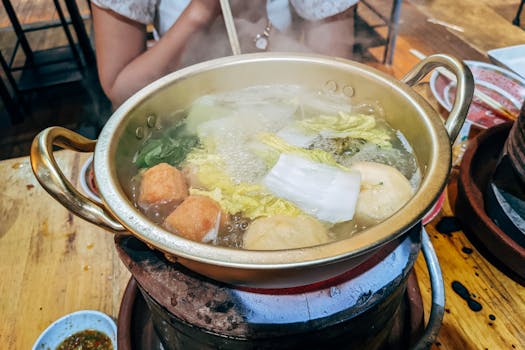
Hot pot (broth)
Rated by 11 diets
The diets react (see scores below)
Diet Ratings
Hot pot broth alone is essentially 0g net carbs (water, spices, possibly soy sauce with minimal carbs). The keto-compatibility depends entirely on what is cooked in it: meat, seafood, and leafy greens are keto-friendly; noodles and starchy vegetables are not.
Broth is often made from animal bones or contains seafood. Vegetables and plant-based proteins can be added, but base broth is typically animal-derived.
Some vegans approve hot pot if explicitly made with vegetable broth and filled with plant-based ingredients, treating the cooking method as neutral.
Broth-based hot pot with vegetables, meat, and seafood is paleo-compliant. Verify broth is bone broth or meat-based (no grains), and dipping sauces contain no soy, sugar, or seed oils.
Broth-based cooking with vegetables and proteins can be Mediterranean-compatible. However, traditional hot pot often includes processed meats and refined carbohydrates. Acceptable if using lean proteins and abundant vegetables.
Some nutritionists view hot pot as adaptable to Mediterranean principles when prepared with olive oil broth, seafood, and abundant vegetables, though not traditional to Mediterranean regions.
Bone broth is universally approved in carnivore diet. Hot pot broth (typically meat-based) is acceptable. Quality depends on what is cooked in it—if only meat/seafood/eggs are added, it remains approved.
Hot pot with compliant broth (bone broth, vegetable broth) and cooked proteins, vegetables, and mushrooms is fully Whole30 compliant. No excluded ingredients if broth contains no added sugar or non-compliant additives.
Plain broth (water, salt, spices) is low-FODMAP. Proteins (meat, tofu) are low-FODMAP. Vegetables vary: mushrooms, bok choy, carrots are low-FODMAP; onion, garlic, snap peas are high-FODMAP. Dipping sauces often contain garlic/soy.
Monash rates individual vegetables separately. Hot pot success depends entirely on vegetable selection and dipping sauce composition. Many broths contain garlic/onion base.
Broth-based cooking allows control of sodium and fat. Vegetables, lean proteins (tofu, chicken, fish), and legumes can be added. Low in saturated fat if lean proteins chosen. Excellent DASH alignment if salt-controlled.
Broth-based (low-glycemic, anti-inflammatory). Customizable with lean proteins (chicken, fish, tofu), low-glycemic vegetables (mushrooms, leafy greens, broccoli), and minimal added fat. Dipping sauces can be controlled. Excellent Zone flexibility and macro balance potential.
Hot pot with broth base is excellent for anti-inflammatory eating. Allows consumption of vegetables, mushrooms, lean proteins, and herbs in a nutrient-preserving broth. Typically includes ginger, garlic, and spices. Minimal processed ingredients. Cooking method preserves nutrients.
Broth-based hot pot allows control over ingredients and fat content. High protein from lean meats, tofu, and seafood. Vegetables add fiber and nutrients. Easy to digest, portion-friendly, and interactive meal supports mindful eating. Minimal GLP-1 side effects if fatty meats are avoided.
Nutritional profile
Six traits that cut across every diet.
Fiber & Plants
How much whole-plant food and fiber it delivers.
Healthy Fats
The quality of its fats (unsaturated, omega-3).
Whole / Unprocessed
How close it is to its natural, unprocessed form.
Gut Gentle
How easy it is on digestion (low FODMAP, few irritants).
Low Glycemic
How little it spikes your blood sugar.
Protein Density
How much protein it packs per calorie.
Controversy Index
Score range: 4–9/10. Higher controversy = more disagreement between diets.
Diet-Specific Tips for Hot pot (broth)
 Keto — 8/10
- broth base: 0-1g carbs
- meat/seafood additions: 0g carbs
- leafy greens: 1-2g carbs per serving
- noodles: 30-40g carbs (avoid)
- starchy vegetables: 10-20g carbs (avoid)
 Vegan — 4/10
- animal broth typical
- customization-dependent
- ingredient control variable
 Paleo — 9/10
- broth approved
- vegetables approved
- meat/seafood approved
- dipping sauce critical
- no grains or legumes
 Mediterranean — 5/10
- broth base variable
- protein selection critical
- vegetable content variable
- processed meat risk
 Carnivore — 8/10
- bone broth is core carnivore food
- meat-based preparation
- no plant ingredients in broth
- depends on added ingredients
 Whole30 — 9/10
- broth compliant
- proteins compliant
- vegetables compliant
- verify no added sugar in broth
- verify no soy sauce (soy is legume)
 Low-FODMAP — 6/10
- Broth base is low-FODMAP if plain
- Protein choices are low-FODMAP
- Vegetable selection critical
- Dipping sauces may contain garlic
- Soy sauce is low-FODMAP
 DASH — 8/10
- Broth-based (low fat if not cream-based)
- Allows vegetable and lean protein emphasis
- Sodium controllable by broth selection
- Interactive meal encourages whole foods
- Tofu and legumes provide plant-based protein
 Zone — 8/10
- Low-glycemic broth base
- Customizable protein sources
- Abundant vegetable options
- Minimal added fat
 Anti-Inflammatory — 8/10
- broth-based (nutrient-rich)
- abundant vegetables and mushrooms
- lean protein options
- anti-inflammatory spices (ginger, garlic)
- minimal processing
- nutrient-preserving cooking
 GLP-1 Friendly — 8/10
- high protein control
- high fiber from vegetables
- low fat if lean proteins chosen
- easy digestibility
- portion-friendly