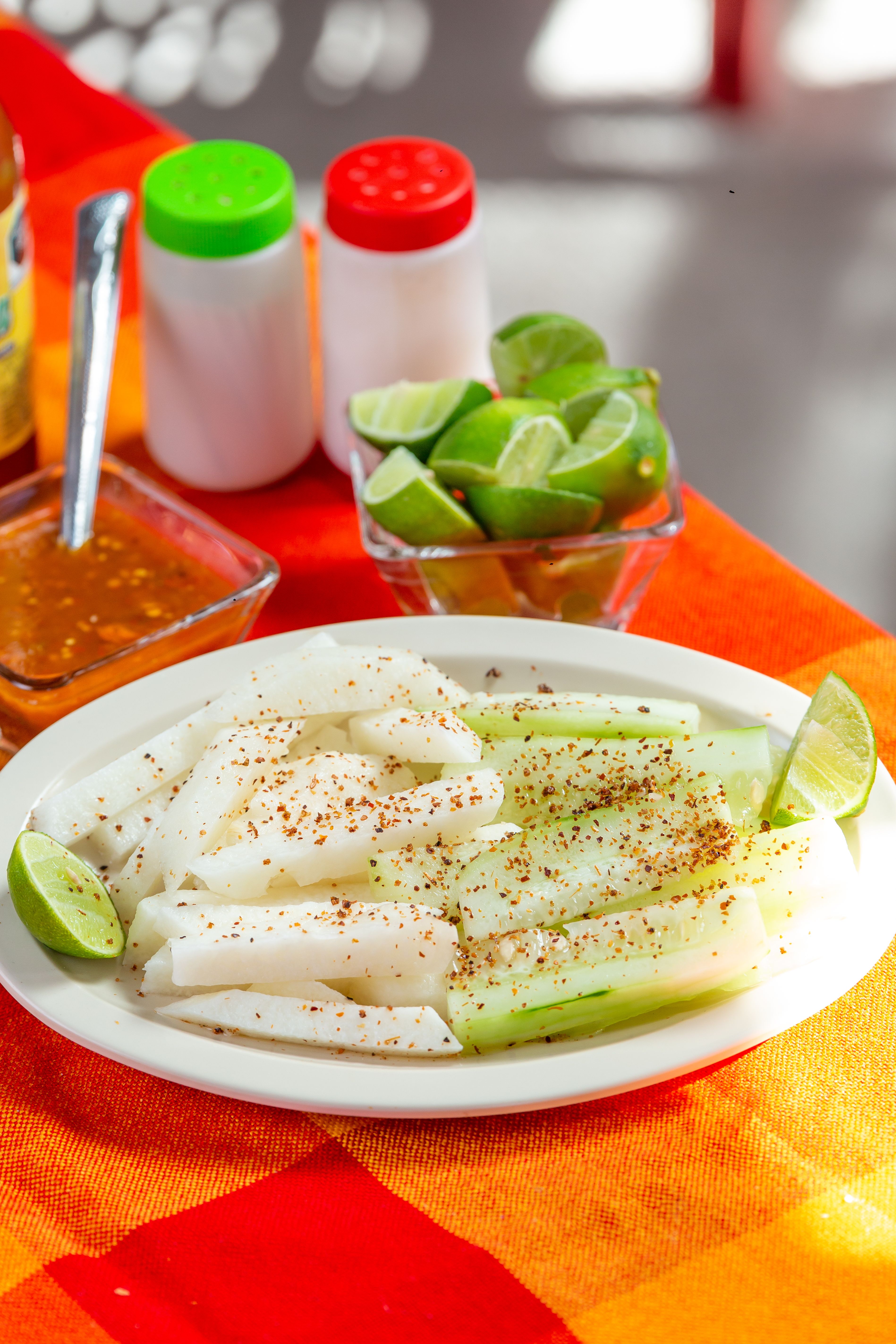
The diets react (see scores below)
Diet Ratings
Jicama contains 5.5g net carbs per 100g. Moderate portions (75-100g) can fit within keto, but it requires tracking. Some practitioners favor it as a lower-carb root vegetable alternative; others avoid all root vegetables.
Some keto practitioners embrace jicama as a lower-carb root vegetable substitute for higher-carb options; strict protocols exclude all root vegetables regardless of relative carb content.
Whole plant food, root vegetable with no animal products or derivatives. High water content and good source of fiber.
Root vegetable available to Paleolithic humans. Low glycemic index, minimal anti-nutrients, nutrient-dense. Inulin content supports gut health.
Root vegetable with moderate carbohydrate content and natural sugars. While nutritious and low in calories, jicama is not traditional to Mediterranean cuisine. Acceptable in moderation but not a core staple.
Some modern Mediterranean diet practitioners include jicama as an acceptable alternative root vegetable due to its low calorie density and prebiotic fiber content, despite geographic non-traditionality.
Root vegetable derived from plants. High in carbohydrates and plant compounds. Excluded from carnivore diet as it violates the animal-only principle.
Root vegetable with no excluded ingredients. Whole, unprocessed, and explicitly compliant with Whole30.
Jicama contains inulin (fructan) and is portion-dependent. Limited Monash University testing available; low-FODMAP status only at restricted serving sizes.
Monash University data on jicama is limited. Jicama contains significant inulin content, making it high-FODMAP at larger portions. Clinical practitioners often recommend caution or avoidance during elimination phase due to fructan load.
Root vegetable very low in sodium with good fiber and potassium. Low calorie density and supports vegetable variety in DASH diet.
Root vegetable with low net carbs (~8.5g per 100g) and low glycemic index (~15). Excellent Zone vegetable choice with prebiotic fiber. Supports vegetable servings without significant insulin impact.
Root vegetable with inulin and some antioxidants but moderate polyphenol content. Higher carbohydrate density than leafy greens. Acceptable in moderation as part of vegetable diversity but not emphasized in anti-inflammatory pyramid.
Some authorities view jicama's prebiotic inulin as beneficial for gut health and anti-inflammatory microbiome support, warranting higher rating.
Low-calorie root vegetable with good fiber, high water content, and minimal fat. Supports hydration and digestion. Crunchy texture aids satiety in small portions. Easy to digest.
Nutritional profile
Six traits that cut across every diet.
Fiber & Plants
How much whole-plant food and fiber it delivers.
Healthy Fats
The quality of its fats (unsaturated, omega-3).
Whole / Unprocessed
How close it is to its natural, unprocessed form.
Gut Gentle
How easy it is on digestion (low FODMAP, few irritants).
Low Glycemic
How little it spikes your blood sugar.
Protein Density
How much protein it packs per calorie.
Controversy Index
Score range: 1–10/10. Higher controversy = more disagreement between diets.
Diet-Specific Tips for Jicama
 Keto — 6/10
- 5.5g net carbs per 100g
- Root vegetable with moderate carbs
- Requires portion awareness
- Higher than leafy greens but lower than parsnips
 Vegan — 9/10
- 100% plant-based
- Whole food
- No processing
- Root vegetable
 Paleo — 8/10
- Root vegetable
- Low glycemic load
- Inulin (prebiotic fiber)
- Minimal anti-nutrients
 Mediterranean — 6/10
- moderate carbohydrate content
- not traditional Mediterranean ingredient
- prebiotic fiber
- portion control recommended
 Whole30 — 10/10
- Root vegetable
- No excluded ingredients
- Whole food
 Low-FODMAP — 4/10
- High inulin (fructan)
- Portion-dependent
- Root vegetable
- Limited Monash testing
 DASH — 8/10
- Very low sodium
- Good potassium content
- High fiber
- Low glycemic impact
 Zone — 8/10
- Low glycemic index
- Moderate net carbs
- Prebiotic fiber content
- Good vegetable alternative
 Anti-Inflammatory — 5/10
- Inulin (prebiotic)
- Moderate antioxidants
- Higher carbohydrate load
- Low omega-6
- Fiber present
 GLP-1 Friendly — 7/10
- high water content
- good fiber
- low calorie
- crunchy texture supports satiety
- easy to digest