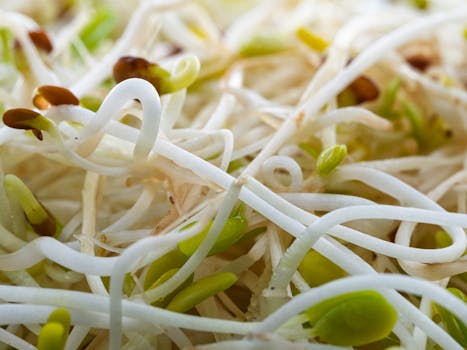
The diets react (see scores below)
Diet Ratings
Contains ~3g net carbs per 100g raw, relatively low but higher than leafy greens. Moderate portions (100-150g) fit within daily limits, but requires tracking. Legume-derived carbs.
Some keto practitioners avoid all legume sprouts due to plant-based carbs and potential antinutrients, while mainstream keto allows small portions of mung bean sprouts as low-carb vegetable additions.
Whole plant legume sprout with enhanced nutrient bioavailability from sprouting. Excellent protein and micronutrient source. Fully vegan-compliant.
Mung beans are legumes, explicitly excluded from paleo diet. Sprouting reduces some anti-nutrients but does not eliminate the fundamental legume classification. Paleo consensus excludes all legume sprouts.
Legume-based sprouts provide plant protein, fiber, and nutrients with minimal processing. Sprouting increases bioavailability. Aligns with Mediterranean emphasis on legumes and whole plant foods.
Legume-derived sprouts, plant-based. Explicitly excluded from carnivore diet. Legumes are prohibited regardless of sprouted form.
Mung beans are legumes, which are excluded for 30 days. Sprouting does not change their legume status.
Mung bean sprouts contain GOS (galacto-oligosaccharides) from legume origin, but sprouting reduces FODMAP content. Monash data suggests low-FODMAP status at 75g; portions above this threshold become problematic.
Monash University rates mung bean sprouts as low-FODMAP at 75g; however, clinical practitioners note that GOS reduction during sprouting is incomplete and individual tolerance varies. Some recommend avoidance during strict elimination phase.
Low-sodium legume sprout with protein, fiber, and vitamin C. Supports DASH legume and vegetable emphasis. Minimal processing, nutrient-dense. Excellent for increasing plant protein.
Sprouts are low-glycemic, minimal net carbs (approximately 1.9g per 100g raw), high fiber. Counts toward vegetable servings. Provide plant-based protein and polyphenols. Excellent raw or lightly cooked. No meaningful portion restriction within daily vegetable limits.
Sprouted legumes with enhanced bioavailability of nutrients and reduced anti-nutrients. High in polyphenols, antioxidants, and plant-based protein. Sprouting increases enzyme activity and vitamin content. Excellent anti-inflammatory food with minimal processing.
Very low calorie (31 cal per cup raw), high water content (90%), good fiber (1.9g per cup), low fat, moderate protein (3.2g per cup) for a vegetable. Easy to digest. Crunchy texture aids satiety. Nutrient-dense (vitamin C, K, folate). Raw or lightly cooked. Works well in small portions as part of mixed meals.
Nutritional profile
Six traits that cut across every diet.
Fiber & Plants
How much whole-plant food and fiber it delivers.
Healthy Fats
The quality of its fats (unsaturated, omega-3).
Whole / Unprocessed
How close it is to its natural, unprocessed form.
Gut Gentle
How easy it is on digestion (low FODMAP, few irritants).
Low Glycemic
How little it spikes your blood sugar.
Protein Density
How much protein it packs per calorie.
Controversy Index
Score range: 1–9/10. Higher controversy = more disagreement between diets.
Diet-Specific Tips for Mung bean sprouts
 Keto — 5/10
- moderate net carbs
- legume-derived
- portion-dependent
- requires tracking
 Vegan — 9/10
- Whole plant food
- Enhanced nutrient availability
- Complete protein
- Minimal processing
 Mediterranean — 8/10
- Legume-based protein
- Nutrient-dense
- Minimal processing
- Increased bioavailability
 Low-FODMAP — 5/10
- Sprouting reduces but does not eliminate GOS
- Legume origin creates FODMAP concern
- Portion control essential
 DASH — 8/10
- Very low sodium
- Plant-based protein
- High fiber
- Vitamin C
- Legume-based
 Zone — 8/10
- Very low net carbs
- Plant-based protein source
- High fiber content
- Minimal glycemic impact
 Anti-Inflammatory — 8/10
- Sprouting increases polyphenol bioavailability
- Enhanced antioxidant activity
- Plant-based protein source
- Reduced anti-nutrients (phytates, lectins)
 GLP-1 Friendly — 8/10
- very low calorie
- high water content
- good fiber
- moderate protein for vegetable
- low fat
- easy to digest
- crunchy texture