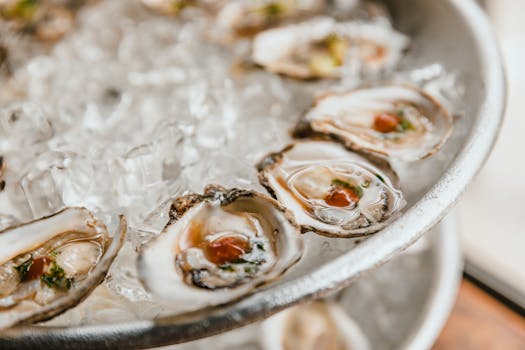
The diets react (see scores below)
Diet Ratings
Oysters contain 3-4g net carbs per 100g (higher than other shellfish due to glycogen content). Consumable in small portions but requires careful tracking to stay within daily carb limit.
Strict keto practitioners avoid oysters entirely due to carb content, while moderate keto followers allow 3-4 oysters as an occasional treat within daily carb allowance.
Oysters are mollusks and animal products. Standard vegan position excludes them. However, some debate exists about sentience and nervous system complexity.
A small minority of vegans argue oysters lack sufficient neurological capacity to warrant moral consideration equivalent to other animals, though mainstream vegan organizations reject this reasoning.
Shellfish consumed by Paleolithic coastal populations. Oysters are unprocessed, nutrient-dense (zinc, iron, B12), and paleo-compliant.
Shellfish with excellent nutritional profile: high in zinc, iron, and B12. Low in saturated fat. Traditional Mediterranean seafood fitting the 2-3 weekly fish/seafood guideline.
Oysters are animal-derived shellfish with high protein, zinc, and B12 content. Low carbohydrate and widely accepted. Some practitioners note slightly higher carb content than other seafood but still well within carnivore guidelines.
Oysters are whole, unprocessed shellfish with no excluded ingredients. Explicitly compliant with Whole30.
Oysters are low in fermentable carbohydrates. Monash University confirms shellfish as low-FODMAP at standard serving sizes (approximately 6 oysters or 100g).
Excellent DASH food. Very lean, rich in zinc, iron, selenium, and potassium. Low saturated fat and cholesterol. Excellent protein-to-calorie ratio. Avoid fried preparations.
Good protein source but contains moderate carbs (~7g per 100g) from glycogen, requiring careful portioning. Protein-to-carb ratio less favorable than other shellfish. Acceptable in Zone but needs vegetable adjustment.
Some Zone practitioners treat oysters more favorably due to micronutrient density and low glycemic impact despite carb content. Dr. Sears' later writings emphasize nutrient density over strict carb counting for whole foods.
Oysters provide zinc, selenium, and B12, but are low in omega-3s. Acceptable as occasional protein source but not emphasized in anti-inflammatory protocols compared to fatty fish.
Some nutritionists highlight oysters' exceptional micronutrient density and argue the low omega-3 content is offset by zinc's immune-modulating properties. Dr. Weil includes shellfish as acceptable.
Moderate protein (6g per 3oz serving), very low fat (<1g), exceptional micronutrient density (zinc, iron, B12, selenium). Low calorie, easy to digest, portion-friendly. Zinc supports immune function during weight loss.
Nutritional profile
Six traits that cut across every diet.
Fiber & Plants
How much whole-plant food and fiber it delivers.
Healthy Fats
The quality of its fats (unsaturated, omega-3).
Whole / Unprocessed
How close it is to its natural, unprocessed form.
Gut Gentle
How easy it is on digestion (low FODMAP, few irritants).
Low Glycemic
How little it spikes your blood sugar.
Protein Density
How much protein it packs per calorie.
Controversy Index
Score range: 2–9/10. Higher controversy = more disagreement between diets.
Diet-Specific Tips for Oysters
 Keto — 5/10
- 3-4g net carbs per 100g
- Moderate protein (9g per 100g)
- Low fat (1g per 100g)
- Portion control essential
 Paleo — 9/10
- High zinc content
- Vitamin B12
- Unprocessed seafood
- Available to hunter-gatherers
 Mediterranean — 8/10
- Nutrient-dense shellfish
- High in zinc and iron
- Low saturated fat
- Traditional Mediterranean consumption
 Carnivore — 8/10
- Pure animal protein
- Exceptional zinc content
- High B12 and selenium
- Slightly higher carbohydrate than other seafood but minimal
 Whole30 — 9/10
- Whole seafood
- No additives in plain form
- Mineral rich
 Low-FODMAP — 8/10
- Minimal oligosaccharides
- Minimal disaccharides
- No polyols
- Pure protein
 DASH — 8/10
- Very lean protein
- Rich in minerals (zinc, iron)
- Low saturated fat
- Avoid fried preparations
 Zone — 6/10
- Protein: ~9g per 100g
- Carbs: ~7g per 100g (glycogen-based, low glycemic)
- Minimal fat: ~1g per 100g
- High in zinc and selenium
- Requires portion control
 Anti-Inflammatory — 5/10
- Low omega-3 content
- High zinc and selenium
- Vitamin B12
- Neutral inflammatory profile
 GLP-1 Friendly — 8/10
- micronutrient-dense
- very low fat
- easy to digest
- zinc and iron rich
- low calorie