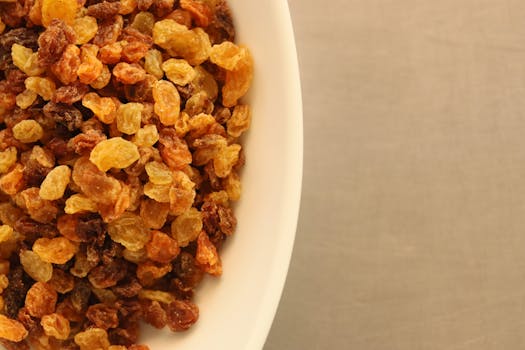
The diets react (see scores below)
Diet Ratings
Raisins are concentrated dried fruit with approximately 21g net carbs per ounce (28g serving). Extremely high sugar density makes them incompatible with ketosis.
Dried grapes with no animal products. Minimal processing. Some conventional raisins may use non-vegan processing aids, but this is rare and not inherent to the product.
Dried fruit with concentrated natural sugars. While grapes are paleo-approved, drying concentrates sugars significantly. Acceptable in moderation but portion control critical.
Some paleo practitioners (including Mark Sisson) accept raisins as occasional treats since they are minimally processed whole fruits with no additives, though stricter interpretations limit dried fruits due to sugar concentration.
While grapes are Mediterranean, raisins are concentrated sources of natural sugars with fiber removed during drying. Acceptable in small amounts as part of whole grain dishes or nuts, but not as frequent snacks.
Dried fruit is plant-derived and highly concentrated in carbohydrates/sugar. Explicitly excluded from carnivore protocol.
Raisins are dried fruit with concentrated natural sugars. While technically compliant (no added sugar), Whole30 discourages dried fruits due to sugar concentration and potential for mindless eating.
Melissa Urban acknowledges dried fruit is technically allowed but recommends limiting or avoiding due to concentrated sugar content and the program's emphasis on whole foods. Some community members treat raisins as fully compliant; others avoid them to honor the spirit of the program.
Raisins are high in fructose and contain polyols (sorbitol). Monash University rates raisins as high-FODMAP even at small portions due to concentrated sugars from drying process.
While nutrient-dense with potassium, fiber, and antioxidants, raisins are concentrated sources of natural sugars and calories. DASH guidelines recommend whole fruits over dried fruits due to higher sugar concentration per serving.
Raisins are explicitly listed as foods to avoid in Zone Diet materials. They are concentrated dried fruit with extremely high sugar density—a small handful delivers 15-20g carbs with minimal fiber. Glycemic load is very high relative to portion size, making Zone balance nearly impossible.
Contain antioxidants and polyphenols but are concentrated in natural sugars. High glycemic index and calorie density make portion control essential. Acceptable in moderation as part of whole-grain dishes.
Some anti-inflammatory advocates emphasize raisins' resveratrol and polyphenol content as beneficial, particularly in small quantities. Dr. Weil's pyramid includes dried fruits in moderation.
Raisins are calorie-dense and sugar-concentrated (15g sugar per 1/4 cup). While they contain fiber (1.5g per 1/4 cup), the sugar-to-fiber ratio is unfavorable for GLP-1 patients eating reduced calories — every bite must count nutritionally. Easy to overeat in small portions. Better fresh fruit alternatives exist with higher water content and lower sugar density.
Nutritional profile
Six traits that cut across every diet.
Fiber & Plants
How much whole-plant food and fiber it delivers.
Healthy Fats
The quality of its fats (unsaturated, omega-3).
Whole / Unprocessed
How close it is to its natural, unprocessed form.
Gut Gentle
How easy it is on digestion (low FODMAP, few irritants).
Low Glycemic
How little it spikes your blood sugar.
Protein Density
How much protein it packs per calorie.
Controversy Index
Score range: 1–9/10. Higher controversy = more disagreement between diets.
Diet-Specific Tips for Raisins
 Vegan — 9/10
- dried fruit
- minimal processing
- no animal products
 Paleo — 5/10
- concentrated sugars
- dried fruit
- minimal processing
- no additives
 Mediterranean — 5/10
- concentrated natural sugars
- fiber reduced compared to fresh grapes
- calorie-dense
- traditional in some Mediterranean regions
 Whole30 — 5/10
- Dried fruit
- Concentrated natural sugars
- No added ingredients
- Portion control concern
 DASH — 5/10
- High natural sugar concentration
- Calorie-dense
- Good potassium source
- Portion control essential
 Anti-Inflammatory — 5/10
- High natural sugar concentration
- High glycemic index
- Contains antioxidants
- Calorie-dense
 GLP-1 Friendly — 4/10
- high sugar concentration
- calorie-dense
- easy to overeat
- low water content
- unfavorable sugar-to-fiber ratio