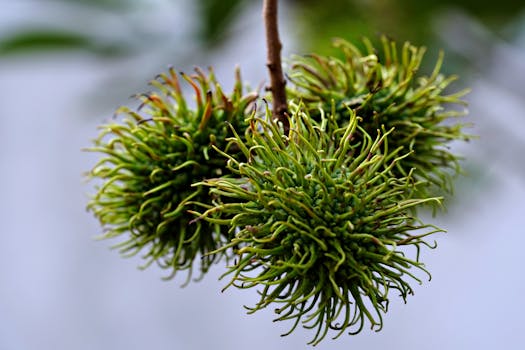
The diets react (see scores below)
Diet Ratings
Rambutan is a tropical fruit with 12-14g net carbs per 100g. Far too high in carbs to fit within ketogenic daily limits; incompatible with maintaining ketosis.
Rambutan is a whole plant fruit, entirely plant-based and unprocessed. No animal-derived ingredients or processing aids.
Rambutan is a tropical fruit with natural sugars, vitamins, and antioxidants. It is unprocessed and aligns with paleo fruit consumption as a whole food available to foragers.
Tropical fruit with vitamin C and fiber. Fits fruit consumption guideline. While not Mediterranean-origin, aligns with principles of whole fruits eaten multiple times daily.
Mediterranean diet traditionally emphasizes regional fruits (grapes, figs, citrus, pomegranate). Rambutan is not indigenous to Mediterranean region but modern interpretations include diverse whole fruits.
Rambutan is a plant-derived tropical fruit containing plant compounds, fiber, and sugars. Explicitly excluded from carnivore diet which permits only animal products. No animal origin.
Rambutan is a whole, unprocessed fruit with no excluded ingredients. Fully compliant with Whole30.
Rambutan is a tropical fruit with moderate fructose content. Monash University has limited specific testing on rambutan. The fruit contains excess fructose relative to glucose, making it potentially problematic. Safe serving size appears to be approximately 3-4 fruits (75g), but individual tolerance varies.
Monash University has not extensively tested rambutan. Clinical FODMAP practitioners suggest caution due to fructose content. Some sources suggest it may be low-FODMAP in small quantities, but this lacks robust Monash validation. Individual fructose malabsorption varies significantly.
Tropical fruit rich in vitamin C, fiber, and antioxidants. Low sodium and no added sugars in fresh form. Supports DASH fruit recommendations.
Tropical fruit with moderate sugar content (~12g net carbs per 100g). Usable as Zone carbohydrate but higher glycemic than berries. Sears limits fruit to 2 servings daily; requires careful portioning and pairing with protein/fat.
Tropical fruit with antioxidants, vitamin C, and polyphenols. Moderate natural sugar content. Less researched than common anti-inflammatory fruits but aligns with colorful fruit emphasis in Weil's pyramid.
Some nutritionists prioritize lower-glycemic fruits; rambutan's moderate sugar content may be less ideal than berries for strict anti-inflammatory protocols, though whole fruit form mitigates glycemic impact.
Tropical fruit with 82 cal per 100g, 1.6g fiber, high water content (80%), and vitamin C. Low glycemic impact. Small serving size naturally portion-friendly. Nutrient-dense per calorie compared to many fruits.
Nutritional profile
Six traits that cut across every diet.
Fiber & Plants
How much whole-plant food and fiber it delivers.
Healthy Fats
The quality of its fats (unsaturated, omega-3).
Whole / Unprocessed
How close it is to its natural, unprocessed form.
Gut Gentle
How easy it is on digestion (low FODMAP, few irritants).
Low Glycemic
How little it spikes your blood sugar.
Protein Density
How much protein it packs per calorie.
Controversy Index
Score range: 1–9/10. Higher controversy = more disagreement between diets.
Diet-Specific Tips for Rambutan
 Vegan — 9/10
- Whole plant food
- Unprocessed
- Fruit
- No animal products
 Paleo — 9/10
- Whole fruit
- Natural sugars
- Rich in vitamin C
- Unprocessed
 Mediterranean — 7/10
- whole fruit form
- vitamin C content
- fiber content
- supports daily fruit intake
 Whole30 — 9/10
- Fruit
- Unprocessed
- No additives
 Low-FODMAP — 5/10
- Excess fructose relative to glucose
- Limited Monash testing data
- Tropical fruit with variable ripeness affecting sugar content
 DASH — 8/10
- Low sodium
- High vitamin C
- Good fiber
- Antioxidant content
 Zone — 5/10
- Moderate glycemic load
- Higher sugar than approved fruits
- Requires portion control
- Limited to 2 servings daily
 Anti-Inflammatory — 7/10
- Antioxidant content
- Vitamin C rich
- Polyphenol profile
- Moderate natural sugars
- Fiber from whole fruit
 GLP-1 Friendly — 7/10
- low calorie
- good fiber
- high water content
- portion-friendly
- nutrient-dense