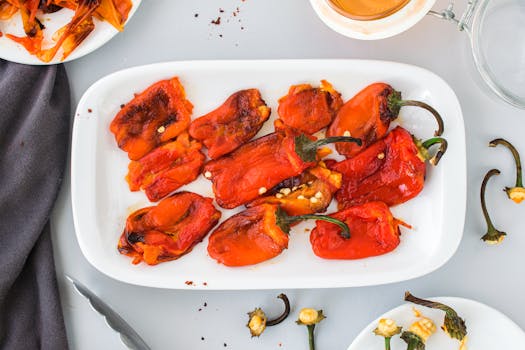
The diets react (see scores below)
Diet Ratings
Roasted red peppers contain approximately 6g net carbs per 100g. Small portions (2-3 oz) are manageable, but they require tracking. The roasting process concentrates sugars slightly, and canned versions may contain added sugars.
Some keto practitioners avoid peppers entirely due to sugar content and prefer zero-carb vegetables, while others allow small portions of red peppers as part of vegetable variety within strict carb limits.
Plant-based vegetable with no animal products or derivatives. Roasting and canning use plant-based ingredients. Fully vegan-compliant.
Red peppers are paleo-approved, but roasting and jarring typically involves processing, added oils (often seed oils), and preservatives. Fresh roasted peppers at home would be approved; commercial versions compromise purity.
Some paleo practitioners accept commercially roasted red peppers if made with olive oil or avocado oil and no added sugars, viewing the convenience and nutrient retention as acceptable.
Roasted red peppers are nutrient-dense with high vitamin C and antioxidants. If roasted with olive oil and minimal processing, they align well with Mediterranean diet. Common in Mediterranean cuisines.
Peppers are plant-derived vegetables and excluded on carnivore diet. No animal-derived content. Incompatible with carnivore framework.
Whole vegetable, minimally processed. Compliant if no added sugars or excluded ingredients in preparation.
Monash University rates red bell peppers as low-FODMAP at 150g serving. Roasting does not increase FODMAP content. Low in fructans and polyols.
Excellent nutrient profile (vitamin C, potassium, antioxidants), but jarred/canned versions often contain 300-400mg sodium per serving. Fresh roasted or low-sodium jarred options recommended.
Moderate glycemic impact (~9g net carbs per 100g). Higher sugar content than green peppers due to ripeness. Roasting concentrates sugars slightly. Usable in Zone but requires portioning awareness. Excellent polyphenol content partially offsets glycemic concern.
Dr. Sears' materials sometimes categorize red peppers as acceptable unlimited vegetables, while other Zone practitioners recommend portion control. Context depends on individual carb tolerance.
Excellent source of vitamin C, carotenoids (lycopene, beta-carotene), and polyphenols. Roasting increases bioavailability of antioxidants. Strong anti-inflammatory profile. If canned, check for added oils and sodium; prefer those in water or minimal oil.
Low-calorie (37 calories per 100g), high-water-content vegetable (92% water) with moderate carbs (9g per 100g) and good fiber (2g per 100g). Excellent source of vitamin C and antioxidants. Mild flavor is easy to digest. Roasting concentrates flavor without adding fat if done properly. Works well as a primary vegetable.
Nutritional profile
Six traits that cut across every diet.
Fiber & Plants
How much whole-plant food and fiber it delivers.
Healthy Fats
The quality of its fats (unsaturated, omega-3).
Whole / Unprocessed
How close it is to its natural, unprocessed form.
Gut Gentle
How easy it is on digestion (low FODMAP, few irritants).
Low Glycemic
How little it spikes your blood sugar.
Protein Density
How much protein it packs per calorie.
Controversy Index
Score range: 1–8/10. Higher controversy = more disagreement between diets.
Diet-Specific Tips for Roasted red peppers
 Keto — 5/10
- 6g net carbs per 100g
- Higher sugar than green peppers
- Roasting concentrates carbs
- Check for added sugars in canned versions
 Vegan — 8/10
- Plant-based
- No animal products
- Minimal processing
- Canned in plant-based liquid
 Paleo — 5/10
- Paleo vegetable base
- Processed/jarred
- Oil type uncertain
- Preservatives likely
 Mediterranean — 8/10
- whole plant food
- high antioxidants
- traditional preparation
- minimal processing if homemade
 Whole30 — 8/10
- Whole food source
- Check label for added sugars or preservatives
- Roasting is acceptable preparation
 Low-FODMAP — 8/10
- Low fructan content
- Low polyol content
- Monash-tested
 DASH — 6/10
- high sodium in jarred/canned form
- exceptional vitamin C content
- high potassium
- rich in antioxidants
- choose low-sodium varieties
 Zone — 6/10
- Moderate net carbs
- Higher sugar than green peppers
- Excellent polyphenol content
- Requires portion awareness
 Anti-Inflammatory — 8/10
- Very high in vitamin C
- Rich in carotenoids and lycopene
- Roasting enhances antioxidant bioavailability
- Anti-inflammatory polyphenols
- Check added oils and sodium if canned
 GLP-1 Friendly — 7/10
- Low calorie density
- High water content
- Moderate carbohydrate load
- Good fiber content
- Rich micronutrient profile
- Mild flavor supports digestion