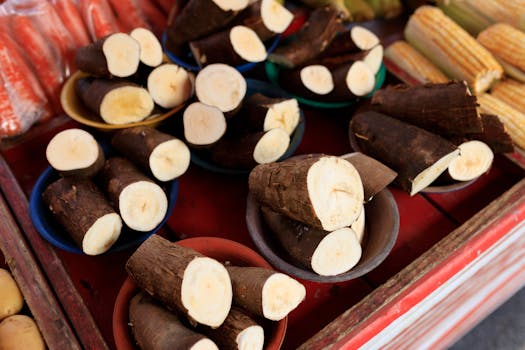
The diets react (see scores below)
Diet Ratings
Contains ~14g net carbs per 100g cooked, extremely starchy root vegetable. Incompatible with keto; even small portions exceed acceptable carb limits.
Whole plant tuber staple with good carbohydrate content. Fully vegan-compliant. Requires cooking to remove cyanogenic compounds but safe when properly prepared.
Yuca is a starchy tuber available in nature and consumed by traditional populations. Similar to sweet potatoes, it is paleo-approved. Unprocessed root vegetable with acceptable nutrient profile.
Starchy root vegetable with high carbohydrate content and minimal fiber. While a whole plant food, it lacks the nutrient density of Mediterranean staples and has significant glycemic impact.
Some Mediterranean diet practitioners in regions with yuca availability accept it as a starch alternative, though it is not traditional to Mediterranean cuisine.
Root vegetable, plant-derived. Explicitly excluded from carnivore diet. High in carbohydrates and plant compounds.
Whole starchy vegetable root, no excluded ingredients. Compliant as a vegetable carbohydrate source.
Yuca is low-FODMAP at standard servings (150g per limited Monash data). Primarily starch-based with minimal fructans. Well-tolerated in elimination phase at appropriate portions.
Monash University testing on yuca is limited. Clinical practitioners generally consider it low-FODMAP based on starch composition, but individual tolerance and preparation method may affect outcomes.
Starchy root vegetable low in sodium but high in calories and carbohydrates with minimal fiber or micronutrients compared to other DASH vegetables. Acceptable as occasional starch but not nutrient-dense.
Yuca is starchy tuber with very high carbohydrate content (approximately 38g carbs per 100g cooked). Extremely high glycemic load, similar to potatoes which Dr. Sears explicitly excludes. Incompatible with Zone protocol. No acceptable portion size.
Starchy root vegetable with high carbohydrate content and minimal polyphenol or antioxidant compounds. Lacks significant anti-inflammatory properties. Contains cyanogenic compounds requiring proper preparation. Acceptable as occasional whole grain alternative but not recommended as dietary staple for anti-inflammatory purposes.
Some view yuca as acceptable resistant starch source when properly prepared, though anti-inflammatory evidence is limited.
High carbohydrate content (38g per 100g cooked), high calorie density (160 cal per 100g cooked), minimal protein (0.9g per 100g), low fiber (1.8g per 100g). Starchy root vegetable with poor nutrient density per calorie for GLP-1 patients. Does not support satiety or nutritional priorities. Portion control extremely difficult.
Nutritional profile
Six traits that cut across every diet.
Fiber & Plants
How much whole-plant food and fiber it delivers.
Healthy Fats
The quality of its fats (unsaturated, omega-3).
Whole / Unprocessed
How close it is to its natural, unprocessed form.
Gut Gentle
How easy it is on digestion (low FODMAP, few irritants).
Low Glycemic
How little it spikes your blood sugar.
Protein Density
How much protein it packs per calorie.
Controversy Index
Score range: 1–9/10. Higher controversy = more disagreement between diets.
Diet-Specific Tips for Yuca (cassava)
 Vegan — 8/10
- Whole plant food
- Good carbohydrate source
- Requires proper preparation
- Traditional staple
 Paleo — 8/10
- Starchy tuber (paleo-approved)
- Available to hunter-gatherers
- Unprocessed
- Moderate carbohydrate content
 Mediterranean — 5/10
- High starch content
- Low fiber relative to carbs
- Non-traditional ingredient
- High glycemic impact
 Whole30 — 9/10
- Whole vegetable
- No excluded ingredients
- Starchy but compliant vegetable
 Low-FODMAP — 7/10
- Primarily starch-based
- Low fructan content
- Limited formal Monash testing
 DASH — 5/10
- Low sodium
- High calorie density
- Low fiber relative to carbs
- Limited micronutrients
- Portion control essential
 Anti-Inflammatory — 4/10
- High carbohydrate, low polyphenol content
- Minimal anti-inflammatory compounds
- Requires proper preparation (cyanogenic compounds)
- Limited nutritional density