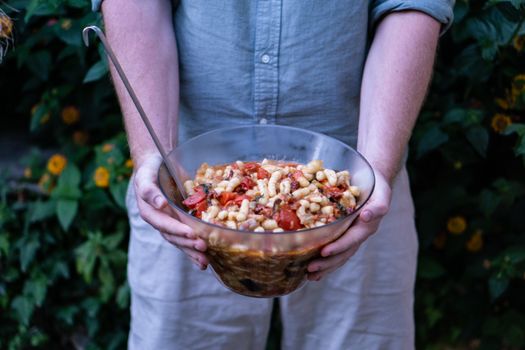
Photo: Anna Guerrero / Pexels
The diets react (see scores below)
Common Ingredients
- white beans
- duck confit
- pork sausage
- pork belly
- tomatoes
- garlic
- thyme
- breadcrumbs
Specific recipes may vary.
Incompatible with 9 of 11 diets
Diet Ratings
Cassoulet is fundamentally incompatible with a ketogenic diet. The dish is built around white beans, which are extremely high in net carbs — a single cup contains roughly 35-40g of net carbs, which alone can exceed or max out an entire day's keto allowance. Breadcrumbs add additional grain-based carbs on top. While the duck confit, pork belly, and pork sausage components are excellent keto foods (high fat, quality protein, near-zero carbs), they are minor players in a bean-heavy stew. The tomatoes and garlic contribute modest additional carbs but are not the primary concern. No reasonable portion of traditional cassoulet can be made keto-compatible without fundamentally reconstructing the dish by replacing beans and breadcrumbs entirely.
Cassoulet is a classic French slow-cooked casserole built almost entirely around animal products. The dish contains duck confit (duck meat preserved in its own fat), pork sausage, and pork belly — all direct animal flesh — making it fundamentally incompatible with a vegan diet. There is no ambiguity here: multiple animal proteins are central to the dish's identity, not incidental additives. The white beans, tomatoes, garlic, thyme, and breadcrumbs are plant-based, but they are supporting ingredients in a meat-forward dish. No vegan version of traditional cassoulet exists without completely replacing the primary protein components.
Cassoulet is fundamentally incompatible with the paleo diet. White beans are legumes, one of the most clearly excluded food groups in paleo due to their lectin and phytate content. Breadcrumbs are made from wheat, a grain — equally excluded. Pork sausage is typically a processed meat containing added salt, fillers, and often cereal binders. While duck confit, pork belly, tomatoes, garlic, and thyme are individually paleo-friendly, the dish's defining ingredients — white beans and breadcrumbs — are hard avoids with no ambiguity. This is a dish built around two non-paleo staples; removing them would result in an entirely different dish, not a paleo version of cassoulet.
Cassoulet is a rich French slow-cooked casserole that heavily features multiple forms of red and processed meat — duck confit, pork belly, and pork sausage — all in a single dish. While white beans are a Mediterranean staple and are genuinely beneficial, they are outweighed by the dominant presence of high-saturated-fat meats. Pork belly is a fatty red meat that the Mediterranean diet limits to a few times per month. Pork sausage is a processed meat, which the Mediterranean diet explicitly minimizes. Duck confit, cooked and preserved in duck fat, adds further saturated fat load. The breadcrumb topping introduces refined grains. The overall dish is protein-heavy with animal fats and processed meats, fundamentally at odds with the plant-forward, olive-oil-centric Mediterranean dietary pattern. The positive elements — beans, garlic, tomatoes, thyme — are present but clearly peripheral to the dish's caloric and nutritional character.
Cassoulet is fundamentally incompatible with the carnivore diet. While it contains carnivore-approved animal proteins (duck confit, pork sausage, pork belly), the dish is built around white beans — a legume that is entirely plant-derived and strictly excluded on carnivore. Beyond the beans, the dish also contains tomatoes (fruit/vegetable), garlic (plant), thyme (herb/spice), and breadcrumbs (grain-based) — multiple layers of plant foods that disqualify it entirely. The animal protein components cannot be separated from the dish as a whole. This is a classic French peasant dish whose identity is inseparable from its legume base.
Cassoulet contains multiple excluded ingredients. White beans are legumes, which are explicitly prohibited on Whole30. Breadcrumbs are made from wheat/grain-based bread, which is also excluded. Additionally, pork sausage typically contains added sugar, preservatives, or other non-compliant additives. Even if compliant sausage were sourced, the white beans and breadcrumbs alone disqualify this dish entirely. There is no compliant version of traditional cassoulet — the white beans are a defining, non-negotiable component of the dish.
Cassoulet contains multiple high-FODMAP ingredients that make it unsuitable during the elimination phase. White beans are very high in GOS (galacto-oligosaccharides) and are a classic high-FODMAP food at any standard serving. Garlic is one of the highest-FODMAP foods tested by Monash, rich in fructans. Traditional breadcrumbs are wheat-based, adding fructans. These three ingredients alone are sufficient to classify this dish as high-FODMAP. The duck confit and pork components (sausage, belly) are inherently low-FODMAP as plain meats, but sausages frequently contain garlic and onion as additives, adding further fructan load. Tomatoes are low-FODMAP at small servings but can accumulate FODMAPs in a slow-cooked dish where multiple servings of tomato are concentrated. Thyme is low-FODMAP as an herb. There is no realistic modification that preserves the identity of cassoulet while making it low-FODMAP, as white beans and garlic are core, defining ingredients of this dish.
Cassoulet is fundamentally incompatible with DASH diet principles. The dish is built around multiple high-saturated-fat, high-sodium meats: duck confit (preserved in its own fat, very high in saturated fat), pork belly (extremely high in saturated fat), and pork sausage (high in both saturated fat and sodium). These three ingredients alone place this dish in direct conflict with DASH's core directives to limit saturated fat, total fat, and red/processed meats. Pork sausage is a processed meat with typically very high sodium content (400-800mg per serving), and the combination of all three proteins likely pushes the sodium content of a single serving well beyond safe DASH thresholds. While white beans are an excellent DASH food (high fiber, potassium, magnesium, plant protein), tomatoes and garlic are DASH-friendly, and thyme is neutral, these beneficial ingredients are far outweighed by the problematic protein components that define the dish. Cassoulet as traditionally prepared is a rich, fatty French peasant dish specifically celebrated for its indulgent fat content — the antithesis of DASH principles.
Cassoulet is a rich, calorie-dense French stew that presents significant challenges for Zone compliance. The protein sources — duck confit, pork sausage, and pork belly — are all high in saturated fat, which conflicts with Zone's emphasis on lean proteins and monounsaturated fats. Duck confit is cooked and preserved in its own fat, and pork belly is one of the fattiest cuts available, making it extremely difficult to hit the Zone's 30% fat target without dramatically overshooting on calories from saturated fat. White beans are a 'favorable' Zone carbohydrate (low-glycemic, high fiber), and tomatoes, garlic, and thyme are Zone-positive. However, the breadcrumb topping adds refined, higher-glycemic carbs. The macro balance of a traditional cassoulet portion is severely skewed toward fat — likely 40-50% of calories from fat, much of it saturated — with insufficient lean protein relative to fat content. While small portions could theoretically be incorporated into a Zone meal, the dish as constructed cannot be balanced into a proper Zone block structure without fundamental reformulation (substituting leaner proteins). The Zone does not categorically ban fatty meats, but Sears consistently flags fatty pork products and duck confit as unfavorable protein choices that disrupt hormonal balance.
Some Zone practitioners applying Sears' later anti-inflammatory framework (Toxic Fat, The Mediterranean Zone) acknowledge that traditional animal fats, including duck fat, are preferable to seed oils and may be acceptable in moderate amounts. The white beans provide excellent Zone-favorable carbohydrate blocks with substantial fiber, and the garlic and thyme offer polyphenol benefits. A small, carefully portioned serving of cassoulet alongside a large salad could technically be worked into a Zone meal plan by a practitioner focused on overall daily ratios rather than per-meal perfection.
Cassoulet presents a genuinely mixed anti-inflammatory profile. On the positive side, white beans are an anti-inflammatory staple — high in fiber, plant protein, and resistant starch that supports a healthy gut microbiome and reduces CRP. Garlic and thyme are well-regarded anti-inflammatory herbs. Tomatoes contribute lycopene and other antioxidants. These elements align well with anti-inflammatory principles. However, the dish is dominated by heavily processed and high-saturated-fat animal proteins: duck confit (typically rendered in its own fat), fatty pork sausage, and pork belly. Together these contribute significant amounts of saturated fat and, in the case of cured sausage, likely sodium and preservatives (nitrates/nitrites), all of which are associated with elevated inflammatory markers. Duck confit in particular is traditionally cooked and preserved in duck fat — a high-saturated-fat medium. Pork belly is among the fattiest cuts available. The breadcrumb topping adds refined carbohydrates. Cassoulet is fundamentally a rich, fat-heavy peasant dish, and while its legume base and aromatics are genuinely anti-inflammatory, the quantity and quality of animal fats tip the overall profile toward pro-inflammatory territory. It is not in the 'avoid' category because the beans and vegetables provide meaningful benefit, but it should be consumed only occasionally and in modest portions.
Some anti-inflammatory practitioners, particularly those following a more permissive Mediterranean-adjacent approach like Dr. Weil's framework, would note that the white bean base, garlic, tomatoes, and thyme make this a reasonable occasional dish — especially if portion size is controlled and the fat is partially trimmed. However, stricter anti-inflammatory protocols and researchers focused on saturated fat and processed meat (e.g., those aligned with the Ornish or PREDIMED frameworks) would flag the pork belly, fatty sausage, and duck confit as clearly pro-inflammatory due to saturated fat load and processed meat additives.
Cassoulet is a rich, slow-cooked French dish built around high-fat proteins — duck confit (duck legs cooked and preserved in their own fat), pork belly, and fatty pork sausage. This combination makes it one of the worst-case scenarios for GLP-1 patients. The high saturated fat load significantly worsens GLP-1 side effects: nausea, bloating, reflux, and prolonged gastric discomfort are all likely given the already-slowed gastric emptying caused by the medication. The breadcrumb topping adds refined carbohydrates with minimal nutritional value. The one redeeming element is the white beans, which provide meaningful fiber and some plant protein, and the garlic, tomatoes, and thyme add micronutrients — but these are minor positives drowned out by the overall fat content of the dish. Even a small serving delivers a substantial fat hit. This dish is not appropriate for GLP-1 patients in its traditional preparation.
*See how scores were generated at our methodology page.
Nutritional profile
Six traits that cut across every diet.
Fiber & Plants
How much whole-plant food and fiber it delivers.
Healthy Fats
The quality of its fats (unsaturated, omega-3).
Whole / Unprocessed
How close it is to its natural, unprocessed form.
Gut Gentle
How easy it is on digestion (low FODMAP, few irritants).
Low Glycemic
How little it spikes your blood sugar.
Protein Density
How much protein it packs per calorie.
Controversy Index
Higher controversy = more disagreement between diets.
Diet-Specific Tips
 Zone — 5/10
View tips
- Duck confit is high in fat (including saturated fat) — a strongly unfavorable Zone protein source
- Pork belly is one of the fattiest meats available, severely skewing fat ratios and saturated fat load
- Pork sausage typically contains added fillers, sodium, and saturated fat — unfavorable in Zone
- White beans are a Zone-favorable, low-glycemic carbohydrate with good fiber content
- Breadcrumb topping adds refined, higher-glycemic carbs
- Tomatoes, garlic, and thyme are Zone-positive ingredients with polyphenol benefits
- Overall macro profile of traditional cassoulet is heavily fat-dominant, hard to balance into 40/30/30
- No lean protein anchor — all protein sources carry excessive fat, making block construction very difficult
 Anti-Inflammatory — 4/10
View tips
- White beans: strong anti-inflammatory legume, high fiber, supports gut health and reduces CRP
- Duck confit: high in saturated fat, traditionally preserved in duck fat — pro-inflammatory
- Pork belly: very high saturated fat content — pro-inflammatory
- Pork sausage: processed meat, likely contains nitrates/nitrites and sodium — pro-inflammatory
- Garlic and thyme: well-documented anti-inflammatory aromatics
- Tomatoes: lycopene and antioxidant content provide anti-inflammatory benefit
- Breadcrumbs: refined carbohydrate addition, modest negative contribution
- Overall dish is saturated-fat-heavy, placing it in the 'limit' or 'moderate' category under most anti-inflammatory frameworks