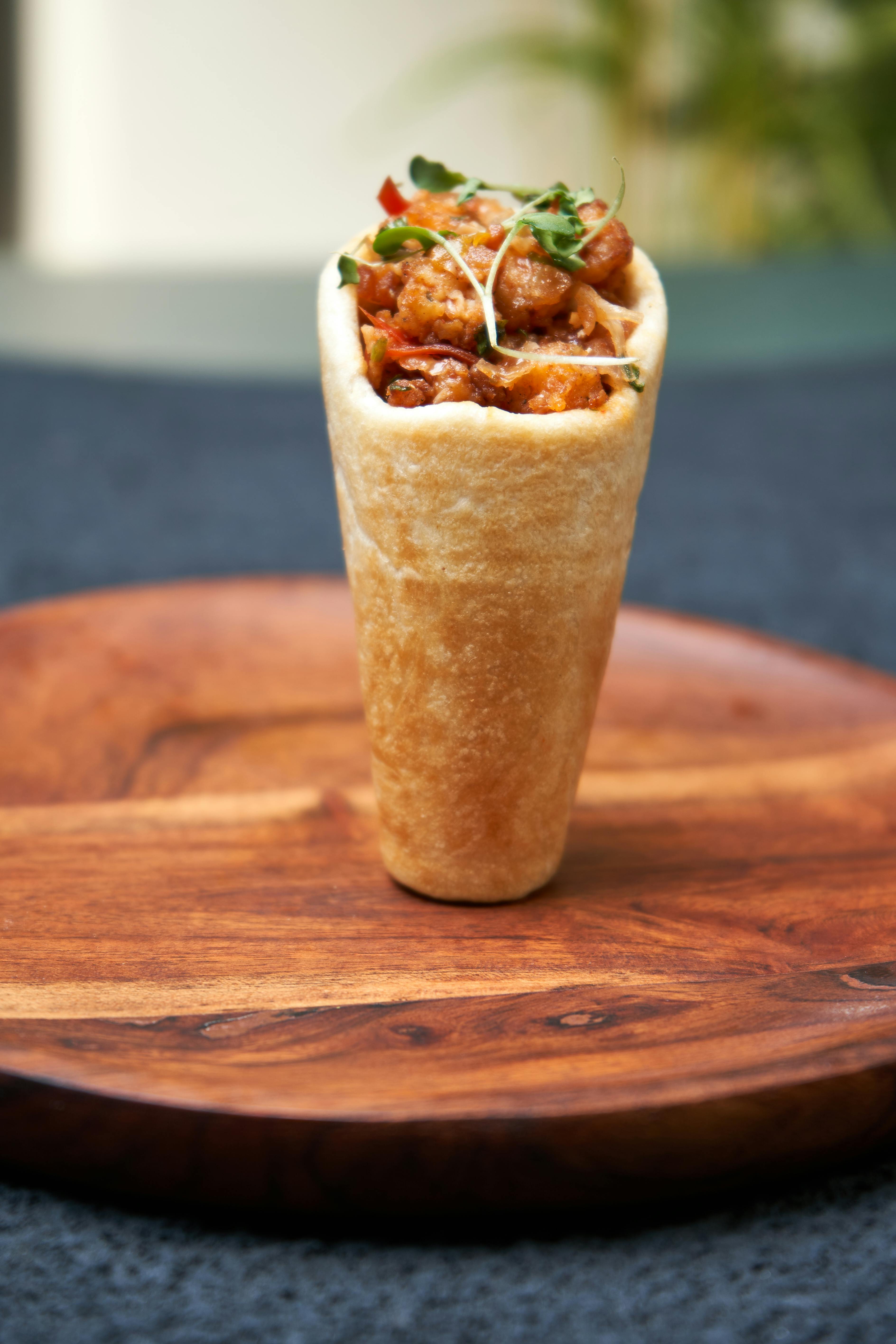
Photo: dhiraj jain / Pexels
The diets react (see scores below)
Common Ingredients
- white bread
- chicken
- curry powder
- onion
- tomato
- ginger
- garlic
- potato
Specific recipes may vary.
Incompatible with 8 of 11 diets
Diet Ratings
Bunny Chow is fundamentally incompatible with a ketogenic diet. The dish is defined by a hollowed-out loaf of white bread, which alone contains 40-60g of net carbs per serving — already at or beyond the entire daily keto limit. Additionally, the inclusion of potato adds another significant source of starch and net carbs. The spiced chicken or lamb filling with onion, tomato, and aromatics would otherwise be acceptable, but the two core structural carbohydrate ingredients (white bread and potato) make this dish impossible to consume in any reasonable portion while maintaining ketosis.
Bunny Chow as described contains chicken or lamb as the primary protein, both of which are animal flesh and strictly excluded from a vegan diet. There is no ambiguity here — this dish is fundamentally built around animal meat. While the other ingredients (white bread, curry powder, onion, tomato, ginger, garlic, potato) are all plant-based, the dish cannot be considered vegan in its traditional form. A vegan adaptation could substitute the meat with chickpeas, lentils, or tofu, but that would constitute a different dish.
Bunny Chow is fundamentally defined by its white bread bowl — a hollowed-out loaf of white bread that serves as both the vessel and a core component of the dish. White bread is a refined grain product and one of the most clearly excluded foods in the paleo framework. There is no version of Bunny Chow without the bread; it is the dish's defining characteristic. Beyond the bread, potato is a debated ingredient in paleo circles, and the dish as a whole represents a processed, grain-centered meal. While the chicken or lamb, curry powder, onion, tomato, ginger, and garlic are all paleo-compatible, the foundational ingredient (white bread) makes this dish impossible to approve or even place in a gray area.
Bunny Chow is a South African street food dish served in a hollowed-out white bread loaf, which is its defining feature. The filling ingredients — chicken, curry spices, onion, tomato, ginger, garlic, and potato — are largely Mediterranean-friendly, featuring aromatic vegetables and lean poultry. However, the white bread 'bowl' is a refined grain with little fiber or nutritional value, contradicting Mediterranean dietary principles that emphasize whole grains. The dish is essentially built around the bread as both vessel and carbohydrate base, making it inseparable from the problematic component. If lamb is chosen as the protein, the dish edges further toward 'avoid' given red meat limitations. The overall structure — a large portion of refined carbohydrate filled with a relatively small amount of vegetables and protein — does not align with Mediterranean plate composition.
Some Mediterranean diet interpreters take a flexible, cultural-context approach and would focus on the filling's merits (vegetables, legumes-adjacent spices, lean protein) while suggesting a simple swap to whole grain bread. In this reading, the dish could score in caution territory, particularly with chicken as the protein and a whole-grain or pita bread substitution.
Bunny Chow is fundamentally incompatible with the carnivore diet. The dish is built around a hollowed-out loaf of white bread — a grain-based food that is strictly excluded. Beyond the bread, virtually every other ingredient is plant-derived: curry powder (a blend of plant spices), onion, tomato, ginger, garlic, and potato are all vegetables/plants that are prohibited. While the chicken or lamb protein component would be acceptable on carnivore, it represents only a fraction of the dish and is thoroughly mixed with excluded plant ingredients. There is no version of this dish that could be adapted to carnivore without being completely reconstructed into an entirely different meal.
Bunny Chow is a South African street food dish where a hollowed-out loaf of white bread serves as the bowl/vessel for a curry filling. White bread is made from wheat flour, which is a grain explicitly excluded on the Whole30. The bread is not incidental — it is the defining structural element of the dish. Beyond the bread, the remaining ingredients (chicken or lamb, curry powder, onion, tomato, ginger, garlic, potato) are all Whole30-compliant, but the dish cannot be considered Bunny Chow without the bread component. Additionally, even if one were to eat only the filling, serving a curry inside bread falls into the spirit-of-the-program concern around using compliant fillings inside excluded vessels.
Bunny Chow contains multiple high-FODMAP ingredients that make it unsuitable during the elimination phase. White bread is made from wheat, which is high in fructans — a major FODMAP trigger. Garlic and onion are two of the highest-FODMAP foods tested by Monash University, both extremely high in fructans even in small quantities. These three ingredients alone make this dish a clear 'avoid.' The combination is compounding: fructans from wheat bread, fructans from garlic, and fructans from onion together represent a very high FODMAP load. Potato, tomato, curry powder (plain spices), ginger, and chicken or lamb are generally low-FODMAP and would be fine, but they cannot offset the high-FODMAP staples in this dish. Bunny Chow as traditionally prepared cannot be made low-FODMAP without fundamentally altering the recipe — replacing the white bread hollowed loaf with a gluten-free alternative and removing/replacing garlic and onion.
Bunny Chow is a South African street food consisting of a hollowed-out loaf of white bread filled with curry. The filling ingredients — chicken (lean protein), onion, tomato, potato, garlic, ginger, and curry spices — are well-aligned with DASH principles, providing vegetables, lean protein, potassium, fiber, and anti-inflammatory spices. However, the white bread component is a refined grain, which DASH de-emphasizes in favor of whole grains. White bread contributes minimal fiber and micronutrients compared to whole-grain alternatives. Additionally, curry preparations can vary widely in sodium content depending on seasoning, and lamb (listed as an alternative protein) is higher in saturated fat than chicken and would score lower under DASH. If lamb is used with fatty cuts, that further conflicts with DASH's limits on saturated fat. The dish is not inherently high-sodium or high in saturated fat (with chicken), but the refined grain base and potential sodium from spice blends and preparation keep it in 'caution' territory.
NIH DASH guidelines explicitly favor whole grains over refined grains, placing white bread at odds with DASH recommendations. However, some updated clinical interpretations note that when white bread is consumed as part of a nutrient-dense meal with vegetables and lean protein — as in this dish — the overall glycemic and nutritional impact may be moderate, and the focus on overall dietary pattern rather than individual foods supports occasional inclusion.
Bunny Chow is a South African street food consisting of a hollowed-out loaf of white bread filled with curry. From a Zone Diet perspective, this dish is fundamentally problematic because its two primary structural carbohydrate sources — white bread and potato — are both high-glycemic and explicitly 'unfavorable' in Zone terminology. White bread causes rapid blood sugar spikes and is essentially impossible to balance within Zone ratios when used as the vessel for an entire meal. Potato is similarly flagged by Dr. Sears as a high-glycemic carbohydrate to avoid. Together, these two ingredients would deliver an enormous carbohydrate load that is predominantly high-glycemic, making it virtually impossible to achieve the 40/30/30 ratio in a Zone-friendly way. The protein component (chicken or lamb curry) is reasonable and the spices (curry powder, ginger, garlic, onion, tomato) are Zone-favorable anti-inflammatory ingredients, but they cannot redeem the macro imbalance created by the bread-and-potato foundation. Unlike a dish where a single unfavorable ingredient can be portioned carefully, the white bread here is the structural container of the dish — it cannot be removed without the dish ceasing to be Bunny Chow. This makes it one of the rare 'avoid' cases where the dish's identity is inseparable from its Zone-unfavorable components.
Bunny Chow is a South African street food dish where a curry is served inside a hollowed-out loaf of white bread. The dish has a genuinely mixed anti-inflammatory profile. On the positive side, the curry base is rich in anti-inflammatory ingredients: garlic and ginger are well-established anti-inflammatory agents, onion and tomato provide quercetin and lycopene respectively, and curry powder typically contains turmeric (curcumin), coriander, cumin, and chili — all of which have documented anti-inflammatory properties. Lean chicken (especially white meat) is an acceptable moderate protein in the anti-inflammatory framework. Potato, while a starchy vegetable, is not itself pro-inflammatory and provides potassium and vitamin C. The significant drawback is the white bread vessel, which is a refined carbohydrate with a high glycemic index. Refined carbs promote blood sugar spikes and downstream inflammatory signaling (elevated IL-6, CRP). The bread is not incidental — it is a defining, structural component of the dish and consumed in substantial quantity. If lamb is chosen as the protein, that introduces additional saturated fat, pushing the score down further. Overall, this is a dish with an anti-inflammatory core (the curry) undermined by a pro-inflammatory delivery format (white bread). It is acceptable occasionally but not aligned with regular anti-inflammatory eating.
Bunny Chow is a South African street food dish consisting of a hollowed-out half or quarter loaf of white bread filled with curry. The protein base (chicken or lamb) and the spiced curry filling with onion, tomato, garlic, and ginger offer real nutritional value, but the dish has several meaningful drawbacks for GLP-1 patients. The white bread vessel is a refined grain with minimal fiber and low nutrient density per calorie — a significant negative given that every calorie must count. The bread also represents a large carbohydrate load in a single serving, which is problematic for blood sugar stability and portion control. If lamb is chosen, the saturated fat content rises considerably, worsening GI side effects. The curry spice blend is generally mild enough to be tolerated, but individual spice sensitivity on GLP-1s varies. On the positive side, chicken-based bunny chow provides a meaningful protein contribution, and the tomato, onion, and potato add some fiber and micronutrients. However, the dish is inherently large and volume-heavy, poorly suited to the small-portion eating pattern recommended for GLP-1 patients, and the white bread base cannot be easily removed without changing the dish entirely. A modified version — using a whole grain bread, choosing chicken over lamb, and consuming only a small portion of the bread — could improve the rating, but the standard preparation warrants a caution.
Some GLP-1-focused dietitians may accept the chicken version of bunny chow in a small portion as a culturally appropriate meal with adequate protein, arguing that eliminating culturally significant foods risks dietary non-adherence. Others would flag the refined white bread and large serving size as fundamentally incompatible with GLP-1 dietary principles regardless of the protein quality, particularly given slowed gastric emptying and the risk of discomfort from a dense, starchy meal.
*See how scores were generated at our methodology page.
Nutritional profile
Six traits that cut across every diet.
Fiber & Plants
How much whole-plant food and fiber it delivers.
Healthy Fats
The quality of its fats (unsaturated, omega-3).
Whole / Unprocessed
How close it is to its natural, unprocessed form.
Gut Gentle
How easy it is on digestion (low FODMAP, few irritants).
Low Glycemic
How little it spikes your blood sugar.
Protein Density
How much protein it packs per calorie.
Controversy Index
Higher controversy = more disagreement between diets.
Diet-Specific Tips
 DASH — 5/10
View tips
- White bread is a refined grain — DASH emphasizes whole grains; substituting whole wheat bread would significantly improve DASH compatibility
- Chicken is a lean protein well-suited to DASH; lamb increases saturated fat and is less preferred
- Vegetables (onion, tomato, potato, garlic, ginger) contribute potassium, fiber, and micronutrients aligned with DASH
- Curry powder and spice blends may add variable sodium — homemade low-sodium versions score better than packaged blends
- Potato is a DASH-friendly source of potassium when not fried or loaded with sodium
- Portion size of bread is significant — Bunny Chow uses a large hollowed loaf, representing multiple refined grain servings
- No added saturated fat, tropical oils, or high-sodium processed ingredients inherently in the recipe — preparation method matters
 Anti-Inflammatory — 5/10
View tips
- White bread is a refined carbohydrate with high glycemic index — a primary concern in anti-inflammatory diets due to blood sugar spikes and elevated inflammatory markers
- Curry powder contains turmeric (curcumin), ginger, and chili — all with strong anti-inflammatory credentials
- Garlic and onion provide allicin and quercetin, both with anti-inflammatory and antioxidant properties
- Tomato contributes lycopene, an anti-inflammatory carotenoid
- Chicken (lean) is an acceptable moderate protein; lamb would add saturated fat and be less favorable
- Potato is a neutral starchy vegetable — not pro-inflammatory but low in anti-inflammatory benefit
- The dish's anti-inflammatory potential is significantly offset by the large quantity of refined white bread used as the serving vessel
 GLP-1 Friendly — 4/10
View tips
- White bread vessel is a refined grain with low fiber and low nutrient density per calorie
- Large, volume-heavy dish poorly suited to small-portion GLP-1 eating pattern
- Chicken option provides meaningful protein; lamb option adds high saturated fat
- Curry spices are generally tolerable but may worsen reflux or nausea in sensitive GLP-1 patients
- Potato adds starchy carbohydrate load, further reducing glycemic favorability
- Tomato, onion, garlic, and ginger contribute micronutrients and some fiber but insufficient to offset refined carbohydrate base
- No high-fiber whole grain component in standard preparation