Chinese
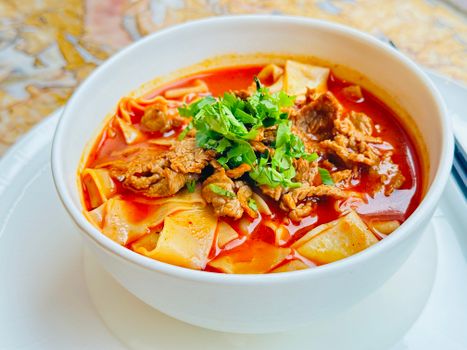
Xinjiang Lamb Noodles
The diets react (see scores below)
Common Ingredients
- wheat noodles
- lamb shoulder
- cumin seeds
- bell peppers
- onion
- tomatoes
- Sichuan peppercorns
- garlic
Specific recipes may vary.
Incompatible with 7 of 11 diets
Diet Ratings
Xinjiang Lamb Noodles are fundamentally incompatible with a ketogenic diet due to the wheat noodles, which are the primary ingredient and a grain-based, high-carbohydrate food. A standard serving of wheat noodles contains roughly 40-60g of net carbs on its own, which already meets or exceeds the entire daily keto carb budget. While lamb shoulder is an excellent keto protein and fat source, and spices like cumin, Sichuan peppercorns, and garlic are fine in small amounts, the dish also contains moderate-carb vegetables (onion, tomatoes, bell peppers) that add further net carbs. The foundational structure of this dish — noodles as the bulk component — makes it impossible to adapt without fundamentally changing the dish itself.
Xinjiang Lamb Noodles contains lamb shoulder as its primary protein, which is unambiguously an animal product (mammal flesh). This makes the dish incompatible with a vegan diet under any interpretation of vegan principles. The remaining ingredients — wheat noodles, cumin seeds, bell peppers, onion, tomatoes, Sichuan peppercorns, and garlic — are all plant-based, but the inclusion of lamb is an absolute disqualifier. There is no meaningful debate within the vegan community on this point.
Xinjiang Lamb Noodles are firmly non-paleo due to the wheat noodles, which are a grain-based product universally excluded from the paleo diet. Wheat is one of the most clearly prohibited foods in all paleo frameworks — it contains gluten, lectins, and phytates that Paleolithic humans never consumed. The remaining ingredients (lamb shoulder, cumin seeds, bell peppers, onion, tomatoes, Sichuan peppercorns, garlic) are all paleo-compliant and would be excellent on their own. However, the wheat noodles are a foundational, structural component of the dish and cannot simply be omitted — they define the dish itself. The overall verdict must reflect the dish as presented.
Xinjiang Lamb Noodles centers on lamb shoulder, a red meat that the Mediterranean diet restricts to a few times per month. The wheat noodles are refined rather than whole grain, further contradicting core Mediterranean principles. While the dish does include beneficial vegetables (bell peppers, onion, tomatoes, garlic) and aromatic spices, these positives are outweighed by the red meat protein and refined grain base. The overall dietary pattern of this dish — red meat as primary protein with refined noodles — is the opposite of the plant-forward, olive oil-based Mediterranean ideal.
Some Mediterranean diet interpreters note that occasional red meat consumption is permitted (a few times monthly), and the generous vegetable content and spice complexity could allow this dish as a rare indulgence. If lamb were used in a small, garnish-like quantity over whole wheat noodles, the score could rise to caution territory.
Xinjiang Lamb Noodles is fundamentally incompatible with the carnivore diet. While lamb shoulder is an excellent carnivore-approved ruminant meat, the dish is built around wheat noodles — a grain-based food that is strictly excluded. Beyond the noodles, the recipe contains multiple plant-based ingredients: bell peppers, onion, tomatoes, garlic, cumin seeds, and Sichuan peppercorns. Every single non-meat ingredient violates carnivore principles. The lamb alone would be approved, but as a dish it cannot be adapted without completely rebuilding it.
Xinjiang Lamb Noodles contain wheat noodles, which are a grain-based pasta product explicitly excluded on the Whole30. Grains (including wheat) are among the core eliminated food groups for the entire 30-day program. Additionally, even if the noodles were replaced with a compliant alternative, noodles or pasta made to replicate the texture of grain noodles would fall under Rule 4's prohibition on recreating comfort food analogues. All other ingredients — lamb shoulder, cumin seeds, bell peppers, onion, tomatoes, Sichuan peppercorns, and garlic — are fully compliant on their own.
Xinjiang Lamb Noodles contains multiple high-FODMAP ingredients that make it unsuitable during the elimination phase. Wheat noodles are high in fructans — a primary FODMAP trigger — and cannot be made low-FODMAP simply by portion control at any standard serving size. Onion is one of the highest-FODMAP foods tested by Monash University, containing significant fructans even in small amounts. Garlic is similarly very high in fructans and must be avoided entirely during elimination. These three ingredients alone are sufficient to classify the dish as high-FODMAP. The lamb shoulder itself is low-FODMAP, as are cumin seeds, bell peppers, tomatoes (in moderate servings), and Sichuan peppercorns. However, the presence of wheat noodles, onion, and garlic as core structural ingredients — not incidental garnishes — means there is no realistic way to consume this dish as prepared while remaining within low-FODMAP limits.
Xinjiang Lamb Noodles present a mixed DASH profile. On the positive side, the dish contains several DASH-friendly vegetables (bell peppers, onion, tomatoes, garlic) that contribute potassium, fiber, and antioxidants, and the spices (cumin, Sichuan peppercorns) add flavor without sodium. Wheat noodles provide carbohydrates but are refined rather than whole grain. The primary concern is lamb shoulder, which is a red meat with notable saturated fat content — DASH guidelines explicitly limit red meat and favor lean poultry, fish, or plant proteins. Lamb shoulder in particular is a fattier cut. Portion size is therefore critical; a small serving (2-3 oz cooked lamb) could fit within DASH's limited red meat allowance, but typical restaurant or home servings likely exceed this. Sodium content depends heavily on preparation — if soy sauce or other salty condiments are added (common in Chinese cooking), sodium could spike well above DASH targets. As listed with no added sauces, the dish is moderate. The vegetable load and spice-forward flavoring are positives, but the red meat base and refined noodles limit the score.
NIH DASH guidelines categorically limit red meat including lamb due to saturated fat and recommend lean alternatives; however, updated clinical interpretations note that unprocessed red meat in small portions (≤3 oz, 1-2 times/week) may be compatible with an overall heart-healthy diet, and some DASH-informed practitioners allow lean cuts of lamb occasionally within a nutrient-rich vegetable context like this dish.
Xinjiang Lamb Noodles present a mixed Zone profile that requires careful portioning but is workable. The dish combines several Zone-unfavorable elements with some favorable ones. Wheat noodles are a high-glycemic refined carbohydrate that Sears classifies as unfavorable — they spike insulin and provide limited fiber relative to their carb load. However, the vegetable components (bell peppers, onion, tomatoes, garlic) are favorable Zone carbs: low-glycemic, polyphenol-rich, and anti-inflammatory. The lamb shoulder is the primary protein concern: while it provides complete protein, lamb is relatively high in saturated fat compared to Zone-preferred lean proteins like skinless chicken or fish. The cumin and Sichuan peppercorns are Zone-neutral spices with polyphenol benefits. To make this Zone-compliant, a practitioner would need to significantly reduce noodle portion (or substitute with shirataki or reduce to a very small block), increase vegetable volume, trim the lamb of visible fat, and potentially add a drizzle of olive oil as the fat block. The dish can be Zone-adapted but requires significant modification from typical restaurant serving ratios.
Some Zone practitioners following Sears' later anti-inflammatory framework (Toxic Fat, The Mediterranean Zone) might be slightly more permissive with lamb's saturated fat given its CLA content and relatively favorable omega-6 to omega-3 ratio compared to grain-fed beef. The polyphenol-rich spice profile (cumin, Sichuan peppercorn, garlic) also aligns with Sears' later emphasis on polyphenols as an anti-inflammatory tool, which could nudge this dish toward a slightly higher score in that context.
Xinjiang Lamb Noodles present a genuinely mixed anti-inflammatory profile. On the positive side, the dish is rich in anti-inflammatory spices — cumin seeds contain cuminaldehyde and flavonoids with anti-inflammatory properties, Sichuan peppercorns offer antioxidant compounds, and garlic provides allicin and organosulfur compounds that reduce inflammatory markers. The colorful vegetables (bell peppers, tomatoes, onion) contribute carotenoids, lycopene, quercetin, and vitamin C. Bell peppers in particular are among the most antioxidant-dense vegetables. The overall spice profile aligns well with anti-inflammatory principles. However, the primary protein — lamb shoulder — is red meat with meaningful saturated fat content, which anti-inflammatory guidelines consistently flag as pro-inflammatory, especially in regular consumption. Lamb is also higher in arachidonic acid than poultry or fish. Wheat noodles are refined carbohydrates that can spike blood glucose and modestly promote inflammatory pathways, though they are less problematic than added sugars or ultra-processed foods. The dish does not use seed oils or trans fats, which is a meaningful absence of pro-inflammatory factors. Assessed holistically: the spice and vegetable base is genuinely beneficial, but the lamb and refined noodles prevent this from reaching 'approve' territory. Suitable for occasional consumption rather than dietary staple.
Some anti-inflammatory practitioners, particularly those following Mediterranean or Dr. Weil-influenced frameworks, would note that moderate red meat consumption (a few times per month) is acceptable, and the herb and vegetable density here partly offsets the lamb's pro-inflammatory load. Conversely, stricter anti-inflammatory protocols — particularly those targeting autoimmune conditions or using the AIP framework — would rate this more negatively, flagging lamb as a consistent red-meat concern and potentially flagging tomatoes and bell peppers (nightshades) as additional triggers for sensitive individuals.
Xinjiang Lamb Noodles present a mixed nutritional profile for GLP-1 patients. On the positive side, lamb shoulder provides meaningful protein and the dish includes fiber-contributing vegetables (bell peppers, onion, tomatoes) and garlic. However, lamb shoulder is a fatty cut with notable saturated fat content, which can worsen GLP-1 side effects like nausea, bloating, and delayed gastric emptying — already slowed by the medication. Wheat noodles are refined carbohydrates with low fiber density, adding bulk calories without strong nutritional payoff. Sichuan peppercorns introduce a spice-forward element that may irritate the GI tract in sensitive patients, though they are less acutely problematic than capsaicin-based spices. Cumin seeds are generally well-tolerated and may aid digestion. The dish can be made more GLP-1-compatible with modifications: swapping lamb shoulder for leaner lamb leg or a non-lamb protein, using whole wheat or high-protein noodles, and keeping the portion of noodles small while increasing vegetable volume. As prepared with lamb shoulder and standard wheat noodles, it sits firmly in the caution range.
Some GLP-1-focused dietitians accept lamb in moderation as a complete protein source with good micronutrient density (iron, zinc, B12), arguing that total fat per serving matters more than the cut itself — a modest portion of lamb shoulder in a vegetable-rich dish may be acceptable for patients without significant GI sensitivity. Others are more restrictive, flagging any fatty red meat as a consistent trigger for nausea and reflux in GLP-1 patients, and recommend avoiding lamb shoulder entirely in favor of leaner proteins.
*See how scores were generated at our methodology page.
Nutritional profile
Six traits that cut across every diet.
Fiber & Plants
How much whole-plant food and fiber it delivers.
Healthy Fats
The quality of its fats (unsaturated, omega-3).
Whole / Unprocessed
How close it is to its natural, unprocessed form.
Gut Gentle
How easy it is on digestion (low FODMAP, few irritants).
Low Glycemic
How little it spikes your blood sugar.
Protein Density
How much protein it packs per calorie.
Controversy Index
Higher controversy = more disagreement between diets.
Diet-Specific Tips
 DASH — 5/10
View tips
- Lamb shoulder is a red meat with significant saturated fat — DASH limits red meat broadly
- Fattier cut of lamb increases saturated fat concern vs. leaner cuts like lamb loin
- Wheat noodles are refined grain, not whole grain as DASH prefers
- Bell peppers, tomatoes, onion, and garlic provide DASH-friendly potassium, fiber, and antioxidants
- Spice-forward seasoning (cumin, Sichuan peppercorn) allows flavor without added sodium
- Sodium risk depends heavily on preparation — added soy sauce or seasoning pastes common in this cuisine could push sodium above DASH limits
- Portion control of lamb is essential; small portions (2-3 oz) are more compatible than typical servings
- Substituting lamb with skinless chicken or fish would significantly improve DASH compatibility
 Zone — 5/10
View tips
- Wheat noodles are unfavorable high-glycemic carbs in Zone methodology — must be strictly portioned
- Lamb shoulder has higher saturated fat than Zone-preferred lean proteins, though not disqualifying
- Bell peppers, tomatoes, and onions are favorable low-glycemic Zone carbohydrates that help balance the dish
- Garlic, cumin, and Sichuan peppercorns provide anti-inflammatory polyphenols aligned with Sears' later writings
- Dish can be Zone-adapted by reducing noodle volume, increasing vegetables, and trimming lamb fat
- No omega-3-rich fats or monounsaturated fats present — would benefit from small olive oil addition
 Anti-Inflammatory — 5/10
View tips
- Lamb shoulder (red meat, saturated fat, arachidonic acid) is a pro-inflammatory primary protein under anti-inflammatory guidelines
- Cumin seeds, Sichuan peppercorns, and garlic provide meaningful anti-inflammatory phytochemicals
- Bell peppers and tomatoes contribute carotenoids, lycopene, and vitamin C — strong antioxidant profile
- Onion provides quercetin, a well-studied anti-inflammatory flavonoid
- Wheat noodles are refined carbohydrates with a modest pro-inflammatory effect on blood glucose
- No seed oils, trans fats, or processed additives — a significant positive
- Tomatoes and bell peppers are nightshades, which may be problematic for autoimmune-sensitive individuals
- Overall balance: anti-inflammatory spice/vegetable base partially offset by red meat and refined starch
 GLP-1 Friendly — 4/10
View tips
- Lamb shoulder is a high-fat cut with significant saturated fat — worsens nausea and bloating on GLP-1 medications
- Refined wheat noodles are low in fiber and contribute empty carbohydrate calories
- Sichuan peppercorns may irritate the GI tract in sensitive GLP-1 patients
- Vegetables (bell peppers, onion, tomatoes) add fiber, micronutrients, and hydration support — a positive element
- Lamb provides complete protein with good iron and B12, but the fat content undermines GLP-1 compatibility
- Dish is portion-sensitive — a small serving with a reduced noodle ratio improves the profile meaningfully
- Modifiable: leaner protein swap and whole-grain or legume-based noodles would upgrade this to a borderline approve