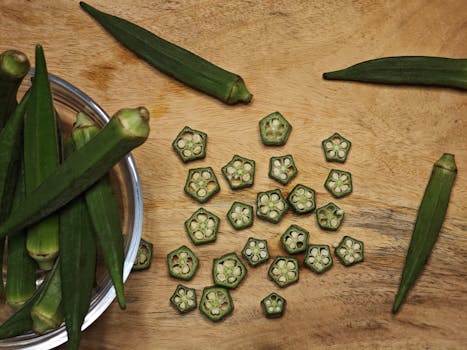
The diets react (see scores below)
Diet Ratings
Okra contains approximately 3.5g net carbs per 100g with high fiber and mucilaginous compounds that support digestive health. It's a well-established keto vegetable that fits comfortably within daily carb limits.
Whole plant food, unprocessed, no animal products or derivatives. Excellent whole-food vegan staple.
Non-starchy vegetable with minimal anti-nutrients. Nutrient-dense, unprocessed, available to hunter-gatherers. Mucilaginous texture aids digestion.
Nutrient-dense vegetable with soluble fiber and antioxidants. Used in Mediterranean cuisines, particularly Middle Eastern and North African regions. Can be prepared with olive oil and tomatoes.
Okra is more prominent in Eastern Mediterranean and North African traditions than Western European Mediterranean cuisines, but is increasingly recognized as compatible across all Mediterranean regions.
Okra is a plant-derived vegetable and excluded on carnivore diet. No animal-derived content. Incompatible with carnivore framework.
Whole, unprocessed vegetable with no excluded ingredients. Fully compliant.
Monash University rates okra as low-FODMAP at 100g serving. Contains minimal fermentable carbohydrates and is well-tolerated in standard portions.
Excellent DASH vegetable: very low sodium, high fiber, good potassium and magnesium. Supports digestive and cardiovascular health. Minimal processing when fresh or frozen.
Low-glycemic vegetable (~7g net carbs per 100g cooked). High fiber, mucilaginous texture aids satiety. Excellent anti-inflammatory properties. Fits Zone vegetable servings without carb block concerns. Preferred non-starchy option.
Excellent source of soluble fiber (mucilage), vitamin C, vitamin K, and antioxidants. Contains polyphenols with strong anti-inflammatory properties. Supports gut health and healthy cholesterol levels. Minimal inflammatory compounds.
Excellent fiber source (3.2g per 100g) with low carbs (7g per 100g) and moderate protein (2g per 100g). High water content (90%) supports hydration. Mucilaginous texture aids digestion and may help with GI comfort. Nutrient-dense with vitamins K and C. Ideal GLP-1 companion vegetable.
Nutritional profile
Six traits that cut across every diet.
Fiber & Plants
How much whole-plant food and fiber it delivers.
Healthy Fats
The quality of its fats (unsaturated, omega-3).
Whole / Unprocessed
How close it is to its natural, unprocessed form.
Gut Gentle
How easy it is on digestion (low FODMAP, few irritants).
Low Glycemic
How little it spikes your blood sugar.
Protein Density
How much protein it packs per calorie.
Controversy Index
Score range: 1–9/10. Higher controversy = more disagreement between diets.
Diet-Specific Tips for Okra
 Keto — 8/10
- 3.5g net carbs per 100g
- High fiber content
- Supports gut health
- Minimal blood glucose impact
 Vegan — 9/10
- Whole plant food
- Unprocessed
- No animal products
- Nutrient-dense
 Paleo — 8/10
- Non-starchy vegetable
- Low anti-nutrients
- Nutrient-dense
- Unprocessed
 Mediterranean — 8/10
- whole plant food
- soluble fiber
- regional Mediterranean use
- traditional preparation methods
 Whole30 — 9/10
- Whole vegetable
- No excluded ingredients
- Nutrient-dense
 Low-FODMAP — 8/10
- Low fructan content
- Low GOS content
- Monash-tested
 DASH — 9/10
- very low sodium
- exceptional fiber content
- high potassium and magnesium
- rich in antioxidants
- supports healthy cholesterol
 Zone — 8/10
- Low net carbs
- High fiber
- Anti-inflammatory
- Supports satiety
 Anti-Inflammatory — 8/10
- High in soluble fiber
- Rich in vitamin C and K
- Anti-inflammatory polyphenols
- Supports gut microbiome
- Low glycemic impact
 GLP-1 Friendly — 8/10
- High fiber content
- Low carbohydrate load
- Moderate protein
- High water content
- Mucilaginous texture supports digestion