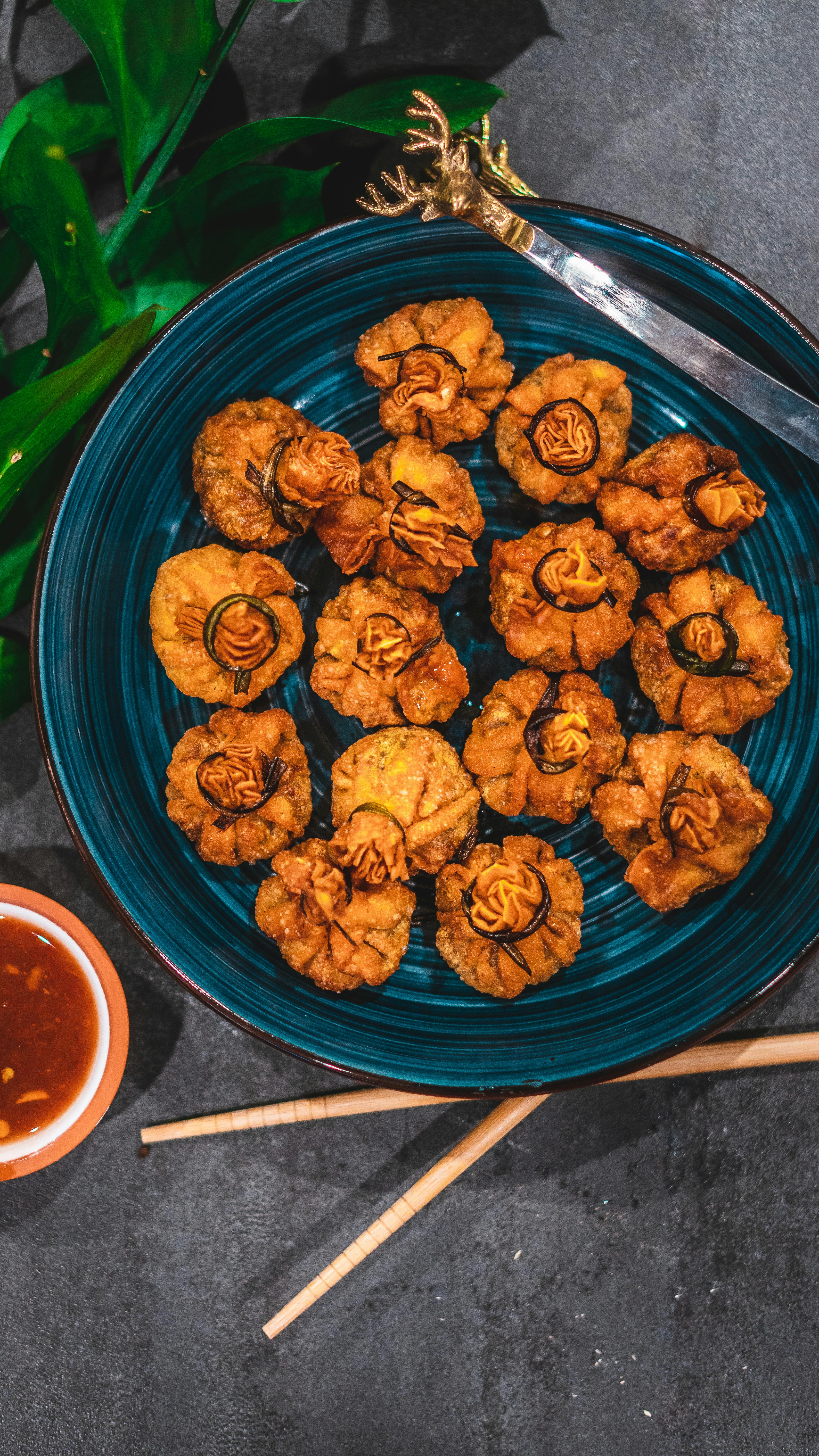
Photo: Chait Goli / Pexels
Chinese
Crab Rangoon
The diets react (see scores below)
Common Ingredients
- wonton wrappers
- cream cheese
- imitation crab
- scallions
- garlic powder
- Worcestershire sauce
- vegetable oil
Specific recipes may vary.
Incompatible with 11 of 11 diets
Diet Ratings
Crab Rangoon is fundamentally incompatible with a ketogenic diet due to wonton wrappers, which are made from wheat flour — a grain-based, high-carb ingredient. Each wonton wrapper contains approximately 5-6g of net carbs, and a standard serving of 4-6 pieces would deliver 20-36g of net carbs from the wrappers alone, potentially consuming or exceeding the entire daily keto carb budget in a single snack. Additionally, imitation crab (surimi) is heavily processed and loaded with added starch and sugar, contributing further carbs. The deep-frying in vegetable oil also introduces inflammatory seed oils, which are discouraged on quality keto protocols. The cream cheese filling is keto-friendly in isolation, but it cannot redeem this dish given the dominant high-carb components.
Crab Rangoon contains multiple animal-derived ingredients that disqualify it from a vegan diet. Cream cheese is a dairy product (excluded under rule 1), and Worcestershire sauce in its standard form contains anchovies (a fish product). While the crab listed is imitation crab, traditional imitation crab (surimi) is made from processed white fish such as pollock, making it non-vegan. Wonton wrappers frequently contain eggs. With three to four likely animal-derived ingredients present, this dish is clearly incompatible with a vegan diet. Vegan-adapted versions could theoretically be made using dairy-free cream cheese, egg-free wonton wrappers, vegan Worcestershire sauce, and a plant-based crab substitute, but as described, the dish is not vegan.
Crab Rangoon is fundamentally incompatible with the Paleo diet. The wonton wrappers are made from wheat flour, a grain explicitly excluded from Paleo. Cream cheese is a dairy product, also excluded. Imitation crab is a heavily processed food made from surimi (white fish paste) combined with starch, sugar, and artificial flavoring — far removed from anything a Paleolithic human would recognize. Vegetable oil (a seed oil) is explicitly excluded in favor of animal fats or approved plant oils. Worcestershire sauce typically contains added sugar, tamarind, and other processed ingredients that are non-Paleo. Virtually every core ingredient in this dish violates Paleo principles, making this an unambiguous avoid.
Crab Rangoon is deeply incompatible with Mediterranean diet principles on multiple levels. The wonton wrappers are refined grain products, cream cheese is a high-saturated-fat dairy used in large quantities rather than sparingly, imitation crab is a heavily processed food product, and the dish is deep-fried in vegetable oil rather than olive oil. This is a Western-Chinese fusion appetizer with no connection to Mediterranean traditions. The combination of refined wrappers, processed protein, high-fat dairy, and deep-frying contradicts nearly every core principle of the Mediterranean diet simultaneously.
Crab Rangoon is fundamentally incompatible with the carnivore diet. The dish is built around wonton wrappers, which are made from wheat flour — a grain and plant food explicitly excluded. It is deep-fried in vegetable oil, another plant-derived ingredient that carnivore practitioners universally reject. The 'crab' is imitation crab (surimi), a heavily processed product made primarily from starch and fish paste with additives, colorings, and sugar. Scallions and garlic powder are plant-derived. Worcestershire sauce contains tamarind, molasses, and other plant ingredients. Cream cheese is a debated dairy item, but even if accepted, it cannot redeem a dish where the majority of ingredients are plant-based, processed, or grain-derived. Virtually nothing in this dish aligns with carnivore principles.
Crab Rangoon contains multiple Whole30-excluded ingredients. Wonton wrappers are made from wheat flour, a grain that is explicitly excluded. Cream cheese is dairy, which is excluded (only ghee and clarified butter are permitted dairy exceptions). Imitation crab (surimi) typically contains wheat starch, sugar, and soy — all excluded ingredients. Worcestershire sauce commonly contains sugar and sometimes soy. Additionally, the dish itself is a fried snack/dumpling that falls squarely into the 'no recreating junk food' rule (Rule 4). There is no compliant version of this dish possible while maintaining its identity.
Crab Rangoon contains multiple high-FODMAP ingredients that make it unsuitable during the elimination phase. Wonton wrappers are made from wheat flour, which is high in fructans — a primary FODMAP trigger. Cream cheese contains lactose, which is a disaccharide FODMAP (though in small amounts per piece it may be moderate). Garlic powder is one of the most concentrated sources of fructans and is explicitly high-FODMAP at any amount per Monash University. Imitation crab (surimi) often contains wheat starch as a binder, adding further fructan exposure. Worcestershire sauce typically contains garlic and onion-derived ingredients, adding additional fructans. Scallion greens are low-FODMAP, but if white/bulb portions are included, they contribute further fructans. The combination of wheat wrappers, garlic powder, and likely wheat-containing surimi makes this dish firmly high-FODMAP at any standard serving size.
Crab Rangoon is highly problematic for the DASH diet on multiple fronts. The dish is deep-fried in vegetable oil, significantly increasing total fat and caloric density. Cream cheese is a full-fat dairy product high in saturated fat, which DASH explicitly limits. Imitation crab (surimi) is heavily processed and very high in sodium, often containing 400-600mg per serving. Wonton wrappers add refined carbohydrates with little fiber. Worcestershire sauce adds additional sodium. The combination of deep frying, full-fat dairy, processed protein, and refined flour wrappers makes this dish counter to nearly every core DASH principle: it is high in saturated fat, high in sodium, low in fiber, devoid of meaningful potassium or magnesium, and uses full-fat rather than low-fat dairy. This is a heavily processed, restaurant-style snack food that DASH guidelines would consistently discourage.
Crab Rangoon is a poor fit for the Zone Diet on nearly every dimension. The wonton wrappers are made from refined white flour — a high-glycemic carbohydrate that Dr. Sears explicitly classifies as 'unfavorable' and cautions against. Cream cheese is high in saturated fat with negligible protein contribution, the opposite of the lean protein and monounsaturated fat profile Zone targets. Imitation crab (surimi) is a heavily processed food loaded with starch fillers and additives, making it a poor-quality protein source compared to Zone-favorable lean proteins. The dish is deep-fried in vegetable oil (likely a high omega-6 seed oil), which directly contradicts Zone's anti-inflammatory principles. The macronutrient ratio is badly skewed: high in refined carbs and saturated/omega-6 fat, low in quality protein and micronutrients. There are essentially no favorable Zone elements here — no low-GI carbs, no lean protein, no monounsaturated fat, and significant inflammatory fat load. While the scallions and garlic powder are technically Zone-friendly, they contribute negligibly. This dish cannot be portion-adjusted into Zone balance in any practical way.
Crab Rangoon is a deep-fried appetizer with a strongly pro-inflammatory nutritional profile across nearly every component. The wonton wrappers are refined white flour with minimal fiber or nutritional value. The cream cheese is full-fat dairy, high in saturated fat, which anti-inflammatory guidelines consistently flag as a food to limit. The protein source is imitation crab (surimi) — a heavily processed product typically made from white fish mixed with starch, sugar, artificial flavors, and food coloring — offering none of the omega-3 benefits of real crab or fatty fish. Deep frying in vegetable oil (likely high-omega-6 refined oil such as soybean or canola) introduces oxidized lipids and a significant omega-6 load, both of which are linked to increased inflammatory markers. Worcestershire sauce adds minimal nutritional benefit and often contains added sugar and additives. The only mildly redeeming ingredients are scallions (antioxidants, quercetin) and garlic powder (allicin), but these are present in negligible amounts and cannot offset the dish's overall pro-inflammatory character. This dish combines refined carbohydrates, saturated fat, processed protein, and deep-frying — a combination that broadly promotes inflammation and should be avoided on an anti-inflammatory diet.
Crab Rangoon is a deep-fried appetizer that fails on nearly every GLP-1 dietary priority. The filling is dominated by cream cheese, a high-saturated-fat, low-protein ingredient that provides minimal nutritional value per calorie. The protein source is imitation crab (surimi), which is heavily processed, low in actual protein, and high in starch and sodium compared to real crab. The wonton wrapper is a refined-grain shell with negligible fiber. Deep frying in vegetable oil adds significant fat and makes the dish heavy and greasy — exactly the profile that worsens GLP-1 side effects including nausea, bloating, reflux, and delayed gastric emptying. There is virtually no fiber, protein density is poor relative to calorie load, and the dish is neither portion-friendly in a meaningful nutritional sense nor nutrient-dense. Even a small serving of 3-4 pieces delivers substantial saturated fat and refined carbohydrates with little protein return.
*See how scores were generated at our methodology page.
Nutritional profile
Six traits that cut across every diet.
Fiber & Plants
How much whole-plant food and fiber it delivers.
Healthy Fats
The quality of its fats (unsaturated, omega-3).
Whole / Unprocessed
How close it is to its natural, unprocessed form.
Gut Gentle
How easy it is on digestion (low FODMAP, few irritants).
Low Glycemic
How little it spikes your blood sugar.
Protein Density
How much protein it packs per calorie.
Controversy Index
Higher controversy = more disagreement between diets.