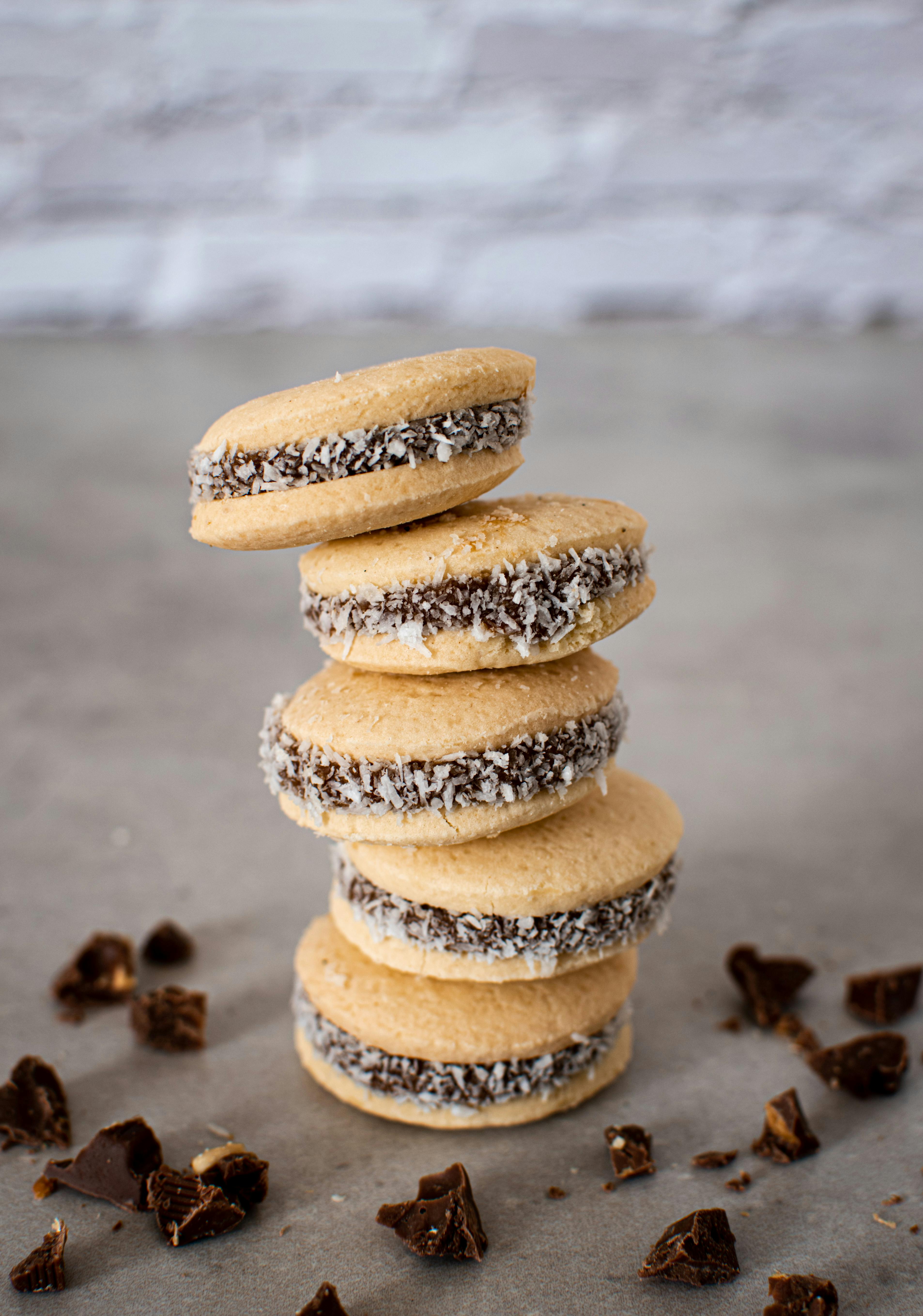
Photo: Agustina R Street / Pexels
Peruvian
Alfajor de Maicena
The diets react (see scores below)
Common Ingredients
- cornstarch
- wheat flour
- butter
- sugar
- egg yolk
- baking powder
- vanilla
- dulce de leche
- powdered sugar
Specific recipes may vary.
Incompatible with 11 of 11 diets
Diet Ratings
Alfajor de Maicena is fundamentally incompatible with a ketogenic diet. It is built entirely on high-carbohydrate ingredients: cornstarch and wheat flour form the cookie base, sugar and dulce de leche (a caramel spread made from milk and sugar) provide the filling, and powdered sugar is dusted on top. A single alfajor can easily contain 30–50g of net carbs, which alone would meet or exceed the entire daily keto carbohydrate allowance. There are no redeeming keto-friendly components — no significant healthy fats from natural sources, no fiber to offset carbs, and no low-carb substitutes used. This is a classic high-sugar, grain-based confection with zero viable path to fitting into ketosis even in small portions.
Alfajor de Maicena contains multiple animal-derived ingredients that are clearly excluded from a vegan diet. Butter is a dairy product, egg yolk is an animal product, and dulce de leche is a milk-based caramel. These three ingredients are unambiguous animal products, making this dish entirely incompatible with vegan dietary standards. There is no meaningful debate within the vegan community about any of these ingredients.
Alfajor de Maicena is fundamentally incompatible with the Paleolithic diet. It contains multiple strictly excluded ingredients: cornstarch (a grain derivative), wheat flour (a grain), butter (dairy), refined sugar, baking powder (typically contains cornstarch and may contain grain additives), and dulce de leche (a dairy-based caramel with refined sugar). Powdered sugar is refined sugar in another form. There is not a single ingredient in this dish that passes paleo criteria — even vanilla, while paleo-friendly on its own, cannot redeem a recipe built entirely on non-paleo foundations. This is a heavily processed confection representing exactly what the paleo framework aims to eliminate.
Alfajor de Maicena is a sweet sandwich cookie made primarily from refined starches (cornstarch and wheat flour), butter as the fat source, significant added sugar, and filled with dulce de leche (a high-sugar caramel). This combination directly contradicts Mediterranean diet principles on multiple fronts: it relies on refined grains rather than whole grains, uses butter instead of olive oil as the primary fat, contains substantial added sugar, and offers virtually no plant-forward nutritional value. Dulce de leche alone is a concentrated source of added sugar and saturated fat. There are no vegetables, legumes, whole grains, or healthy fats present. This is a processed sweet treat with no meaningful place in the Mediterranean dietary pattern.
Alfajor de Maicena is a Peruvian cookie sandwich that is entirely incompatible with the carnivore diet. The dish is built on cornstarch and wheat flour — both plant-derived grains that are strictly excluded. It is sweetened with sugar and powdered sugar, and flavored with vanilla, all of which are plant-based or processed non-animal ingredients. The filling, dulce de leche, is a dairy-derived caramel, which would be the only marginally animal-derived component, but it is heavily processed with sugar. Baking powder is also a non-animal leavening agent. There is no meaningful animal protein source. This dish represents virtually everything the carnivore diet excludes: grains, plant starches, refined sugars, and plant-derived flavoring.
Alfajor de Maicena contains multiple Whole30-excluded ingredients: wheat flour (a grain), butter (dairy — only ghee/clarified butter is allowed), sugar (added sugar), dulce de leche (dairy plus added sugar), and powdered sugar (added sugar). Even setting aside the excluded ingredients individually, this dish is a cookie/baked sweet — exactly the type of junk food recreation that Whole30 Rule 4 prohibits regardless of ingredient compliance. There is no compliant path for this dish.
Alfajor de Maicena contains two significant high-FODMAP ingredients that make it unsuitable during the elimination phase. First, wheat flour is high in fructans, a key FODMAP, and even small amounts are problematic during elimination. Second, dulce de leche is made from condensed milk, which is very high in lactose — a significant disaccharide FODMAP. While cornstarch, butter, egg yolk, sugar, baking powder, and vanilla are all low-FODMAP ingredients, the combination of wheat flour and dulce de leche creates a double FODMAP hit that disqualifies this dish entirely during elimination. Even if wheat flour is used in relatively small proportion alongside cornstarch, it is not safe during the strict elimination phase.
Alfajor de Maicena is a Peruvian sandwich cookie made with cornstarch, refined wheat flour, butter, sugar, egg yolks, and filled with dulce de leche (a caramel spread high in sugar), then dusted with powdered sugar. This is a high-sugar, high-saturated-fat dessert snack with no meaningful DASH-positive nutrients. It contains butter (saturated fat), dulce de leche (high added sugar and saturated fat), and refined starches with negligible fiber, potassium, calcium, or magnesium. The DASH diet explicitly limits sweets, added sugars, saturated fats, and refined carbohydrates — all of which are the primary components of this food. It offers no lean protein, no whole grains, no fruits or vegetables, and no DASH-aligned nutritional benefit. Occasional small portions would not derail a DASH diet entirely, but the food itself is squarely in the 'avoid' category by DASH criteria.
Alfajor de Maicena is a sandwich cookie filled with dulce de leche and dusted with powdered sugar — a confection built almost entirely from high-glycemic, nutritionally empty carbohydrates and saturated fat. The primary carbohydrate sources (cornstarch, wheat flour, refined sugar, dulce de leche, powdered sugar) are all high-glycemic with no fiber to moderate their glycemic impact, precisely the category Dr. Sears classifies as most disruptive to the eicosanoid balance the Zone seeks to maintain. Butter supplies saturated fat rather than the preferred monounsaturated fats. There is no meaningful lean protein component. The macronutrient profile is roughly the inverse of Zone targets: very high in rapidly digesting carbs, high in saturated fat, and virtually devoid of protein. Even in small portions, this food provides no useful Zone block material — it would spike insulin sharply, produce no satiety protein, and offer no anti-inflammatory benefit. Fitting even a single alfajor into a Zone snack framework would require such a tiny portion (a few grams) that it becomes impractical as a food, not a seasoning. This firmly places it in the 'avoid' category alongside candy and sugary desserts.
Alfajor de Maicena is a traditional Peruvian shortbread sandwich cookie with a strongly pro-inflammatory nutritional profile. The base is made from refined cornstarch and wheat flour — both high-glycemic refined carbohydrates with minimal fiber, nutrients, or anti-inflammatory compounds. Butter is a saturated fat source that anti-inflammatory guidelines recommend limiting. The filling is dulce de leche, which is essentially concentrated caramelized milk and sugar — a double hit of added sugar and full-fat dairy. The cookie is then dusted with powdered sugar, adding yet another layer of refined sugar. There is virtually nothing in this dish that aligns with anti-inflammatory principles: no omega-3s, no significant antioxidants or polyphenols, no fiber, no beneficial phytonutrients. The combination of refined carbs, added sugars, and saturated fat is a textbook driver of elevated inflammatory markers (CRP, IL-6) in the research literature. This is an occasional treat food with no meaningful anti-inflammatory redeeming qualities.
Alfajor de Maicena is a cornstarch-based shortbread sandwich cookie filled with dulce de leche and dusted with powdered sugar. It is essentially pure refined carbohydrate and sugar with virtually no protein, no fiber, and significant saturated fat from butter. The dulce de leche filling adds a concentrated sugar load on top of an already high-glycemic cookie base. For GLP-1 patients, this food fails on nearly every priority: it offers no meaningful protein to protect muscle mass, no fiber to support digestion or prevent constipation, and delivers mostly empty calories. The high sugar and butter content are likely to worsen nausea, reflux, and blood sugar instability. With severely reduced appetite on GLP-1 medications, consuming a food this nutritionally vacant represents a significant missed opportunity for nutrient intake. The small, snackable portion size is the only marginally positive attribute, but even a single alfajor contributes little beyond sugar and refined starch.
*See how scores were generated at our methodology page.
Nutritional profile
Six traits that cut across every diet.
Fiber & Plants
How much whole-plant food and fiber it delivers.
Healthy Fats
The quality of its fats (unsaturated, omega-3).
Whole / Unprocessed
How close it is to its natural, unprocessed form.
Gut Gentle
How easy it is on digestion (low FODMAP, few irritants).
Low Glycemic
How little it spikes your blood sugar.
Protein Density
How much protein it packs per calorie.
Controversy Index
Higher controversy = more disagreement between diets.