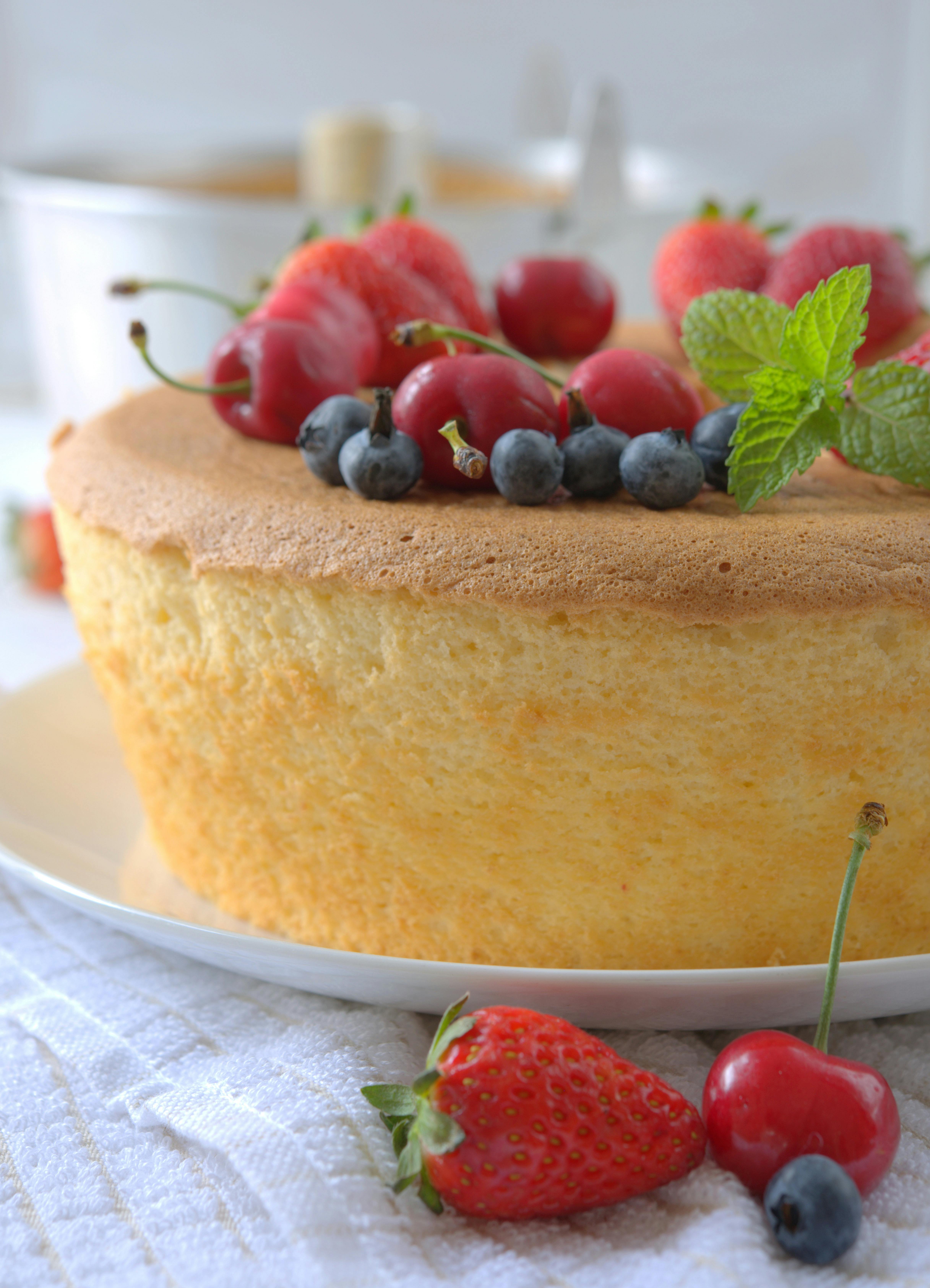
Photo: Nonik Yench / Pexels
American
Angel Food Cake
The diets react (see scores below)
Common Ingredients
- egg whites
- sugar
- cake flour
- cream of tartar
- vanilla extract
- salt
Specific recipes may vary.
Incompatible with 8 of 11 diets
Diet Ratings
Angel Food Cake is fundamentally incompatible with a ketogenic diet. It is built on two major keto-prohibited ingredients: sugar and cake flour (a refined grain). A standard serving (about 50g or one slice) contains approximately 29g of net carbs, almost entirely from sugar and refined flour. There is virtually no fat, which also runs directly counter to the high-fat requirement of keto. The egg whites provide some protein but without fat, and the overall macronutrient profile — high carb, very low fat, low protein — is the opposite of what keto demands. Even a small portion would consume the majority of a day's carb allowance.
Angel Food Cake contains egg whites as a primary structural ingredient, making it clearly non-vegan. Egg whites are an animal product excluded under all mainstream vegan frameworks. There is no ambiguity here — the recipe is fundamentally built around whipped egg whites, which provide its characteristic airy texture. No vegan version of this specific recipe exists without substituting the egg whites with a plant-based alternative such as aquafaba.
Angel Food Cake contains multiple non-paleo ingredients that make it clearly incompatible with the Paleolithic diet. Cake flour is a refined grain product (wheat), which is explicitly excluded from paleo. Refined sugar is also prohibited. Salt (added) is discouraged. While egg whites and vanilla extract are paleo-friendly, and cream of tartar is a natural byproduct of winemaking generally considered acceptable, the foundational ingredients — refined wheat flour and refined sugar — are hard disqualifiers. There is no version of this dish that could be considered paleo without completely reimagining it.
Angel Food Cake is built on refined cake flour (a highly refined grain stripped of fiber and nutrients) and a large quantity of added sugar — two ingredients that directly contradict Mediterranean diet principles. While egg whites are a lean protein source and are acceptable in moderation, they do not redeem a recipe whose caloric base is refined carbohydrates and sugar. There is no olive oil, no whole grains, no legumes, no vegetables or fruit, and no nutritional density characteristic of Mediterranean eating. As a processed, sugar-forward American dessert with refined grain as its structural foundation, this dish falls squarely in the 'avoid' category.
Angel Food Cake is fundamentally incompatible with the carnivore diet. While egg whites are an animal product, they are combined with sugar, cake flour (a grain), cream of tartar (a plant-derived acid), and vanilla extract (plant-derived) — making this dish predominantly plant- and grain-based. The result is a high-carbohydrate, highly processed baked good that violates virtually every carnivore principle: no grains, no sugar, no plant-derived additives. Even the egg whites, the sole animal-derived ingredient, are used in their least nutritious form (stripped of yolks, which contain the fat and micronutrients carnivore prioritizes). This is a dessert/snack with no place in any tier of the carnivore diet.
Angel Food Cake is excluded on multiple grounds. First, it contains cake flour, which is a grain product (wheat-based) and explicitly excluded from Whole30. Second, it contains added sugar, which is also explicitly excluded. Third, and independently sufficient, Angel Food Cake is explicitly listed as a category of baked good ('cake') that violates the Whole30 'no recreating baked goods/junk food' rule, even if compliant ingredients could theoretically be substituted. All three violations converge to make this a clear avoid.
Angel food cake is made from egg whites, sugar, cake flour, cream of tartar, vanilla extract, and salt. Egg whites are low-FODMAP and protein-rich. Sugar (sucrose) is low-FODMAP. Cream of tartar, vanilla extract, and salt are all low-FODMAP. The main concern is cake flour, which is made from wheat and contains fructans. However, angel food cake uses a relatively small ratio of flour to egg whites and sugar — typically about 1 cup of cake flour for a 10-inch tube pan serving 12, meaning each slice contains roughly 1–2 tablespoons of wheat flour. Monash University has not specifically tested angel food cake, but the fructan load per slice is likely low due to the small flour quantity per serving. At a standard single slice (approximately 50–60g), this is likely borderline low-FODMAP, but the wheat flour content introduces meaningful FODMAP risk that increases with portion size.
Monash University has not specifically tested angel food cake, so the FODMAP load must be estimated from its wheat flour content. Many clinical FODMAP practitioners advise avoiding all wheat-containing baked goods during the strict elimination phase, even in small amounts, to prevent ambiguity in symptom tracking. If portion is kept to one small slice and wheat fructan tolerance is assessed, this may be manageable for some individuals.
Angel food cake occupies a middle ground in DASH diet compatibility. On the positive side, it is fat-free (no butter, oil, or egg yolks), very low in sodium, and contains no saturated fat or cholesterol — making it notably lighter than most desserts and cakes. It avoids tropical oils, full-fat dairy, and red meat entirely. However, it is primarily composed of refined sugar and cake flour (refined carbohydrate), with virtually no fiber, potassium, calcium, magnesium, or other DASH-emphasized nutrients. It provides empty calories rather than the nutrient-dense profile DASH prioritizes. DASH does allow limited sweets (5 or fewer servings per week of sweets/added sugars), and angel food cake — in a modest portion — fits within that allowance better than most desserts due to its fat-free nature. It is often considered one of the more DASH-compatible dessert options when consumed occasionally and in controlled portions.
NIH DASH guidelines categorize sweets as a limited food group to minimize, placing angel food cake in a restricted category alongside other desserts. However, some DASH-oriented dietitians and clinicians highlight angel food cake as a preferred occasional treat compared to butter-rich cakes, noting its zero saturated fat and low sodium profile make it the most DASH-friendly dessert option when a sweet treat is desired.
Angel food cake is essentially pure high-glycemic carbohydrates with negligible protein and virtually zero fat. While egg whites are a Zone-favorable protein, the quantity is overwhelmed by sugar and cake flour in the final product — a typical slice contains roughly 30g of high-glycemic carbohydrates, only 3g of protein, and nearly 0g of fat. This produces a wildly unbalanced macronutrient ratio, essentially the inverse of what Zone requires. The primary carbohydrate sources — refined cake flour and sugar — are among the most unfavorable in Zone terminology: high-glycemic, nutrient-poor, and highly insulinogenic. There is no fat component whatsoever, making it impossible to achieve even an approximation of the 40/30/30 ratio without adding substantial protein and fat alongside it. Even as a small 'treat,' the sugar and refined flour content would spike insulin significantly. Zone methodology specifically flags refined sugar and white flour as foods to avoid because they disrupt eicosanoid balance and trigger rapid insulin release. This is one of the clearest 'avoid' cases in Zone assessment.
Angel food cake is a refined carbohydrate dessert with a high sugar load and minimal nutritional value from an anti-inflammatory perspective. The primary ingredients — white sugar and cake flour (highly refined wheat) — are well-established drivers of blood sugar spikes, insulin response, and downstream inflammatory signaling (elevated CRP, IL-6). Refined carbohydrates and added sugars are explicitly limited or avoided in all major anti-inflammatory frameworks. On the positive side, angel food cake contains no saturated fat, no trans fats, no seed oils, and no artificial additives — distinguishing it from worse offenders like butter cakes, frosted cupcakes, or commercially processed snacks. Egg whites provide modest protein but stripped of the anti-inflammatory nutrients (choline, selenium, lutein) found in whole eggs. Vanilla, cream of tartar, and salt are nutritionally negligible. The cake's unusually low fat content prevents it from reaching 'avoid' territory — it is arguably the least inflammatory cake option — but its sugar and refined flour content still make it clearly pro-inflammatory when consumed regularly.
Angel food cake is a low-fat dessert — its fat-free profile and light, airy texture make it one of the more tolerable sweet treats for GLP-1 patients, especially compared to butter-based cakes. However, it is essentially a high-sugar, refined-carbohydrate food with negligible protein and zero fiber. With reduced appetite on GLP-1 medications, every bite needs to count nutritionally, and angel food cake delivers mostly empty calories. The sugar content can also cause blood sugar spikes, which is particularly relevant for GLP-1 patients who often have metabolic concerns. Its main redeeming qualities are its low fat content (avoids worsening nausea/reflux), light texture (easy to digest, small portions satisfy), and the fact that it is far better than a fatty or fried dessert. It scores above 'avoid' territory primarily because it won't significantly worsen GLP-1 side effects, but it offers nothing meaningful toward the protein and fiber priorities that define a GLP-1-supportive diet. Acceptable as an occasional small treat, not as a regular snack.
*See how scores were generated at our methodology page.
Nutritional profile
Six traits that cut across every diet.
Fiber & Plants
How much whole-plant food and fiber it delivers.
Healthy Fats
The quality of its fats (unsaturated, omega-3).
Whole / Unprocessed
How close it is to its natural, unprocessed form.
Gut Gentle
How easy it is on digestion (low FODMAP, few irritants).
Low Glycemic
How little it spikes your blood sugar.
Protein Density
How much protein it packs per calorie.
Controversy Index
Higher controversy = more disagreement between diets.
Diet-Specific Tips
 DASH — 5/10
View tips
- Fat-free: no butter, oil, or egg yolks — zero saturated fat
- Very low sodium — cream of tartar and small salt quantity contribute minimally
- High in refined sugar and refined flour — nutrient-poor, high glycemic
- Negligible fiber, potassium, calcium, or magnesium content
- Fits within DASH's limited sweets allowance (<5 servings/week) better than most desserts
- Not a DASH core food, but among the least harmful dessert choices in moderation
 Anti-Inflammatory — 4/10
View tips
- High added sugar content — directly pro-inflammatory, raises blood glucose and insulin
- Refined cake flour — stripped of fiber, raises glycemic load
- Zero anti-inflammatory nutrients: no omega-3s, antioxidants, polyphenols, or fiber
- No saturated fat, trans fat, or seed oils — mitigates worst inflammatory concerns
- No artificial additives or preservatives in the homemade form
- Egg whites contribute protein but lack the anti-inflammatory micronutrients of whole eggs
 GLP-1 Friendly — 4/10
View tips
- Zero protein — offers no support for the 100-120g daily protein target critical for muscle preservation
- Zero dietary fiber — does not support digestion or constipation prevention
- High sugar content — refined carbohydrates with no nutritional buffer
- Low fat — does not worsen nausea, bloating, or reflux, which is a meaningful advantage over most desserts
- Light, airy texture — easy to digest given slowed gastric emptying
- Nutrient-poor per calorie — poor use of limited appetite capacity
- Small servings are realistic — portion-friendly by nature of the food's lightness