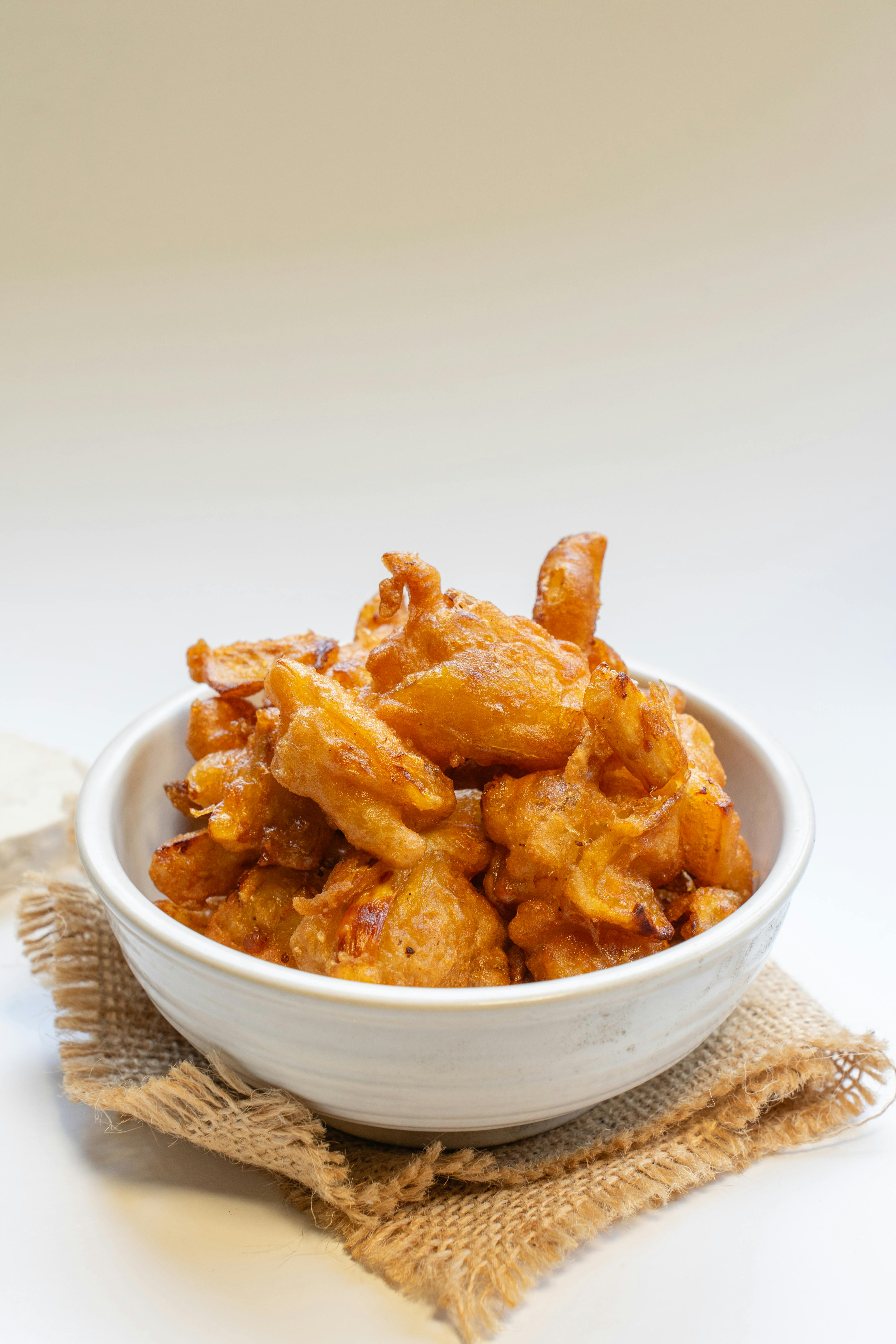
Photo: Tamba Budiarsana / Pexels
American
Apple Fritter
The diets react (see scores below)
Common Ingredients
- flour
- apples
- cinnamon
- sugar
- eggs
- milk
- baking powder
- salt
- vegetable oil
Specific recipes may vary.
Incompatible with 11 of 11 diets
Diet Ratings
Apple fritters are fundamentally incompatible with a ketogenic diet. The primary ingredients — wheat flour and sugar — are the exact foods keto eliminates. A single apple fritter typically contains 35-50g of net carbs, enough to exceed or nearly exhaust an entire day's carb allowance in one snack. Flour provides dense starch, sugar adds direct glucose, and apples contribute fructose and additional carbohydrates. The frying oil is the only keto-friendly component, but healthy fat cannot redeem a dish built on grains and sugar. There is no portion size that makes this snack keto-compatible.
Apple fritters contain both eggs and milk, which are animal-derived products explicitly excluded from a vegan diet. These are core structural ingredients in the batter — eggs provide binding and lift, while milk adds moisture — not incidental additives. Despite the dish featuring fruit (apples) and plant-based spices, the presence of two distinct animal ingredients makes this clearly non-vegan. Vegan versions can be made by substituting flax eggs or aquafaba for eggs and plant-based milk (oat, almond, soy) for dairy milk, but the traditional recipe as listed does not qualify.
Apple Fritters are fundamentally incompatible with the Paleo diet. The dish contains multiple strictly excluded ingredients: flour (a grain product), refined sugar, milk (dairy), baking powder (a processed leavening agent with additives), salt, and vegetable oil (a seed oil). While apples, cinnamon, and eggs are Paleo-approved, they are minor components in a recipe dominated by non-Paleo ingredients. There is no version of this traditional fritter that could be considered Paleo without a complete ingredient overhaul.
Apple fritters are a deep-fried, sugar-laden treat made with refined white flour and vegetable oil — directly contradicting core Mediterranean diet principles. While apples, eggs, and cinnamon are wholesome ingredients, the dish is dominated by refined grains, added sugar, and frying in non-olive vegetable oil. Deep-frying in refined oils (typically soybean or canola) is not characteristic of Mediterranean cooking, and refined flour with added sugar places this firmly in the 'minimal consumption' category. This is an occasional indulgence at best, not a compatible snack.
Apple fritters are almost entirely plant-based and processed, making them completely incompatible with the carnivore diet. The primary ingredients — flour (grain), apples (fruit), sugar (processed plant derivative), cinnamon (plant spice), baking powder (plant-based leavening), and vegetable oil (plant oil) — are all explicitly excluded from carnivore. The only marginally carnivore-compatible ingredients are eggs and milk, but they are minor components in what is fundamentally a grain-and-fruit pastry fried in plant oil. There is no meaningful animal protein source, and the dish is dominated by carbohydrates and plant compounds that carnivore explicitly rejects.
Apple fritters are excluded on multiple grounds. First, they contain flour (a grain/wheat product), which is explicitly banned on Whole30. Second, they contain added sugar, also explicitly excluded. Third, they contain dairy milk, another excluded category. Fourth, and independently sufficient on its own, apple fritters fall squarely into the 'no recreating baked goods/junk food' rule — they are a fried dough confection analogous to donuts or fritters, a category explicitly prohibited even if compliant ingredients were substituted. This dish fails Whole30 on at least four distinct grounds.
Apple fritters contain multiple high-FODMAP ingredients that make them unsuitable during the elimination phase. Wheat flour is high in fructans and is a primary ingredient. Apples are high in both fructose (excess fructose) and polyols (sorbitol), and are consistently flagged as high-FODMAP at any typical serving size by Monash University. Milk contributes lactose, another significant FODMAP. With three independently high-FODMAP ingredients forming the structural backbone of this dish, there is no realistic portion size at which an apple fritter would be considered low-FODMAP. Even a single fritter would deliver problematic amounts of fructans (wheat), excess fructose and sorbitol (apples), and lactose (milk).
Apple fritters are deep-fried in vegetable oil, creating a high-fat, high-calorie snack that conflicts with DASH diet principles on multiple fronts. While apples and cinnamon are DASH-friendly ingredients, the overall dish is dominated by refined white flour (not a whole grain), added sugar, and deep-frying, which significantly raises total fat content and caloric density. DASH emphasizes limiting sweets, added sugars, refined grains, and excess fat. The frying process also adds substantial vegetable oil absorption, pushing fat intake well above DASH targets. Salt is also added, contributing unnecessary sodium. As a fried, sugary snack made from refined flour, apple fritters fall squarely in the 'sweets and added sugars' category that DASH explicitly limits to 5 or fewer servings per week — and even then, the preference is for lower-fat, lower-sugar options.
An apple fritter is a deep-fried dough snack that is essentially incompatible with Zone Diet principles. The dominant macronutrient is high-glycemic carbohydrate from white flour and added sugar, deep-fried in omega-6-heavy vegetable oil (likely soybean or canola). There is negligible lean protein, no favorable fat source, and virtually no fiber to offset the glycemic impact. The apples provide some polyphenols and minimal fiber, but they are overwhelmed by the surrounding batter and frying medium. This snack would cause a sharp insulin spike — exactly what the Zone Diet is designed to prevent — and offers no meaningful path to achieving a 40/30/30 block balance. Even in a 'caution' framing, there is no realistic portion size that makes this a Zone-compatible snack without stripping it down to something unrecognizable. Categorized as an 'unfavorable' carbohydrate source in Zone terminology with compounding issues from the frying fat.
Apple fritters are a deep-fried pastry with a heavily pro-inflammatory profile. The base is refined white flour — a refined carbohydrate that spikes blood glucose and promotes inflammatory cytokine release. Added sugar is a primary driver of inflammation, raising CRP and IL-6 in research. Deep-frying in vegetable oil (typically high-omega-6 oils like corn or soybean) at high temperatures generates oxidized lipids and aldehydes, which are acutely pro-inflammatory. The milk and eggs are minor contributors and largely neutral. The one redemptive ingredient is cinnamon, a genuinely anti-inflammatory spice, and apples provide some quercetin and fiber — but in the quantities used in a fritter, these benefits are negligible against the inflammatory load of the overall dish. This is essentially a deep-fried refined carbohydrate with added sugar, which represents exactly the type of food anti-inflammatory frameworks consistently flag as harmful.
Apple fritters are deep-fried dough with minimal nutritional value for GLP-1 patients. Despite containing eggs and milk, the primary caloric contribution comes from refined flour, sugar, and absorbed frying oil — making this a high-fat, high-sugar, low-protein, low-fiber food. Frying in vegetable oil significantly increases fat content per serving and slows gastric emptying further on top of the GLP-1 medication effect, raising the risk of nausea, bloating, and reflux. The refined flour and sugar spike blood sugar with little satiety value. A standard apple fritter (roughly 100-120g) delivers approximately 300-400 calories, 15-20g fat, 40-50g refined carbohydrates, minimal protein (~4g), and negligible fiber — nearly the opposite of what GLP-1 patients need from every calorie consumed. The apple content is too small to meaningfully contribute fiber. This is a textbook empty-calorie food for this patient population.
*See how scores were generated at our methodology page.
Nutritional profile
Six traits that cut across every diet.
Fiber & Plants
How much whole-plant food and fiber it delivers.
Healthy Fats
The quality of its fats (unsaturated, omega-3).
Whole / Unprocessed
How close it is to its natural, unprocessed form.
Gut Gentle
How easy it is on digestion (low FODMAP, few irritants).
Low Glycemic
How little it spikes your blood sugar.
Protein Density
How much protein it packs per calorie.
Controversy Index
Higher controversy = more disagreement between diets.