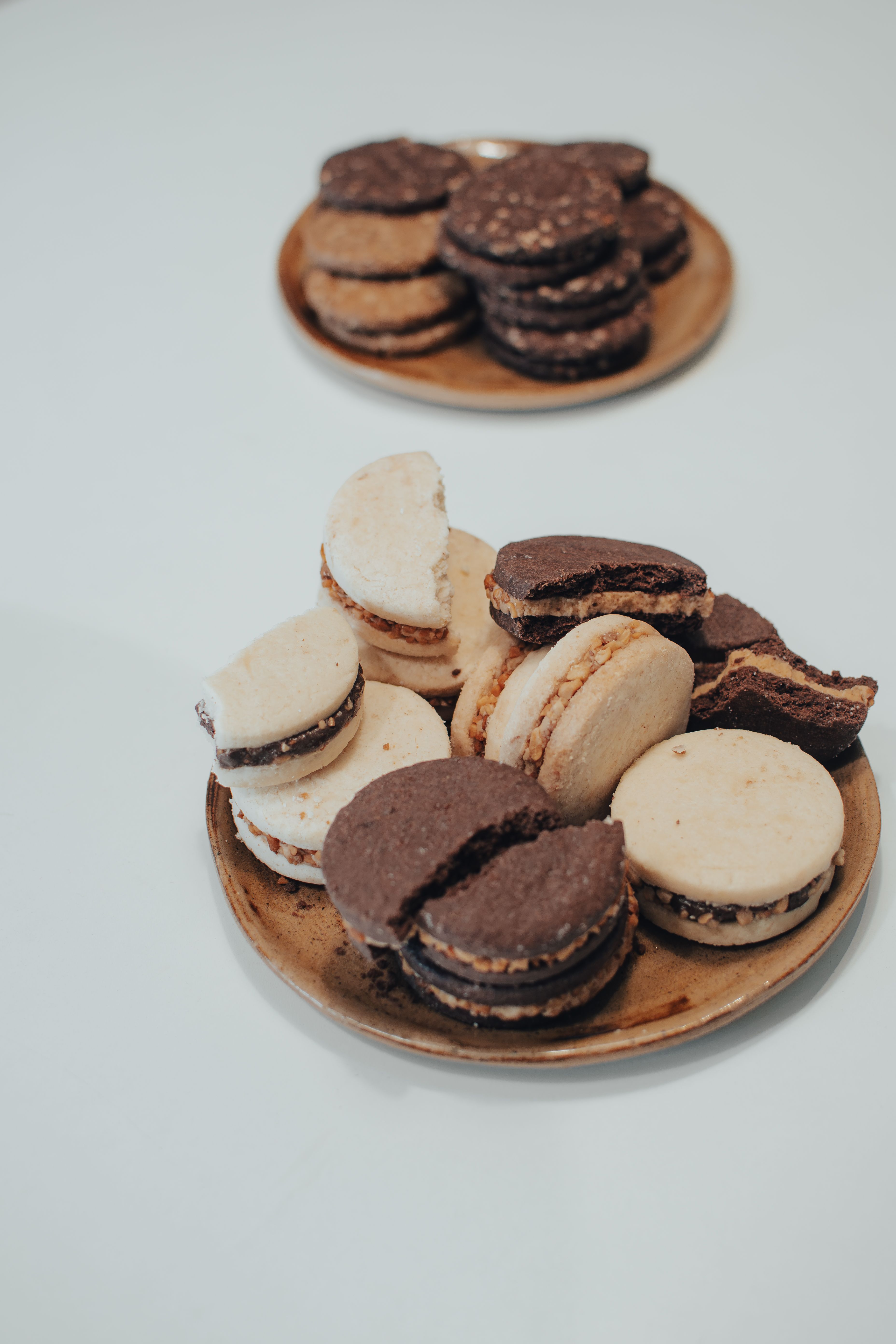
Photo: Gaspar Zaldo / Pexels
Argentine
Alfajores
The diets react (see scores below)
Common Ingredients
- flour
- cornstarch
- butter
- egg yolks
- sugar
- dulce de leche
- shredded coconut
- vanilla
Specific recipes may vary.
Incompatible with 11 of 11 diets
Diet Ratings
Alfajores are a classic Argentine cookie sandwich that is fundamentally incompatible with a ketogenic diet. The cookie shells are made from wheat flour and cornstarch — both high-carb grains — and are heavily sweetened with sugar. The filling is dulce de leche, which is essentially caramel made from milk and sugar, one of the most carb-dense confections possible. A single alfajor typically contains 30-45g of net carbs, which alone can exceed the entire daily keto carb allowance. There are no redeeming low-carb elements; even the shredded coconut, which is borderline keto-friendly on its own, cannot offset the massive carb load from the other ingredients. This dish would immediately break ketosis.
Alfajores contain multiple animal-derived ingredients that disqualify them from a vegan diet. Butter is a dairy product, egg yolks are an animal product, and dulce de leche is a caramel spread made from milk (also a dairy product). Three distinct animal ingredients are present, making this clearly non-vegan with no ambiguity.
Alfajores are fundamentally incompatible with the paleo diet. The recipe contains multiple hard-excluded ingredients: wheat flour (a grain), cornstarch (a grain derivative), butter (dairy), sugar (refined sugar), and dulce de leche (a dairy-based caramel spread with added sugar). There is not a single gray-area ingredient here — every core structural component of this cookie is explicitly off-limits under paleo rules. Shredded coconut and vanilla are the only paleo-compliant ingredients, but they are minor flavor components in an otherwise entirely non-paleo dish. No substitution or moderation argument can rehabilitate this dish within any mainstream paleo framework.
Alfajores are a classic Argentine confection that directly contradicts Mediterranean diet principles across multiple dimensions. The dish is built on refined flour and cornstarch (refined grains with no fiber), butter (saturated fat replacing olive oil as the primary fat), sugar (added sugars), and dulce de leche (a highly concentrated sugar-and-dairy confection). There are no vegetables, legumes, whole grains, or healthy fats present. This is a processed sweet snack with high added sugar, refined carbohydrates, and saturated fat — precisely the food category the Mediterranean diet most strongly discourages. Shredded coconut adds some plant content but is often sweetened and does not redeem the overall profile.
Alfajores are a quintessential Argentine pastry that is almost entirely plant-derived and heavily processed. The primary structure is built from flour and cornstarch — both grain-based carbohydrates that are explicitly excluded from the carnivore diet. Sugar is a pure processed carbohydrate with no place in any tier of carnivore eating. Dulce de leche, while dairy-based, is a heavily sweetened caramel confection loaded with sugar. Shredded coconut is a plant food. Vanilla is a plant-derived flavoring. The only marginally carnivore-adjacent ingredients are butter and egg yolks, but they are present in trace amounts and completely overwhelmed by the dominant plant and sugar content. This dish offers no meaningful animal nutrition and is defined by exactly the foods the carnivore diet eliminates: grains, sugar, and plant additives.
Alfajores are a classic Argentine sandwich cookie that violates Whole30 on multiple levels. They contain flour (a grain, excluded), butter (dairy, excluded — only ghee/clarified butter is permitted), sugar (added sugar, excluded), and dulce de leche (a caramel-like dairy and sugar confection, excluded on both counts). Even setting aside individual excluded ingredients, alfajores are cookies — a baked good/junk food that is explicitly prohibited by Whole30's Rule 4 even when made with otherwise compliant ingredients. This dish fails categorically.
Alfajores contain two major high-FODMAP ingredients that make them unsuitable during the elimination phase. First, regular wheat flour is high in fructans and is a primary ingredient in the cookie dough — there is no low-FODMAP substitute indicated here. Second, dulce de leche is a concentrated milk caramel that is very high in lactose, making it a significant FODMAP source on its own. While cornstarch, butter, egg yolks, sugar, vanilla, and shredded coconut (in small amounts) are individually low-FODMAP, the combination of wheat flour and dulce de leche creates a dish that is unambiguously high-FODMAP at any standard serving size. Even a single alfajor would contain meaningful amounts of both fructans and lactose.
Alfajores are a classic Argentine confection consisting of buttery shortbread-style cookies sandwiched with dulce de leche (a caramel spread made from sweetened condensed milk) and rolled in shredded coconut. Nearly every ingredient conflicts with DASH principles: refined white flour provides no fiber or micronutrients, butter contributes significant saturated fat, egg yolks add dietary cholesterol and saturated fat, sugar and dulce de leche deliver high amounts of added sugar and additional saturated fat from the condensed milk base, and shredded coconut (especially sweetened varieties) adds a tropical oil source with saturated fat. The overall profile is high in saturated fat, high in added sugar, high in refined carbohydrates, and essentially devoid of the potassium, magnesium, calcium, and fiber that DASH emphasizes. There is no meaningful lean protein, no vegetables or fruit, no whole grains, and no low-fat dairy component. This is precisely the category of sweets and confections that DASH guidelines explicitly advise limiting or eliminating.
Alfajores are a classic Argentine shortbread cookie sandwich filled with dulce de leche and coated in shredded coconut. From a Zone Diet perspective, this food is nearly impossible to incorporate into a balanced meal. The macronutrient profile is dominated by high-glycemic carbohydrates (refined white flour, cornstarch, sugar, and dulce de leche — which is essentially sweetened condensed milk) and saturated fat (butter, egg yolks). There is virtually no lean protein and no monounsaturated fat. The carbohydrate load is extremely high-glycemic, which would cause a significant insulin spike — precisely the hormonal response the Zone Diet is designed to prevent. Dulce de leche is essentially concentrated sugar and saturated fat, among the most unfavorable Zone ingredients. There is no meaningful fiber, no polyphenol content, no omega-3s, and the fat profile skews heavily saturated. Even with careful portioning, a single alfajor would deliver a disproportionate carbohydrate-to-protein-to-fat ratio with no realistic way to re-balance it as a Zone snack without dramatically altering the food itself. The absence of any protein source compounds the problem. This is one of the rare cases where the food genuinely earns a low score because it cannot be meaningfully 'zoned.'
Alfajores are a classic Argentine confection with a strongly pro-inflammatory nutritional profile. The base is refined white flour and cornstarch — two refined carbohydrates with minimal fiber and a high glycemic impact. They are heavily sweetened and filled with dulce de leche, which is essentially a concentrated sugar-and-full-fat-dairy product (high in saturated fat and added sugars). Butter adds further saturated fat. The egg yolks and shredded coconut are the only ingredients with any neutral-to-mildly-positive properties, but they do not offset the dominant pro-inflammatory profile. There are no omega-3s, polyphenols, antioxidants, fiber-rich whole grains, or other anti-inflammatory elements of note. This is a treat composed almost entirely of refined carbohydrates, added sugars, and saturated fat — three of the key drivers of inflammatory markers like CRP and IL-6 that anti-inflammatory dietary frameworks explicitly limit or avoid.
Alfajores are a classic Argentine shortbread sandwich cookie filled with dulce de leche and rolled in shredded coconut. They are essentially the opposite of a GLP-1-friendly food across every major criterion. The ingredient list is dominated by refined flour, cornstarch, butter, sugar, and dulce de leche — delivering high refined carbohydrates, significant saturated fat, and concentrated sugar with virtually no protein, negligible fiber, and poor nutrient density per calorie. Dulce de leche alone is a high-sugar, high-fat filling that spikes blood glucose and contributes empty calories. The buttery shortbread base is dense, fatty, and slow to digest, which compounds the gastric-emptying delay caused by GLP-1 medications and increases risk of nausea, bloating, and reflux. Shredded coconut adds saturated fat without meaningful fiber benefit in this quantity. There is no redeeming protein source listed. For a patient eating significantly fewer calories per day, this snack offers almost no nutritional return and actively works against GLP-1 treatment goals of muscle preservation, blood sugar stabilization, and GI comfort.
*See how scores were generated at our methodology page.
Nutritional profile
Six traits that cut across every diet.
Fiber & Plants
How much whole-plant food and fiber it delivers.
Healthy Fats
The quality of its fats (unsaturated, omega-3).
Whole / Unprocessed
How close it is to its natural, unprocessed form.
Gut Gentle
How easy it is on digestion (low FODMAP, few irritants).
Low Glycemic
How little it spikes your blood sugar.
Protein Density
How much protein it packs per calorie.
Controversy Index
Higher controversy = more disagreement between diets.