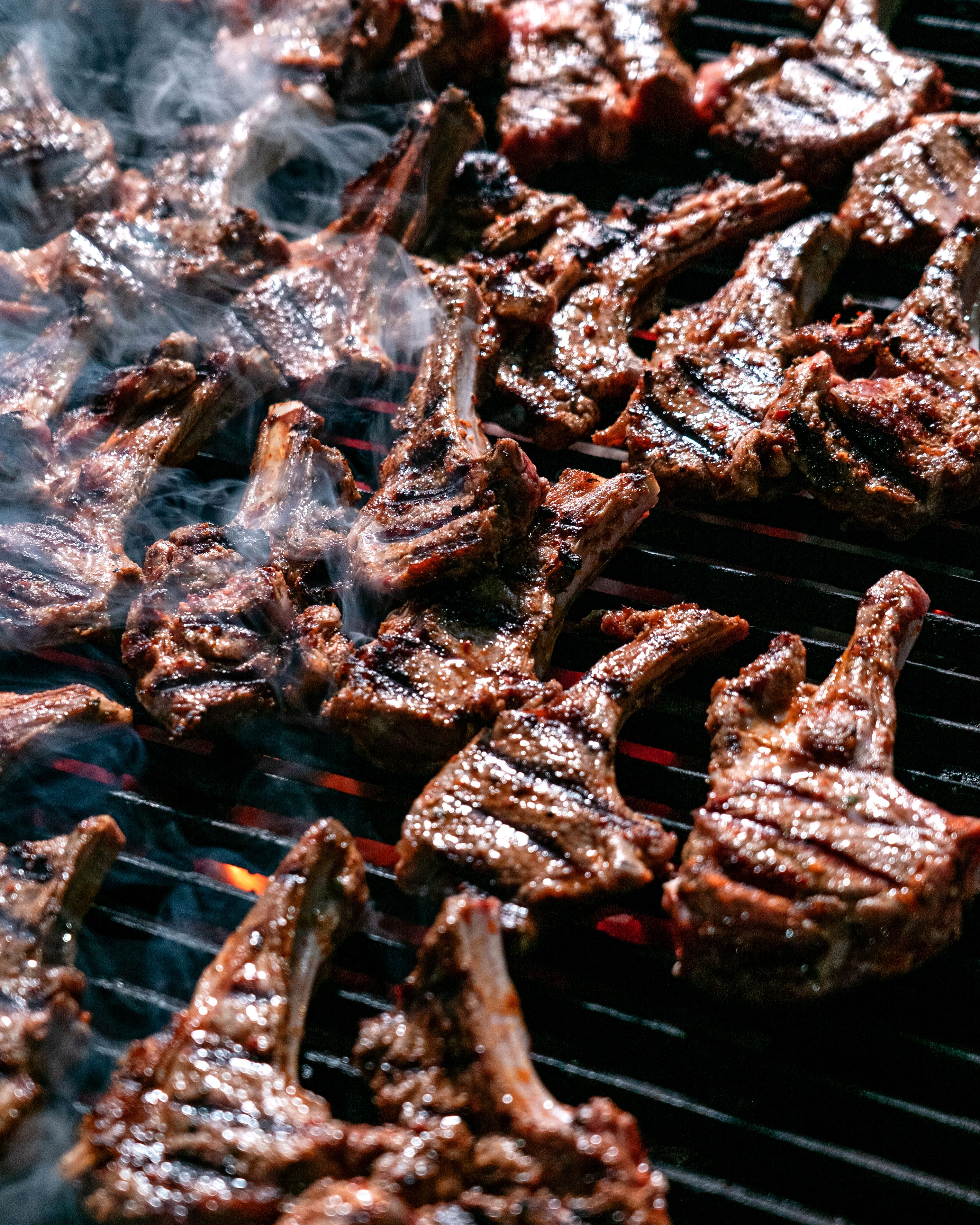
Photo: Mohamed Olwy / Pexels
The diets react (see scores below)
Common Ingredients
- beef ribs
- sausage
- blood sausage
- sweetbreads
- salt
- chimichurri
Specific recipes may vary.
Incompatible with 5 of 11 diets
Diet Ratings
Argentine asado is an outstanding keto meal. Beef ribs are fatty, protein-rich, and essentially zero-carb. Traditional sausages (chorizo) and blood sausage (morcilla) are generally low-carb, though morcilla sometimes contains rice or oats as filler — this is the main concern. Sweetbreads (thymus/pancreas glands) are organ meats with negligible carbs and good fat content. Salt adds no carbs. Chimichurri is made from herbs, garlic, olive oil, and vinegar — virtually zero net carbs and adds healthy fat. The overall dish is naturally high-fat, moderate-to-high protein, and very low in net carbs, making it an ideal keto meal in most traditional preparations.
Strict keto practitioners flag traditional morcilla (blood sausage) as a potential issue, as Argentine recipes frequently include rice or bread as a binder, which could add meaningful carbs. Some keto adherents recommend skipping morcilla or verifying ingredients before consuming.
Asado is an Argentine barbecue tradition centered entirely on animal products. The dish contains beef ribs (mammal muscle tissue), sausage (ground meat), blood sausage (morcilla, made from pig blood and fat), and sweetbreads (thymus or pancreatic glands from a calf or lamb). Every primary ingredient is an animal product or animal-derived offal. Chimichurri and salt are plant-based, but they function only as condiments and do not alter the fundamental nature of this dish. There is no vegan version of traditional asado — the dish is definitionally meat-based.
Asado is a traditional Argentine barbecue featuring beef ribs, sausage (chorizo), blood sausage (morcilla), and sweetbreads (mollejas) — all of which are animal-based and ancestrally appropriate in principle. Beef ribs and sweetbreads are clearly paleo-approved organ and muscle meats. Chimichurri, made from herbs, garlic, olive oil, and vinegar, is largely paleo-compliant. However, two significant issues lower the score: (1) Salt is explicitly excluded under strict paleo rules as an 'added salt' processed mineral not available in concentrated form to hunter-gatherers. (2) Sausage and blood sausage, as commercially prepared products, typically contain added salt, fillers, preservatives, or grain-based binders, making them processed meats that fall outside clean paleo guidelines. The dish scores in caution territory — the core proteins are excellent paleo choices, but the processing of the sausages and the use of salt are meaningful violations under strict interpretation.
Many practical paleo practitioners and authors like Mark Sisson (The Primal Blueprint) take a lenient view on salt and minimally processed sausages, arguing that the overall nutrient density and absence of grains/legumes/dairy makes a dish like asado highly paleo-compatible. Robb Wolf's community similarly tends to accept traditional cured meats when grain-free fillers are absent.
Asado is a quintessential Argentine mixed-meat grill featuring beef ribs, pork sausage, blood sausage (morcilla), and sweetbreads (offal) — all forms of red and processed meat. This combination directly contradicts core Mediterranean diet principles on multiple levels: red meat should be limited to a few times per month, processed meats (sausage, blood sausage) are explicitly discouraged due to high saturated fat, sodium, and additives, and organ meats/offal are not part of the dietary framework. The sheer quantity and variety of animal proteins in a single dish makes this a poor fit. Chimichurri (herbs, garlic, olive oil, vinegar) is the one Mediterranean-friendly element, but it cannot redeem the overall composition. There is no significant plant-based component, no whole grains, and no legumes present.
Asado is largely carnivore-compatible: beef ribs are an excellent fatty ruminant cut, sweetbreads (thymus/pancreas organ meat) are highly encouraged for micronutrient density, and blood sausage (morcilla) is animal-derived and nutrient-dense. Salt is universally accepted. The sausage (chorizo) may contain additives, fillers, or spices depending on preparation — traditional Argentine chorizo often includes paprika, garlic, and other plant-based seasonings, which strict carnivore excludes. The primary disqualifying ingredient is chimichurri, a classic Argentine condiment made from parsley, oregano, garlic, vinegar, and plant oil — all plant-derived and explicitly off-limits on carnivore. Without chimichurri, this dish would score 8-9. The presence of chimichurri and likely-spiced sausage pulls the overall score down.
Strict carnivore and Lion Diet adherents would flag not only the chimichurri (fully plant-based) but also the spiced sausage and potentially the blood sausage if it contains fillers or grain-based binders common in commercial preparations. Even without chimichurri, some purists would caution against any processed sausage unless the ingredients are verified as pure meat and salt.
Asado as a concept — grilled meats over an open fire — is fully aligned with Whole30's whole-food philosophy. Beef ribs and sweetbreads (thymus/pancreas offal) are straightforwardly compliant animal proteins. Salt and chimichurri (herbs, garlic, vinegar, olive oil) are compliant seasonings. However, the sausage and blood sausage (morcilla) are the sticking points. Commercial Argentine chorizo and morcilla typically contain added sugar, starchy fillers, or other excluded ingredients. Morcilla in particular often includes rice or breadcrumbs as a binder. Without verified compliant versions of both sausages, the dish as commonly prepared must be rated cautiously. If the sausages are sourced from a producer using only compliant ingredients (meat, fat, salt, compliant spices), the dish would be fully approvable.
Some Whole30 practitioners would argue that even compliant sausage and blood sausage represent processed meat products that conflict with the program's whole-food spirit, echoing the guidance Melissa Urban has offered around relying heavily on processed meats. However, the official Whole30 rules do not categorically exclude sausage — only specific non-compliant ingredients within them.
The core proteins in asado — beef ribs, sweetbreads — are inherently low-FODMAP, as plain meats and organ meats contain no FODMAPs. Salt is also safe. However, the dish becomes problematic with two key ingredients: (1) Sausages (chorizo-style) and blood sausage (morcilla) almost universally contain garlic and onion as primary seasonings, both of which are high-FODMAP fructan sources. Even small amounts of garlic or onion in sausage seasoning can trigger symptoms during elimination. (2) Chimichurri, the classic Argentine condiment, is traditionally made with garlic and sometimes onion, both high-FODMAP. If chimichurri is consumed in typical quantities, this alone could disqualify the dish. The beef ribs and sweetbreads themselves are safe, and a low-FODMAP version of asado is achievable (using garlic-infused oil in chimichurri instead of garlic cloves, and sourcing FODMAP-friendly sausages without onion/garlic), but as traditionally prepared and served, the sausages and chimichurri present real FODMAP risk.
Monash University rates plain grilled meats as approved with high confidence, but clinical FODMAP practitioners would flag traditional Argentine sausages (chorizo, morcilla) as high-risk due to almost certain garlic and onion content in their seasoning. The safety of this dish hinges entirely on ingredient sourcing and preparation — a modified version could score 8-9, but a traditional asado as commonly served warrants caution during elimination.
Argentine Asado is fundamentally incompatible with the DASH diet. The dish centers on red and processed meats — beef ribs (high in saturated fat), pork sausage, blood sausage (morcilla), and sweetbreads (organ meat high in cholesterol) — all of which DASH explicitly limits or discourages. Beef ribs are fatty cuts with significant saturated fat content. Sausage and blood sausage are processed meats typically very high in sodium and saturated fat, two nutrients DASH specifically targets for reduction. Sweetbreads (thymus/pancreas) are high in cholesterol and saturated fat. While chimichurri (herb-based sauce) is DASH-friendly and salt is controllable in theory, the overall protein profile of this dish is the opposite of what DASH recommends (lean poultry, fish, legumes, and limited lean red meat). This dish is essentially an all-red-and-processed-meat meal with no vegetables, whole grains, or low-fat dairy components.
Argentine Asado is a celebration of fatty, high-saturated-fat meats that sit at the challenging end of Zone compliance. Beef ribs are high in saturated fat and not a lean protein source. Sausage (chorizo) adds more saturated fat and is processed. Blood sausage (morcilla) is high in fat and typically contains fillers like rice or oats that add carbs. Sweetbreads (thymus/pancreas) are organ meats high in cholesterol and fat. Collectively, these proteins are far from the Zone ideal of lean protein. The meal also lacks the critical Zone carbohydrate component — there are essentially no carbohydrates present, meaning the 40/30/30 ratio cannot be achieved from the dish itself. Chimichurri provides beneficial polyphenols and some monounsaturated fat from olive oil, which Sears would approve of. However, the fat profile of the proteins is dominated by saturated fat, not monounsaturated fat. A Zone practitioner could theoretically eat a small portion of leaner cuts (e.g., a small amount of the beef rib meat, avoiding the fattiest parts) and pair the meal with large servings of low-glycemic vegetables and a lean protein source, but as served, Asado makes Zone compliance very difficult. The score of 3 reflects that while not completely off-limits in tiny portions, the dish as a whole is poorly suited to Zone principles.
Some Zone practitioners and Sears' later anti-inflammatory writings acknowledge that the saturated fat concern is secondary to the omega-6/omega-3 ratio issue. Grass-fed beef, common in Argentina, has a more favorable omega-3 profile than grain-fed beef, which Sears explicitly endorses. A portion-controlled serving of leaner asado cuts with chimichurri and a large vegetable side could be made Zone-compatible, which might push the score slightly higher for the grass-fed version of this dish.
Asado is a traditional Argentine mixed grill centered on beef ribs, sausage (chorizo), blood sausage (morcilla), and sweetbreads (mollejas) — a combination that is heavily pro-inflammatory by virtually every anti-inflammatory framework. Beef ribs are high in saturated fat and arachidonic acid, both linked to elevated inflammatory markers (CRP, IL-6). Processed sausages and blood sausage introduce sodium, saturated fat, and often preservatives/nitrates — all flagged as inflammatory. Sweetbreads (organ meat/thymus gland) are very high in purines and arachidonic acid. The only mitigating element is chimichurri, which contains anti-inflammatory herbs (parsley, oregano, garlic) and olive oil, contributing meaningful polyphenols and allicin. However, chimichurri functions as a condiment and cannot offset the dominant pro-inflammatory load of the protein components. The grilling method (high-heat char) also produces advanced glycation end-products (AGEs) and heterocyclic amines, which are associated with increased oxidative stress. Overall, this dish is the antithesis of an anti-inflammatory meal for regular consumption.
Argentine asado is a high-fat, fatty-cut-dominant meal that is poorly suited for GLP-1 patients. Beef ribs are heavily marbled with saturated fat; sausage (chorizo) and blood sausage (morcilla) are processed, high-fat, high-sodium meats; sweetbreads (thymus/pancreas offal) are rich in fat and cholesterol. While the protein content is high in absolute terms, the fat load per serving is excessive and directly worsens the core GLP-1 side effects: nausea, bloating, reflux, and prolonged gastric discomfort caused by slowed gastric emptying. The meal contains virtually no fiber, no meaningful water content, and is dominated by saturated fat — the opposite of what GLP-1 patients need. Chimichurri and salt are nutritionally neutral in small amounts and do not offset the dish's fundamental problems. This is not a portion-sensitivity situation — even a small serving of this combination is problematic due to the fat density of every component.
*See how scores were generated at our methodology page.
Nutritional profile
Six traits that cut across every diet.
Fiber & Plants
How much whole-plant food and fiber it delivers.
Healthy Fats
The quality of its fats (unsaturated, omega-3).
Whole / Unprocessed
How close it is to its natural, unprocessed form.
Gut Gentle
How easy it is on digestion (low FODMAP, few irritants).
Low Glycemic
How little it spikes your blood sugar.
Protein Density
How much protein it packs per calorie.
Controversy Index
Higher controversy = more disagreement between diets.
Diet-Specific Tips
 Keto — 9/10
View tips
- Beef ribs are zero-carb and high in fat — ideal keto protein
- Sweetbreads are organ meat with negligible carbs
- Chimichurri is herb/olive oil based — very low carb and adds healthy fat
- Morcilla (blood sausage) may contain rice or grain fillers — verify before eating
- Chorizo-style sausage is typically low-carb but check for added fillers
- No grains, sugars, or starchy vegetables in the dish
- High-fat content aligns well with 70-80% fat macro target
 Paleo — 5/10
View tips
- Beef ribs and sweetbreads are unprocessed organ/muscle meats — strongly paleo-approved
- Chimichurri is paleo-compliant when made with olive oil, herbs, garlic, and vinegar
- Added salt is technically excluded under strict paleo rules
- Commercially prepared sausage and blood sausage often contain salt, preservatives, and potential grain-based fillers — classifying them as processed meats
- If sausages are homemade and grain/additive-free, the dish scores higher
- Overall protein profile is ancestrally appropriate despite processing concerns
 Carnivore — 6/10
View tips
- Beef ribs: excellent fatty ruminant cut, fully approved
- Sweetbreads: organ meat, highly valued on carnivore for micronutrients
- Blood sausage (morcilla): animal-derived and nutrient-rich, but may contain onion, spices, or fillers depending on recipe
- Sausage (chorizo): typically seasoned with paprika, garlic, and plant spices — not strictly carnivore
- Chimichurri: fully plant-based (parsley, oregano, garlic, vinegar, plant oil) — must be omitted on carnivore
- Salt: universally accepted on carnivore
- Dish can be made carnivore-compliant by removing chimichurri and verifying sausage ingredients
 Whole30 — 5/10
View tips
- Beef ribs and sweetbreads are fully Whole30-compliant animal proteins
- Chimichurri ingredients (herbs, garlic, vinegar, olive oil) are all compliant
- Salt is explicitly allowed
- Commercial Argentine chorizo frequently contains sugar or non-compliant fillers — label verification required
- Morcilla (blood sausage) commonly contains rice, breadcrumbs, or other grain binders — typically non-compliant as sold
- Dish is approvable only if compliant versions of both sausages are confirmed
 Low-FODMAP — 5/10
View tips
- Beef ribs and sweetbreads are inherently low-FODMAP as plain meats
- Traditional sausage (chorizo) contains garlic and onion — high-FODMAP fructans
- Blood sausage (morcilla) typically seasoned with onion and garlic — high-FODMAP
- Chimichurri traditionally contains garlic cloves — significant fructan source
- Salt is FODMAP-free
- Low-FODMAP version possible with garlic-infused oil chimichurri and unseasoned sausages
- Standard serving of this dish as traditionally prepared likely exceeds safe FODMAP thresholds
 Zone — 5/10
View tips
- Beef ribs and sausages are high in saturated fat, not Zone-favorable lean protein
- Blood sausage and sausage are processed meats with additives, contrary to Zone anti-inflammatory principles
- No carbohydrate component present — the 40% carb target cannot be met from this dish alone
- Chimichurri contains Zone-favorable olive oil and polyphenols
- Argentine grass-fed beef has better omega-3 profile than grain-fed, partially mitigating concerns
- Multiple high-fat protein sources make block portioning extremely difficult
- As a standalone meal, macro ratios are deeply skewed toward fat and protein with near-zero carbs