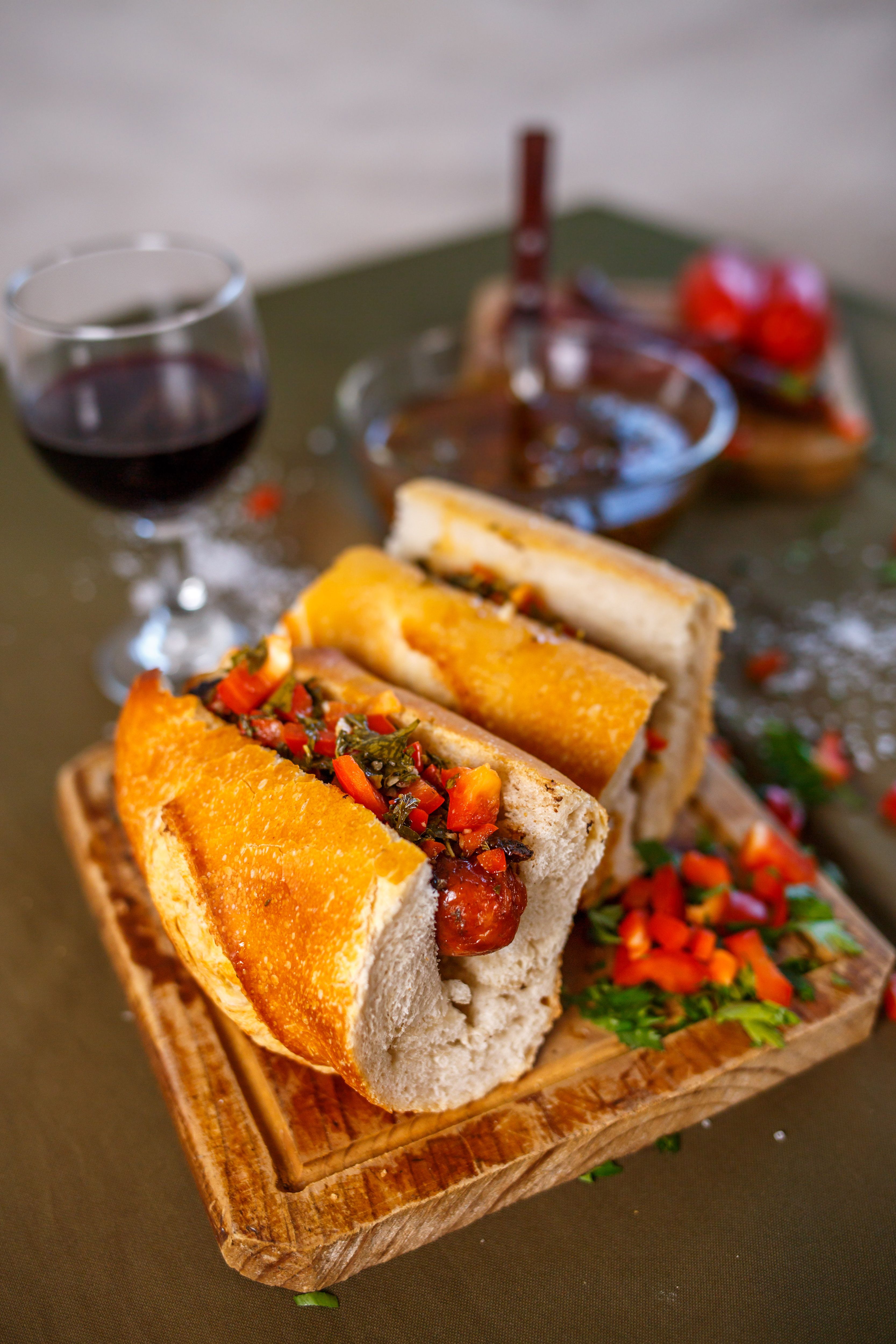
Photo: Los Muertos Crew / Pexels
The diets react (see scores below)
Common Ingredients
- chorizo
- bread roll
- chimichurri
- parsley
- garlic
- oregano
- vinegar
Specific recipes may vary.
Incompatible with 9 of 11 diets
Diet Ratings
Choripan is fundamentally built around a bread roll, which is a grain-based, high-carb component that alone likely contributes 25-35g of net carbs per serving — instantly threatening or exceeding the daily keto limit. The chorizo itself and the chimichurri (parsley, garlic, oregano, vinegar, oil) are keto-friendly components, but the bread roll makes the dish as traditionally served incompatible with ketosis. There is no meaningful way to consume a 'choripan' without the bread roll; without it, the dish becomes simply grilled chorizo with chimichurri, which is a different dish entirely.
Choripan is built around chorizo, a pork-based sausage, which is a direct animal product. This is an unambiguous violation of vegan dietary principles. The chimichurri components (parsley, garlic, oregano, vinegar) are fully plant-based, and the bread roll is typically vegan, but the primary protein — chorizo — makes the entire dish non-vegan. There is no meaningful debate within the vegan community about whether pork sausage is acceptable.
Choripan is fundamentally incompatible with the paleo diet. The dish's defining characteristic is the bread roll (pan), which is a wheat-based grain product — one of the clearest exclusions in paleo. Additionally, Argentine chorizo is typically a processed sausage that often contains added salt, preservatives, and fillers. The chimichurri components (parsley, garlic, oregano, vinegar) are individually paleo-compatible, but they cannot redeem a dish built around bread and processed meat. This is a street food defined by its grain-based vessel.
Choripan is fundamentally at odds with Mediterranean diet principles. The primary protein is chorizo, a processed pork sausage high in saturated fat, sodium, and preservatives — directly contradicting the diet's limits on red/processed meat and highly processed foods. The bread roll is a refined grain product, another category to minimize. While chimichurri contains beneficial herbs (parsley, garlic, oregano) and vinegar, these positives are minor and cannot offset the core issues. Processed meats like chorizo are among the foods most explicitly discouraged in Mediterranean dietary guidelines.
Choripan is fundamentally incompatible with the carnivore diet. While the chorizo itself could potentially be carnivore-friendly if made from pure pork and salt, the dish as traditionally prepared includes multiple disqualifying components: a bread roll (grain-based, strictly excluded), chimichurri sauce (plant-based condiment), parsley (herb/plant), garlic (plant), oregano (plant spice), and vinegar (plant-derived fermented product). The majority of ingredients are plant-derived, making this a clear avoid. Even if one were to strip the dish down to just the chorizo, Argentine chorizo often contains spices and fillers that would need scrutiny.
Choripan is fundamentally incompatible with Whole30 due to two major violations: (1) the bread roll is a grain-based product, explicitly excluded from the program, and (2) chorizo commonly contains added sugar, paprika blends with sulfite-treated spices, and other non-compliant additives. Even if a compliant chorizo could be sourced, the bread roll alone makes this dish a clear 'avoid.' Furthermore, serving meat in a bread roll format is precisely the kind of 'recreating junk food' scenario the program discourages — it mirrors a sandwich or wrap structure explicitly called out as off-limits. The chimichurri components (parsley, garlic, oregano, vinegar) are all Whole30-compliant, but they cannot save the dish from its core violations.
Choripan contains multiple high-FODMAP ingredients that make it unsuitable during the elimination phase. The bread roll is wheat-based, making it high in fructans — a primary FODMAP concern. The chimichurri sauce contains garlic, which is one of the highest-FODMAP foods known (fructans), and is problematic even in small quantities. Argentine chorizo itself may contain garlic and onion as seasonings, adding further fructan load. Oregano in small amounts is generally fine, parsley is low-FODMAP, and vinegar is low-FODMAP, but these safe ingredients cannot offset the significant FODMAP burden from the bread roll and garlic. The combination of wheat bread + garlic-containing chimichurri + potentially garlic/onion-seasoned chorizo makes this dish clearly high-FODMAP at any standard serving.
Choripan is an Argentine street food sandwich consisting of chorizo (a cured, heavily seasoned pork sausage) served in a bread roll with chimichurri sauce. This dish conflicts with DASH diet principles on multiple fronts. Argentine chorizo is a fatty, processed pork sausage high in sodium (typically 600-900mg per link), saturated fat, and often contains nitrates/preservatives. The white bread roll adds refined carbohydrates with little nutritional value and additional sodium. While the chimichurri sauce (parsley, garlic, oregano, vinegar) is DASH-friendly in itself — featuring fresh herbs rich in potassium and antioxidants — it cannot offset the core issues. The dish as a whole is high in saturated fat from the fatty pork sausage, high in sodium, uses processed/cured red meat (which DASH explicitly limits), and relies on refined grain rather than whole grain bread. DASH guidelines explicitly recommend limiting red meat, processed meats, saturated fat, and sodium — all of which are primary features of this dish.
Choripán presents multiple Zone Diet challenges. The chorizo (pork sausage) is a high-fat, high-saturated-fat protein source — far from the lean protein ideal of the Zone. A typical chorizo link contains significant saturated fat and often omega-6-heavy fat content, throwing off the 30% fat target with the wrong type of fat. The bread roll is a refined, high-glycemic carbohydrate — exactly what Zone labels 'unfavorable.' Together, these two main components violate both the protein quality and carbohydrate quality pillars of Zone methodology. The chimichurri (parsley, garlic, oregano, vinegar, typically olive oil) is actually Zone-favorable — polyphenol-rich herbs and monounsaturated fat from olive oil align with Sears' anti-inflammatory principles. However, chimichurri cannot rescue the overall macro imbalance. The dish as traditionally prepared would be carbohydrate-heavy from the roll (refined), saturated-fat-heavy from the chorizo, and protein-adequate but from a poor-quality source. It is not categorically impossible to portion (a small amount of chorizo on a partial roll could be block-managed), but as a practical snack it skews the Zone ratio significantly. It lands solidly in 'caution' rather than 'avoid' only because it is not nutritionally empty and could theoretically be portion-controlled.
Choripan is a popular Argentine street food consisting of grilled chorizo sausage in a bread roll, topped with chimichurri. The dish has a mixed anti-inflammatory profile. On the negative side, chorizo is a processed, high-fat pork sausage — typically high in saturated fat, sodium, and often contains preservatives and additives like nitrates, all of which are pro-inflammatory. The white bread roll contributes refined carbohydrates with minimal fiber, which can spike blood sugar and promote low-grade inflammation. These two core components are clearly in the 'limit' or 'avoid' category under anti-inflammatory principles. On the positive side, chimichurri is a genuine anti-inflammatory bright spot: it's built from parsley (rich in flavonoids and vitamin C), garlic (allicin, sulfur compounds with documented anti-inflammatory and antimicrobial effects), oregano (rosmarinic acid, antioxidants), and vinegar (acetic acid, may support glycemic control). Extra virgin olive oil in the chimichurri would further boost the profile. However, the chimichurri, while genuinely beneficial, is a condiment — it doesn't offset the inflammatory burden of the primary components. Overall, this dish is best treated as an occasional indulgence rather than a regular feature of an anti-inflammatory diet.
Choripan is a poor fit for GLP-1 patients. Argentine chorizo is a high-fat, high-saturated-fat pork sausage — exactly the type of fatty, processed meat that worsens GLP-1 side effects including nausea, bloating, and reflux due to slowed gastric emptying. The bread roll adds refined carbohydrates with minimal fiber or protein value, and the combination of fatty sausage plus dense bread creates a heavy, hard-to-digest meal. Chimichurri itself (parsley, garlic, oregano, vinegar, oil) is relatively benign in small amounts, but it does not redeem the dish nutritionally. The overall profile is high saturated fat, moderate-to-low protein density relative to calories, low fiber, and poor digestibility — a combination that directly conflicts with the top three GLP-1 dietary priorities.
*See how scores were generated at our methodology page.
Nutritional profile
Six traits that cut across every diet.
Fiber & Plants
How much whole-plant food and fiber it delivers.
Healthy Fats
The quality of its fats (unsaturated, omega-3).
Whole / Unprocessed
How close it is to its natural, unprocessed form.
Gut Gentle
How easy it is on digestion (low FODMAP, few irritants).
Low Glycemic
How little it spikes your blood sugar.
Protein Density
How much protein it packs per calorie.
Controversy Index
Higher controversy = more disagreement between diets.
Diet-Specific Tips
 Zone — 4/10
View tips
- Chorizo is a high-saturated-fat, fatty processed pork product — not a lean Zone protein source
- Bread roll is a refined, high-glycemic carbohydrate classified as 'unfavorable' in Zone terminology
- Chimichurri ingredients (parsley, garlic, oregano, olive oil, vinegar) are Zone-favorable — anti-inflammatory, polyphenol-rich
- Overall 40/30/30 macro ratio is difficult to achieve: the dish skews toward refined carbs and saturated fat
- As a snack category, portioning is even more restricted, making block balance harder
- No vegetables present to provide low-glycemic carbohydrate balance
 Anti-Inflammatory — 4/10
View tips
- Chorizo is a processed red/pork meat high in saturated fat, sodium, and often nitrate preservatives — pro-inflammatory
- White bread roll is a refined carbohydrate with minimal fiber, contributing to glycemic load
- Chimichurri provides meaningful anti-inflammatory benefit via garlic, parsley, oregano, and vinegar
- Garlic contains allicin and sulfur compounds with well-documented anti-inflammatory effects
- Parsley is rich in flavonoids (apigenin, luteolin) and vitamin C
- Oregano contributes rosmarinic acid and antioxidant polyphenols
- The anti-inflammatory herbs are present as a condiment and cannot offset the core inflammatory components
- Grilling method is preferable to frying, but high-heat charring of processed meat may produce pro-inflammatory compounds (AGEs, HCAs)